Inspiration Study Circle

Inspiration Study Circle

Best IAS/PCS/UPSC Coaching in Dehradun

Difference between UKPSC Upper and Lower PCS Exams: The Ultimate Aspirant’s Guide

Table of Contents

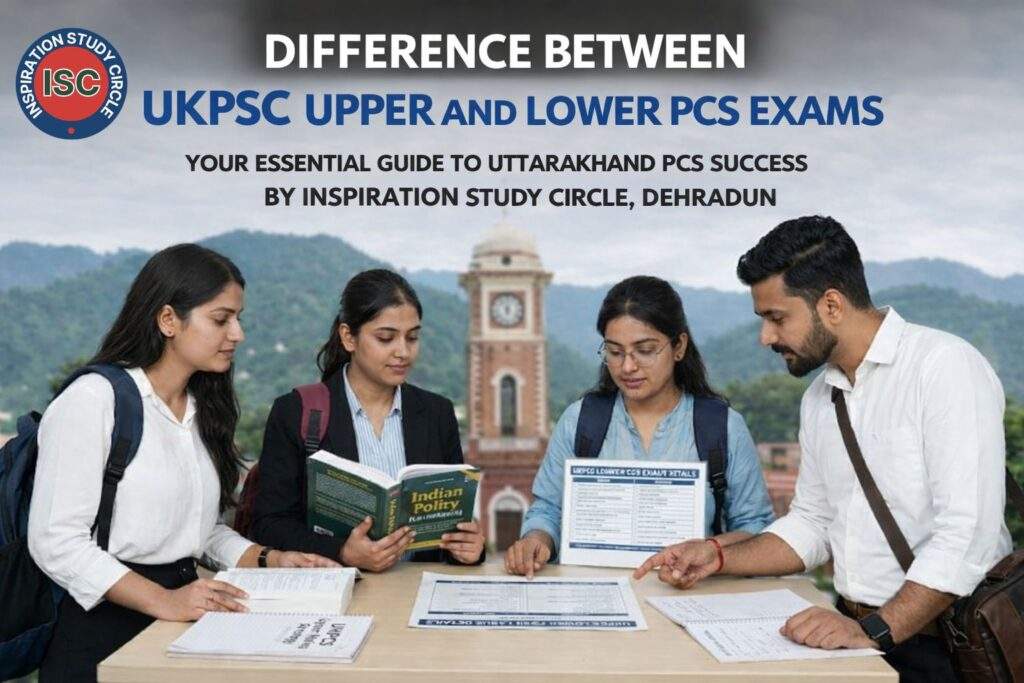
Difference between UKPSC Upper and Lower PCS Exams

I’ve sat across the desk from thousands of students here in Dehradun. I’ve seen that specific look in their eyes—a mix of fiery ambition and a very quiet, nagging confusion. It usually happens right after a fresh notification UKPSC lower exam or Upper PCS is released.

The question is almost always the same: “Sir, should I prepare for the Upper PCS or the Lower PCS? Can I do both? And what exactly is the difference between them?”

If you are feeling this confusion, let me start by saying: It is completely okay. You aren’t just choosing an exam; you are choosing the next thirty years of your life. The path you take today will determine whether you sit in the SDM’s chair or manage the vital administrative threads of a sub-division as a Naib Tehsildar.

At Inspiration Study Circle Dehradun, we believe that clarity is the first step toward a rank. You cannot win a race if you don’t know the track. So, let’s sit down, clear the fog, and compare UKPSC upper and lower exams like we’re planning a strategic roadmap.

What are UKPSC Upper and Lower PCS Exams?

In simple terms, the Uttarakhand Public Service Commission (UKPSC) conducts these two distinct examinations to recruit officers for the state’s administrative machinery.

  • Upper PCS: This is the “Big League.” It targets Group A and high-level Group B administrative posts. Think of the “Lal Batti” (though now more symbolic) culture—Sub-Divisional Magistrates (SDM), Deputy Superintendents of Police (DSP), and Regional Transport Officers (ARTO).
  • Lower PCS: This focuses on vital Group B and Group C subordinate administrative roles. These are the officers who implement policies on the ground—Naib Tehsildars, Supply Inspectors, and Marketing Inspectors.

While both are prestigious “Sarkari” jobs that command immense respect in our society, the UKPSC upper vs lower PCS exams differ significantly in their intensity, the depth of their syllabus, and the career trajectory they offer.

Key Differences UKPSC Upper Lower: At a Glance

Before we dive into the “how-to,” let’s look at the “what.” Here is a comprehensive breakdown of the difference between UKPSC upper and lower PCS that every aspirant should memorize.

The Comparison Table

BasisUKPSC Upper PCSUKPSC Lower PCS
Cadre/GroupGroup A & Group B (Gazetted)Group B & Group C (Subordinate)
Typical PostsSDM, DSP, Finance Officer, ARTONaib Tehsildar, Supply Inspector, Tax Officer
Exam StagesPrelims + Mains (7-8 Papers) + InterviewPrelims + Mains (2 Papers) + Interview
Syllabus DepthExtensive, Analytical, SubjectiveSpecific, Fact-based, Objective/Subjective Mix
Difficulty LevelVery High (UPSC standard)Moderate to High
Qualificationqualification for UKPSC upper: Graduationqualification UKPSC lower exam: Graduation
Age Limitage limit UKPSC upper PCS: 21 to 42 yearsage limit UKPSC lower PCS: 21 to 42 years
Salary GradeLevel 10 and aboveLevel 7 to Level 9
Promotion ScopeCan reach IAS/IPS cadreCan reach Upper PCS level roles
Attempts Allowedattempts allowed UKPSC upper lower: Generally as per ageSame as Upper PCS

Detailed Section on Syllabus Difference

This is where the real struggle begins. I often see students downloading the UKPSC upper syllabus PDF and the lower one, only to realize that while the subjects look similar, the treatment of those subjects is worlds apart.

The UKPSC upper lower syllabus difference is essentially the difference between being a specialist and a generalist.

Subjects in UKPSC Upper PCS

In the Upper exam, you need to be a philosopher, a historian, and a scientist all at once. The syllabus includes:

  • General Studies I to IV: Covering History, Geography, Polity, Economy, Ethics, and International Relations.
  • Language & Essay: A massive focus on your ability to articulate thoughts in Hindi and English.
  • Uttarakhand Special: Deep dive into state history (Katyuri, Chand, Pawar dynasties) and geography.

UKPSC Lower PCS Topics List

The Lower PCS is more “grounded.” It tests your awareness of facts rather than your ability to write 500-word philosophical essays. The UKPSC lower PCS topics list usually focuses on:

  • General Awareness (History, Geography, Polity).
  • General Intelligence and Mental Ability (Much higher weightage than Upper PCS).
  • Current Affairs (Specifically state-centric).
  • Drafting and Basic Hindi (For the Mains stage).

The Exam Pattern: Upper vs Lower

Understanding the exam pattern UKPSC upper vs lower is critical for your daily routine. If you are preparing for Upper, you need a pen in your hand at all times. If you are preparing for Lower, you need a sharp eye for MCQ elimination.

UKPSC Upper Exam Pattern

  1. Prelims: Two papers (General Studies and CSAT). It is purely a screening test.
  2. Mains: This is the real UKPSC PCS prelims mains difference. The Upper Mains consists of multiple descriptive papers. You have to write until your fingers ache.
  3. Interview: A personality test worth 275 marks (subject to latest notification) that tests your administrative temperament.

UKPSC Lower Exam Pattern

  1. Prelims: A single paper consisting of 150 questions (GS + Mental Ability).
  2. Mains: Usually consists of two papers (General Studies and Essay/Drafting). It’s less “academic” and more “functional.”
  3. Interview: A personality test, though generally carrying fewer marks than the Upper PCS.

Eligibility: Age, Qualification, and Attempts

Don’t let a technicality break your heart. Before you check the admit card UKPSC upper, ensure you meet the criteria.

  • UKPSC Upper PCS Eligibility: You must be a Graduate. The age limit UKPSC upper PCS is 21 to 42 years. There are relaxations for SC/ST/OBC and Ex-servicemen as per the official state government norms.
  • UKPSC Lower PCS Eligibility: Similar to Upper, you need a Graduation degree. The age limit UKPSC lower PCS is also 21 to 42 years. Some specific posts (like Supply Inspector) might prefer candidates with specific knowledge, but a general degree is mostly enough.
  • Attempts: In Uttarakhand, there isn’t a strict “number of attempts” rule like UPSC. As long as you are within the age bracket, you can keep trying. But let’s aim to clear it in the first go, shall we?

Preparation Strategy: A Mentor's Guide

At Inspiration Study Circle, we don’t believe in “one size fits all.” Your strategy UKPSC upper mains cannot be the same as your Lower PCS prep.

How to Prepare UKPSC Upper Exam

If you are eyeing the SDM post, you need to start with the “Mains-first” approach.

  1. Read NCERTs: Don’t skip these. They are the foundation.
  2. Answer Writing: Join our best PCS coaching in Dehradun specifically for answer-writing sessions. Your knowledge is useless if it’s trapped in your head.
  3. Current Affairs: Use newspapers like The Hindu or Indian Express plus state-level news.
  4. Books for UKPSC Upper Syllabus: Focus on standard books like Laxmikanth for Polity and Spectrum for History, but keep the UKPSC upper previous papers as your constant guide.

Tips for UKPSC Lower PCS

For the Lower exam, your focus shifts to facts and speed.

  1. Mental Ability: Don’t ignore the math and reasoning. It can make or break your UKPSC lower merit list standing.
  2. State GK: Memorize the data—census, districts, mountain peaks, and schemes.
  3. Mock Tests UKPSC Lower: Speed is the key. You need to solve 150 questions with 90% accuracy.
  4. UKPSC Lower Question Papers: Solve at least the last 10 years of papers to understand the Commission’s favorite topics.

Realistic Case Studies: Finding Your Path

Case Study 1: The “Upper” Vision

Meet Aryan. He’s a 24-year-old from Dehradun who was confused about whether to aim for Upper or Lower. He loved deep reading but hated quick, trick-based math.

At Inspiration Study Circle, we analyzed his strengths. We told him, “Aryan, your writing style is excellent. You can analyze complex issues.” He chose to prepare UKPSC upper exam. He didn’t get distracted by the notification UKPSC lower exam. He stuck to his strategy UKPSC upper mains, and in the UKPSC upper result 2026, he saw his name next to the “Finance Officer” post.

Case Study 2: The “Stepping Stone” Strategy

Then there’s Megha. She was a working professional with limited time. She needed a job fast to support her family. We advised her to focus on Lower PCS first. She used our mock tests UKPSC lower and focused on the UKPSC lower PCS topics list.

She cleared the exam and became a Naib Tehsildar. But she didn’t stop. With the confidence and financial security of her job, she later used her experience to clear the Upper PCS. She turned her “Lower” success into an “Upper” career.

Why Choose Inspiration Study Circle Dehradun?

  • Expert Faculty: Mentors who don’t just teach from books but from experience.
  • UKPSC Focused Mentoring: We specialize in Uttarakhand. We know the difference between a question that will appear in Upper vs. Lower.
  • Answer Writing Practice: Our feedback isn’t just “Good” or “Bad”; it’s a detailed surgical analysis of your style.
  • Mock Interview Guidance: We simulate the actual Commission environment.
  • Best PCS Coaching in Dehradun: We provide personalized study plans because every student’s journey is different.

Whether you are looking for UKPSC upper cut off marks data or the latest UKPSC lower question papers, our resource center is always open for you.

Final Mentor-Style: Your Career Direction

At the end of the day, the UKPSC upper PCS vs lower PCS debate is not about which is “easier.” Both require grit. Both require you to sacrifice your sleep and your social life for a greater cause.

The UKPSC PCS vacancy upper lower cycles are your window of opportunity. If you feel you have the analytical depth to lead districts, go for Upper. If you want to be the backbone of the administration and prefer a more objective preparation style, Lower is a brilliant career move.

Don’t let confusion paralyze you. The worst thing you can do is stand still. Pick a path, trust your mentor at Inspiration Study Circle, and start walking. Your name on the UKPSC upper result 2026 or the Lower merit list is a result of the decision you make today.

The road to the “Lal Batti” starts here. Are you ready?

Join Inspiration Study Circle Dehradun for expert guidance. Let’s turn your aspiration into your designation.

Contact us today for a Free Counseling Session.

Recent Post​
Blank Form (#5)

Scroll to Top