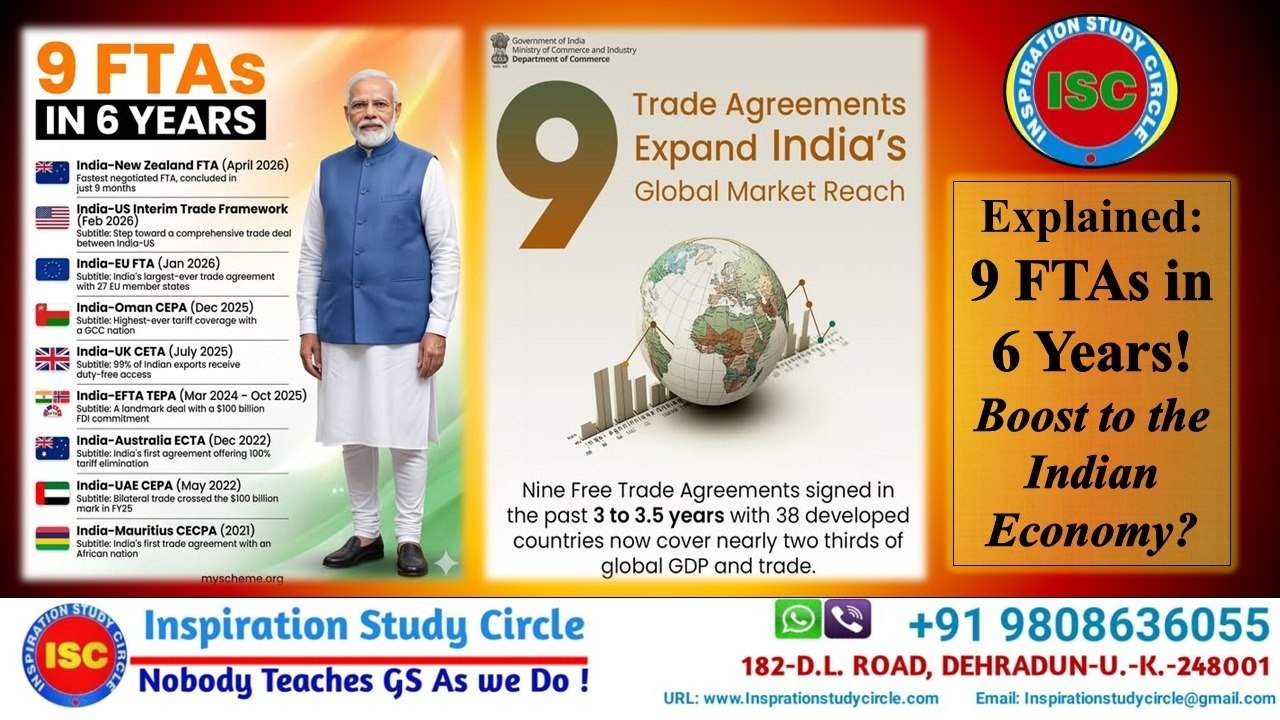
In just six years, India has signed or advanced 9 major FTAs, spanning the UAE, Australia, the UK, the EU, and now New Zealand. These agreements are unlocking duty-free access, boosting exports, attracting billions in investment, and expanding global market reach.
Between 2021 and 2026, India signed nine major Free Trade Agreements (FTAs) and frameworks covering 38 countries to aggressively expand its global trade footprint, secure investments, and bypass rising global protectionism. Governed under a strategic shift to elevate local industries (“Make in India”) and empower sectors like MSMEs and agriculture, this surge marks India’s transformation into an active trade diplomat.
What is an FTA?
A Free Trade Agreement (FTA) is a legally binding pact between two or more countries to eliminate or significantly reduce trade barriers, such as tariffs (import taxes) and quotas, on goods and services traded between them.
Here is the formal definition broken down by its essential criteria:
The Three Pillars of a Standard FTA
Tariff Elimination: The complete removal or phased reduction of customs duties on a vast majority of product categories (usually over 80–90% of traded goods).
Non-Tariff Liberalisation: The streamlining of administrative hurdles, such as simplifying customs procedures, aligning product safety standards, and removing restrictive import quotas.
Services and Investment Access: The opening of domestic sectors (like banking, IT, or telecommunications) to foreign service providers and protecting foreign investors from arbitrary legal changes.
Key Legal Mechanism: Rules of Origin
An FTA is not a general open border for the entire world. To prevent a third-party country from exploiting the deal, FTAs rely strictly on Rules of Origin (RoO).
Example: If Country A and Country B have an FTA, Country C cannot simply ship its goods to Country A, slap a new label on them, and smuggle them into Country B tax-free. The product must undergo significant manufacturing or value addition within the member countries to qualify for the zero-tax rate.
Explaining FTA to UPSC/PCS Students
Imagine two countries want to trade with each other, but they face high “entry fees” (called tariffs or taxes) whenever they send goods across borders.
A Free Trade Agreement (FTA) is an official pact between two or more countries to lower or completely remove these taxes, making it cheaper and easier for them to buy and sell from one another.
The Pizza and Soda Analogy
Imagine your school has a rule: students from School A cannot bring snacks into School B unless they pay a ₹50 “snack tax” at the gate.
Because of this tax, a School A student trying to sell a pizza slice to a School B student has to charge a very high price to make a profit.
To fix this, the student councils of both schools sign a “Snack FTA.”
The Result: The ₹50 tax is dropped. Now, School B students get cheaper pizza, and School A students can sell way more slices. Everyone wins.
What is Actually Included in an FTA?
While it is called “free trade,” it is not a free-for-all. It is a highly detailed rulebook that covers three main things:
Goods (Physical Stuff): Dropping taxes on items like smartphones, cars, clothes, and fruits so they cost less in shop aisles.
Services (Brain Power): Making it easier for professionals—like software engineers, doctors, or teachers—to work in each other’s countries without endless paperwork.
Investments (Money): Allowing companies to build factories, shops, or offices in the partner country with less government interference.
Why Countries Keep "Exceptions"
An FTA does not mean everything becomes tax-free. Countries always keep a “Negative List” of sensitive items they want to protect.
For instance, when India signs trade deals, it often keeps dairy products and agriculture completely out of the agreement. This ensures that cheap, subsidised foreign milk or wheat does not flood Indian markets and bankrupt local Indian farmers.
The Pros and Cons
Governments spend months or even years negotiating these deals because they have a massive impact on the economy.
The Good Side (Pros)
The Risky Side (Cons)
Cheaper Products: Consumers get access to foreign goods at much lower prices.
Local Business Risk: Local factories might shut down if cheaper foreign goods flood the market.
More Jobs: Local factories expand and hire more workers to export goods abroad.
Job Losses: Some local industries might shrink if they cannot compete with international brands.
Global Friendships: Countries that trade heavily with each other rarely go to war.
Dependency: A country might become too reliant on another nation for essential goods.
The Timeline and key pointers of the 9 major FTAs
Timeline of India's 9 FTAs (2021–2026)
India–Mauritius CECPA (Feb 2021): India’s first-ever comprehensive trade agreement signed with an African nation, facilitating institutional mechanisms to boost bilateral trade.
India–UAE CEPA (May 2022): A major milestone that crossed the $100 billion bilateral trade mark by FY25 by eliminating or lowering tariffs on over 80% of goods.
India–Australia ECTA (Dec 2022): India’s first major agreement with a developed country offering 100% tariff elimination on Indian exports, aiming to double bilateral trade by 2030.
India–EFTA TEPA (Mar 2024): A landmark multi-nation deal with the European Free Trade Association (Iceland, Liechtenstein, Norway, Switzerland) that brought a historic $100 billion Foreign Direct Investment (FDI) commitment over 15 years.
India–UK CETA (July 2025): Grants 99% duty-free market access for Indian exports to the United Kingdom, opening seamless professional mobility and service channels.
India–Oman CEPA (Dec 2025): Delivers India’s highest-ever tariff coverage with a Gulf Cooperation Council (GCC) nation, offering zero-tariff access to 99.38% of Indian exports while safeguarding sensitive domestic sectors.
India–EU FTA (Jan 2026): Hailed as the “Mother of all deals,” this historic trade pact with the 27 European Union member states was reached after two decades of talks, opening up a shared market of nearly 2 billion people.
India–US Interim Trade Framework (Feb 2026): A crucial preparatory step establishing a pathway towards a full-scale, comprehensive bilateral trade deal with the United States.
India–New Zealand FTA (Apr 2026): India’s fastest-negotiated trade agreement, concluded in just 9 months, offering 100% duty-free access for Indian exports while completely protecting India’s sensitive domestic dairy and agriculture sectors from foreign competition.
Core Pillars & Strategic Impact
Export Competitiveness: Massive tariff reductions give immediate structural advantages to Indian engineering goods, textiles, gems, pharmaceuticals, and handicrafts.
Talent & Job Mobility: Concluded agreements systematically build streamlined pathways, social security relief, and post-study work visa choices for IT professionals, students, and healthcare practitioners.
Strategic Balancing: Negotiations are aggressively targeted to safeguard vulnerable sectors like domestic dairy, while establishing alternative, resilient supply networks independent of protectionist trade shifts.
Impact on the Indian Economy
India’s proactive shift toward signing major Free Trade Agreements (FTAs) between 2021 and 2026 acts as a powerful economic catalyst, driving export volumes, expanding foreign investments, and upgrading key industrial supply chains. Historically, India approached FTAs with caution due to the risks of cheap imports flooding local markets. However, the modern “new-generation” agreements are highly strategic, balancing open market access with targeted protections for local manufacturing.
The impact of these trade pacts on the Indian economy breaks down into five distinct economic categories:
1. Accelerating Merchandise & Service Exports
Tariff Advantages: Eliminating or reducing customs duties gives immediate price advantages to labour-intensive sectors like textiles, leather, gems and jewellery, pharmaceuticals, and engineering goods.
Service Integration: Agreements like the India–UK CETA and India–UAE CEPA simplify cross-border regulations, providing India’s dominant IT, financial services, and healthcare sectors seamless entry into high-value Western and Middle Eastern economies.
2. Driving Inbound Foreign Direct Investment (FDI)
Binding Commitments: Modern FTAs legally lock in secure investment environments. A prime example is the landmark India–EFTA TEPA, which guarantees a historic $100 billion investment commitment into India over 15 years.
“China Plus One” Positioning: By lowering trade barriers with major global economic blocs like the European Union and the United States, global corporations are highly incentivised to establish manufacturing hubs within India, turning the country into a premier alternative manufacturing destination.
3. Managing the Trade Deficit & Protecting Sensitive Sectors
The Negative List Strategy: Unlike early trade agreements, recent negotiations strictly include exclusions to safeguard vulnerable domestic communities. India aggressively excludes sectors like agriculture and dairy (e.g., completely carve-outs in the India–New Zealand FTA) to shield local farmers from heavily subsidised foreign competition.
Strict Rules of Origin: To curb trade deficits and prevent third-party countries from routing cheap goods into India, new deals mandate strict value-addition checks. Products must be genuinely manufactured within the partner country to earn tariff cuts.
4. Boosting Local Manufacturing ("Make in India")
Cheaper Raw Materials: FTAs lower import duties on critical raw materials and machinery that India cannot source locally.
Value Chain Progression: Lower raw material costs reduce production overheads for domestic factories, allowing Indian products to compete more effectively on price and quality globally.
5. Enhancing Professional & Student Mobility
Visa Relaxation Quotas: Rather than dealing with complex, standalone immigration limits, India leverages its FTAs to secure fixed, streamlined visa quotas.
Mutual Recognition Agreements (MRAs): India negotiates MRAs so that degrees or certifications earned by Indian nurses, engineers, and accountants are officially recognised by partner nations, ensuring direct, professional job mobility.
Summary: Economic Trade-offs
Positive Economic Drivers
Ongoing Risks & Challenges
Greater Market Access: Entry into rich markets comprising billions of consumers.
Domestic Adjustment Costs: High competition forces local MSMEs to upgrade quickly or lose market share.
Diversified Supply Networks: Reduced single-country dependency for critical tech and energy.
Revenue Loss: Lower customs collection drops immediate tax revenue at Indian ports.
Technology Transfers: Joint ventures inject modern tech into Indian industries.
Non-Tariff Barriers: Partners may still use strict safety/environmental laws to block Indian goods.
Disclaimer: The above-written article contains facts and arguments analysed from platforms like Wikipedia, and editions of The Hindu and The Indian Express.