
ISC Explained New RBI Monetary Policy
Table of Contents
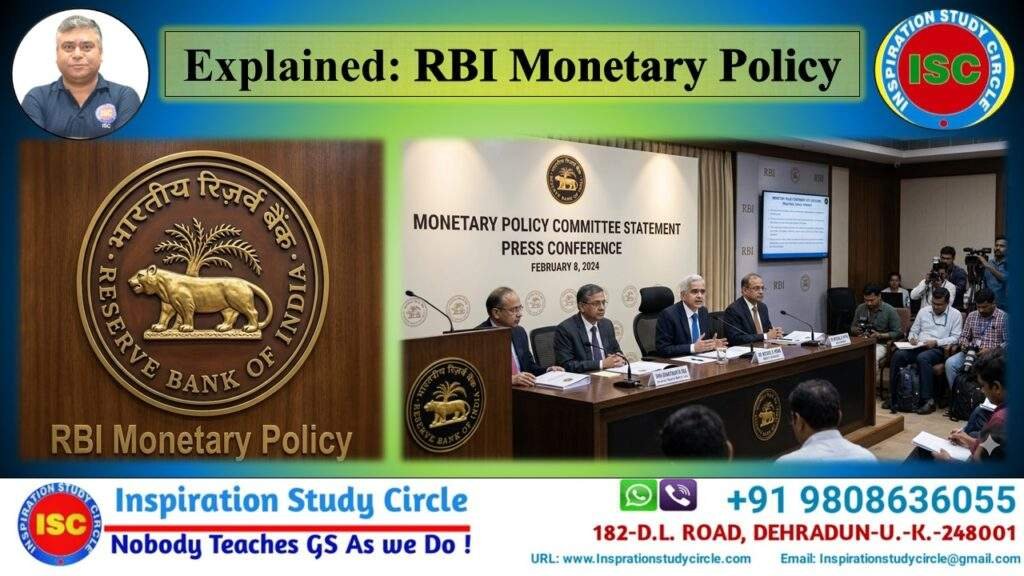
The Reserve Bank of India (RBI) Monetary Policy Committee (MPC) unanimously decided to keep the benchmark repo rate unchanged at 5.25%. Led by Governor Sanjay Malhotra, the committee opted for a cautious approach, maintaining a “Neutral” policy stance to balance resilient domestic economic growth against global geopolitical risks and food inflation pressures.
This monetary policy was released on Wednesday, August 5, 2026.
It marked the conclusion of the three-day Monetary Policy Committee (MPC) review meeting that ran from August 3 to August 5, 2026.
1. Key Policy Rates and Reserve Ratios
The RBI maintained a status quo across all key macroeconomic operational rates:
- Repo Rate: Remaining at 5.25% (the rate banks borrow from the RBI).
- Standing Deposit Facility (SDF): Stable at 5.00% (collateral-free bank deposits tool).
- Marginal Standing Facility (MSF): Unchanged at 5.50% (emergency overnight borrowing).
- Bank Rate: Kept steady at 5.50%.
- Cash Reserve Ratio (CRR): Positioned at 3.00%.
2. Revised Growth and Inflation Outlook
The central bank presented an optimistic yet vigilant macroeconomic report for FY 2026-27 (FY27):
- GDP Growth Target Raised: Upgraded to 6.7% (from 6.6%) due to robust domestic demand and manufacturing.
- CPI Inflation Forecast Cut: Adjusted downward to 5.0% for the full year.
- Quarterly Inflation Trajectory: Projected to peak at 5.9% in Q3 due to food/fuel supply disruptions before easing down to 5.5% in Q4.
- Benign Core Inflation: Stripping out food and fuel, core inflation is highly stable at 4.3%.
3. Key Policy Drivers and Economic Rationale
Distinct domestic and external variables shape the MPC’s data-dependent, neutral strategy:
- External Sector Vulnerabilities: Volatile global energy markets, shipping blockages, and conflicts in West Asia demand policy prudence.
- Food and Weather Disruptions: Risks from El Niño patterns and monsoon deficits keep food item prices vulnerable to spikes.
- Rupee and Liquidity Stability: Daily system liquidity is comfortable with an average ₹1 lakh crore surplus, allowing smooth credit delivery.
4. Direct Financial Impact on Consumers
Area | Impact Analysis |
Loan EMIs | Home, car, and personal loan EMIs will remain flat and stable in the near term. |
FD Depositors | Fixed Deposit returns will hold at current rates, offering steady yields for savers. |
Corporate Borrowing | Access to capital remains reasonably priced, sustaining robust corporate credit growth. |
Key Takeaways for UPSC 2027-28 Exam
For a UPSC 2027 aspirant, the August 2026 RBI Monetary Policy must be analysed beyond the numbers, with a focus on macro-structural linkages, policy transitions, and the central bank’s operational frameworks.
1. The Stance Transition: Implications of "Neutral"
- Policy Flexibility: The continuation of the “Neutral” stance (shifted earlier from “Withdrawal of Accommodation”) signals that the RBI is data-dependent and open to moving interest rates in either direction based on incoming macroeconomic data.
- Balancing Act: This stance shows the MPC is no longer solely focused on tightening liquidity to tame inflation, but is equally balancing domestic growth durability against global crosswinds.
2. Macro-Structural Adjustments: Growth vs. Inflation
- Growth Decoupling: Upgrading the GDP growth target to 6.7% for FY27 showcases India’s structural economic resilience, driven by robust domestic consumption and private capital expenditure (CapEx), despite a slowing global economy.
- CPI Headline vs. Core Inflation: While headline CPI inflation is projected at 5.0% (above the 4.0% medium-term target but within the 2-6% tolerance band), Core Inflation is stable at 4.3%.
- UPSC Analytical Point: This divergence highlights that inflation in India remains primarily supply-side driven (volatile food and energy prices due to weather and geopolitics) rather than demand-driven, testing the limitations of purely demand-side monetary tools (like the Repo Rate).
3. Monetary Policy Transmission and Liquidity
- Operational Rate Stability: By holding the Repo Rate at 5.25%, the SDF (5.00%) and MSF (5.50%) automatically remain aligned. This maintains the standard 50-basis-point corridor of the Monetary Policy Framework.
- Liquidity Management: A system liquidity surplus of ~₹1 lakh crore ensures smooth credit flow without fueling demand-pull inflation, a critical equilibrium point for banking sector health.
4. External Sector Vulnerabilities (GS Paper III Linkages)
- Geopolitical Spillover: The policy highlights external risks, including shipping disruptions (e.g., Red Sea/West Asia conflicts) and global energy volatility.
- Spillover Effect: For UPSC, connect this to “imported inflation” and how central banks in emerging markets must maintain a safety cushion in interest rates to prevent sudden capital flight and currency depreciation against a strong US Dollar.
5. High-Yield Summary Table for GS-III
Prelims/Mains Focus Area | Core Policy Element | Macroeconomic Concept |
Monetary Framework | Repo held at 5.25%, SDF at 5.00% | 40 bps corridor maintained around the policy rate. |
Inflation Targets | Headline CPI at 5.0% | Within Section 45ZA target band (4% +/- 2%). |
Growth Drivers | FY27 GDP upgraded to 6.7% | Driven by resilient domestic CapEx and manufacturing. |
Supply-Side Rigidities | Food inflation pressures | Highlighting limits of monetary tightening on structural shocks. |
Difference between SDF, MSF, and Repo Rate instruments
1. Core Definitions and Roles
These three instruments form the Liquidity Adjustment Facility (LAF) corridor used by the RBI to manage money supply and steer the call money rate.
- Repo Rate (Policy Rate): The benchmark rate at which commercial banks borrow short-term funds from the RBI by pledging government securities (G-Secs) as collateral with an agreement to buy them back.
- Standing Deposit Facility (SDF): The floor of the LAF corridor where banks park excess overnight liquidity with the RBI without receiving any G-Secs as collateral.
- Marginal Standing Facility (MSF): The ceiling of the LAF corridor where banks can borrow emergency overnight funds from the RBI by dipping into their Statutory Liquidity Ratio (SLR) quota at a higher interest rate.
2. Side-by-Side Structural Comparison
Feature | Standing Deposit Facility (SDF) | Repo Rate | Marginal Standing Facility (MSF) |
Direction of Funds | Banks \(\rightarrow \) RBI (Absorbs liquidity) | RBI \(\rightarrow \) Banks (Injects liquidity) | RBI \(\rightarrow \) Banks (Injects emergency liquidity) |
Collateral Required | No collateral given by RBI to banks | Yes, G-Secs provided by banks | Yes, G-Secs (including SLR quota) |
Current Rate (Aug 2026) | 5.00% | 5.25% | 5.50% |
Position in LAF Corridor | Floor (Lower Bound) | Centre (Target Policy Rate) | Ceiling (Upper Bound) |
Primary Purpose | Absorb non-inflationary excess liquidity | Regular liquidity management | Manage acute cash shortages overnight |
The 50-Basis-Point Operational Corridor
The RBI maintains a symmetric 50 bps corridor to prevent extreme volatility in interbank lending rates:
SDF (5.00%) ↔ Repo Rate (5.25%) ↔ MSF (5.50%)
The call money rate (the rate at which banks lend to each other) ideally moves within this tight window.
Why SDF is a Game Changer over Reverse Repo
- No Collateral Constraint: Under the old Fixed Reverse Repo system, the RBI had to give G-Secs to banks to absorb money. If the RBI ran out of securities, it could not absorb excess liquidity.
- Unbounded Absorption: SDF requires no collateral from the RBI, allowing the central bank to absorb an infinite amount of excess liquidity from the banking system during times of cash surpluses (e.g., heavy foreign inflows).
The MSF Safety Valve
- SLR Flex: Normally, banks cannot touch the G-Secs locked in their Statutory Liquidity Ratio (SLR) mandate.
- Emergency Dip: MSF allows banks to break this rule and pledge a small percentage of their SLR securities to borrow emergency money, acting as an essential financial safety valve.
The Statutory Liquidity Ratio (SLR) vs. Cash Reserve Ratio (CRR) mechanisms
1. Structural Comparison: CRR vs. SLR
The Cash Reserve Ratio (CRR) and Statutory Liquidity Ratio (SLR) are quantitative monetary tools used by the RBI under the RBI Act, 1934 and Banking Regulation Act, 1949, respectively, to control liquidity and ensure banking stability. [1, 2, 3, 4]
Feature | Cash Reserve Ratio (CRR) | Statutory Liquidity Ratio (SLR) |
Form of Reserves | Liquid cash only | Cash, Gold, or unencumbered G-Secs |
Where to Keep It | Deposited with the RBI | Maintained by the bank itself |
Interest Earned | 0% (RBI pays no interest) | Earns interest (from G-Secs/Gold) |
Current Rate (Aug 2026) | 3.00% | 18.00% |
Primary Target | Controls inflation & system liquidity | Ensures bank solvency & funds govt debt |
2. Operational Mechanics
Both ratios are calculated as a percentage of a bank’s Net Demand and Time Liabilities (NDTL), which essentially represents the total public deposits held by the bank. [1, 2]
Cash Reserve Ratio (CRR) Mechanics
- The Pipeline: If a bank receives ₹100 in fresh deposits, it must immediately send ₹3 to the RBI as cash.
- The Purpose: This money is completely locked away. It serves as a direct brake on the money multiplier effect, reducing the credit creation capacity of commercial banks to curb demand-pull inflation. [1, 2]
Statutory Liquidity Ratio (SLR) Mechanics
- The Pipeline: Out of that same ₹100 deposit, the bank must store ₹18 within its own vaults or investment portfolio, primarily in safe, government-approved securities (G-Secs). [1]
- The Purpose: This ensures that if depositors suddenly rush to withdraw money, the bank holds highly liquid assets that can be sold instantly to prevent a bank run. [1, 2]
3. Critical Analytical Insights for UPSC
The Crowding-Out Effect
- Government Financing: SLR acts as a guaranteed, captive market for government borrowing. Because banks are legally mandated to buy G-Secs to fulfil their 18% SLR quota, the government can easily finance its fiscal deficit. [1, 2, 3]
- Private Sector Impact: High SLR rates can lead to the “crowding-out” of the private sector, as a large chunk of bank credit is funnelled to the government instead of private businesses.
Connection to the MSF Safety Valve
- The SLR Link: As established in the LAF corridor, the G-Secs locked under the 18% SLR quota are legally untouchable for regular daily borrowing.
- The Exception: Under the Marginal Standing Facility (MSF), the RBI permits financially stressed banks to breach this 18% floor, pledging a small portion of their SLR securities to borrow emergency overnight funds. [1]
How Changes in CRR and SLR Directly Impact the Indian Economy
When the Reserve Bank of India (RBI) manipulates the Cash Reserve Ratio (CRR) and the Statutory Liquidity Ratio (SLR), it alters the volume of loanable funds flowing through commercial banks. This adjustment triggers a predictable chain reaction across the entire financial ecosystem.
1. The Mechanics of Tightening Liquidity (Rate Hikes)
When inflation trends above target levels, the RBI implements a contractionary monetary policy by raising the CRR, the SLR, or both.
RBI Hikes CRR / SLR
↓
Banks hold more cash/G-Secs as reserves.
↓
Squeeze on total loanable funds available for the public.
↓
Banks increase lending rates to protect their profit margins.
↓
Borrowing becomes expensive for corporations and retail consumers.
↓
Decline in business expansions, car purchases, and home buying
↓
Overall demand cools down, leading to a drop in headline inflation
2. The Mechanics of Easing Liquidity (Rate Cuts)
When economic growth slows down or private investment stalls, the RBI shifts toward an expansionary or accommodative policy by lowering the reserve ratios.
Step-by-Step Economic Impact
RBI Cuts CRR / SLR
↓
Fewer funds are locked up in reserves.
↓
Banks suddenly experience a surge in surplus cash.
↓
Banks lower their lending rates to attract new borrowers.
↓
Loans become significantly cheaper and more accessible.
↓
Companies borrow to expand operations, and consumers increase spending.
↓
Increased economic activity boosts GDP growth and employment.
Disclaimer: The above information and views are taken from various news and information platforms such as Wikipedia, The Hindu, and the Indian Explorer.