ISC Explained- Vande Bharat Network
ISC Explained: Vande Bharat Network Table of Contents ISC Explained: Vande Bharat Network The Vande Bharat Express network is India’s...
Read More → 
Inspiration Study Circle
Best IAS/PCS/UPSC Coaching in Dehradun
Inspiration Study Circle
Best UPSC/IAS/PSC/UKPCS Coaching in Dehradun
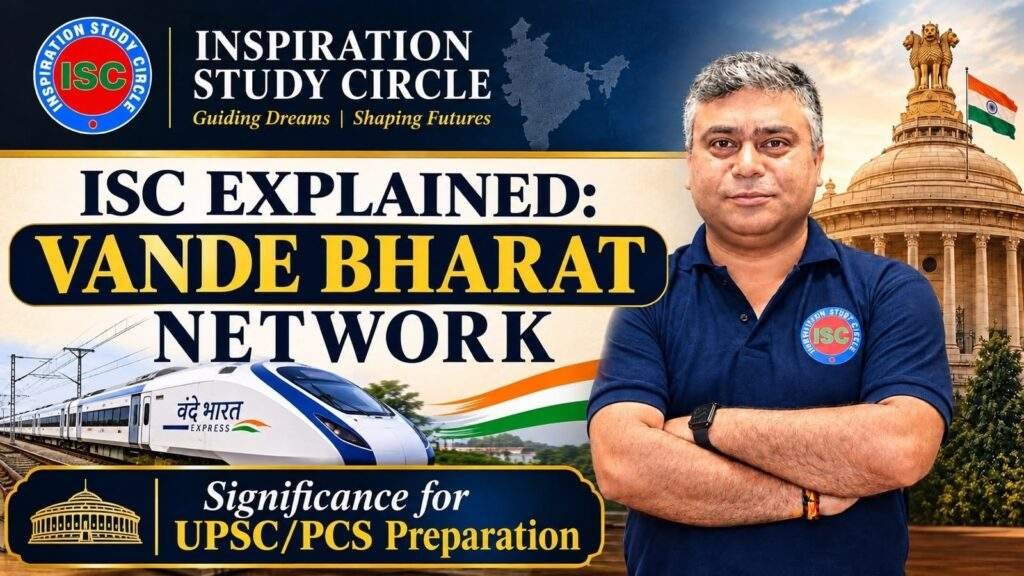
The Vande Bharat Express network is India’s semi-high-speed electric train system operated by Indian Railways.
It is a reserved, air-conditioned chair car service connecting cities that are less than 800 km (500 mi) apart or take less than ten hours to travel with existing services. Prime Minister Narendra Modi officially inaugurated the first commercial Vande Bharat service on 15 February 2019.
The trainsets are self-propelling electric multiple units (EMUs) in eight, sixteen or twenty coach configurations. They were introduced as part of the Make in India initiative by the Indian government, and are designed and manufactured by the state-owned Integral Coach Factory in Chennai. Introduced in 2018, the trainsets achieved speeds up to 183 km/h (114 mph) during trial runs. However, the maximum operational speed is restricted to 160 km/h (99 mph), which is achieved by the Rani Kamalapati–Hazrat Nizamuddin and Hazrat Nizamuddin-Khajuraho services on the Tughlakabad–Agra section. This is the highest operational speed on the Indian Railways network, shared with Gatimaan Express over the same section. The train is capable of faster acceleration and deceleration, and it went from 0 to 100 km/h in 52 seconds during trial runs.
Vande Bharat sleeper services, operating dedicated sleeper trainsets, were inaugurated in January 2026. These trains consist of sixteen air-conditioned sleeper coaches.
The first service was introduced in February 2019.
As of 17 August 2026, 79 Vande Bharat trains are in service, which includes 22 twenty-car services, 18 sixteen-car services and 39 eight-car services.
As of July 2026, 81 pairs of Vande Bharat Chair car trains are in service across the country, covering 79 distinct routes. Two routes—Tatanagar–Patna and Jammu Tawi–Srinagar—are served by two pairs of Vande Bharat services each.
The Vande Bharat Express network represents a paradigm shift in India’s transport infrastructure, transitioning from an ambitious single-route prototype in 2019 to a comprehensive nationwide grid.
From the perspective of UPSC (Civil Services) and State PCS examinations, this topic spans multiple papers, primarily GS Paper 3 (Infrastructure: Railways, Science & Technology, and Indigenisation), GS Paper 2 (Government Policies & Interventions), and the Preliminary Examination (Facts, Schemes, and Digital/Safety Interventions).
For the Prelims, focus on the technical, developmental, and structural aspects of the trainsets:
In Mains, you must analyse how the rail network impacts the broader Indian economy:
An excellent UPSC Mains answer must critically evaluate the bottlenecks and offer actionable solutions:
Here are 5 mains-oriented model questions on the Vande Bharat Network, designed specifically for an UPSC/PCS preparation blog. They are structured to cover different syllabus papers (GS 2, GS 3) and evaluate different analytical dimensions.
The rapid expansion of the Vande Bharat Express network represents a structural shift in India’s transport geography. Critically evaluate how semi-high-speed rail networks can resolve India’s logistical bottlenecks and accelerate regional economic integration.
From Train 18 to a nationwide network, Vande Bharat is being hailed as a triumph for ‘Aatmanirbhar Bharat’. Discuss the technological breakthroughs achieved in its indigenisation and analyse the challenges India faces in exporting this technology globally.
While modernising rolling stock is essential for a rising economy, it must not come at the cost of social equity. In light of the high fare structure of Vande Bharat trains, examine how the parallel introduction of Amrit Bharat trains balances the state’s developmental goals with its welfare obligations.
‘The real bottleneck of the Vande Bharat project lies not in the manufacturing of its rolling stock, but in the archaic nature of India’s track infrastructure.’ Critically analyze this statement, highlighting the steps needed to bridge the gap between train capabilities and actual track speeds.
Examine the role of the Vande Bharat network within the larger framework of the National Rail Plan (NRP) and the vision of ‘Viksit Bharat @ 2047’. How does this network contribute to the decarbonisation goals of the transport sector?
Visit Our Website – Inspiration Study Circle