
Inspiration Study Circle

Inspiration Study Circle

Best IAS/PCS/UPSC Coaching in Dehradun

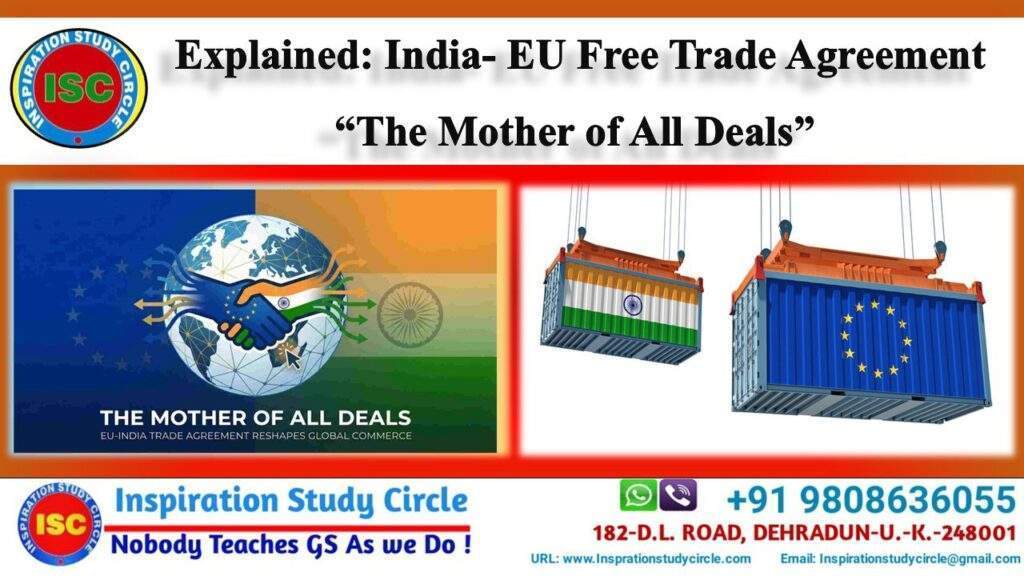
Explained: India- EU FTA “The Mother of All Deals”

Table of Contents

India- EU FTA “The Mother of All Deals

The “Mother of All Deals” is the popular name for the India-European Union Free Trade Agreement (FTA), a landmark pact reached on 27 January 2026. The deal concluded nearly two decades of negotiations and is described as a “strategic economic bridge” connecting two of the world’s largest economies.

1. Massive Economic Scale

  • Market Size: It creates a unified free trade zone of 2 billion people.
  • GDP Share: The agreement covers roughly 25% of global GDP and one-third of global trade.
  • Projected Growth: Bilateral trade is expected to more than double from approximately $137 billion in 2025 to $300 billion by 2032

2. Trade in Goods: Slashing Tariffs

The agreement eliminates or reduces tariffs on over 96% of goods traded. 

  • India’s Gains (Export to EU): The EU will eliminate tariffs on 99.5% of Indian exports by value.
    • Immediate zero-duty access for labour-intensive sectors like textiles, apparel, leather, footwear, gems, and jewellery.
    • Tariffs on marine products (shrimp, frozen fish) up to 26% will be eliminated.
  • EU’s Gains (Export to India): India will liberalise 92.1% of its tariff lines (covering 97.5% of EU exports).
    • Automobiles: Duties on premium cars will drop from 110% to 10% over time, with a fixed annual quota.
    • Wines & Spirits: Prohibitive duties of 150% will be reduced to 20–30% for wines and 40% for spirits.
    • Industrial Goods: Tariffs on machinery (up to 22%), chemicals, and medical devices will be removed or phased out. 

3. Services & Mobility: "Talent Mobility"

The deal includes a future-ready mobility framework aimed at making India a global hub for talent. 

The deal includes a future-ready mobility framework aimed at making India a global hub for talent. 

  • Services Market Access: India secures access to 144 EU service sub-sectors (including IT, R&D, and education), while the EU gains access to 102 Indian sub-sectors (including finance and maritime).
  • Skilled Professionals: Provides an assured regime for temporary stay for business visitors and intra-corporate transferees. Crucially, spouses and dependents are granted entry and working rights.
  • AYUSH Practitioners: For the first time, practitioners of Indian traditional medicine can work under home titles in EU nations where the practice is not regulated. 

4. Strategic & Green Partnership

  • Green Transition: The EU will provide a €500 million (53,285 crore) package to help Indian industries upgrade to sustainable technologies.
  • Defence & Security: A new Security and Defence Partnership was signed alongside the FTA to facilitate “co-development” and “co-production” of military equipment.
  • CBAM & Carbon Tax: While no direct relief was granted for the EU’s Carbon Border Adjustment Mechanism (CBAM), a formal technical dialogue was established to align standards. 

5. Implementation Timeline

  • Political Agreement: Finalised on 27 January 2026.
  • Legal Scrubbing: Currently undergoing legal review and translation.
  • Operational Date: Although formal entry into force is expected in 2027, Commerce Minister Piyush Goyal has expressed hope to fast-track implementation within the calendar year 2026

What Is Its Significance for India?

The significance of the “Mother of All Deals” (India-EU FTA) for India is both economically transformational and geostrategically vital. Beyond simple tariff cuts, it serves as a cornerstone for India’s Viksit Bharat 2047 vision. 

1. Economic Significance: Global Competitiveness

  • Massive Export Surge: The agreement provides preferential access for over 99% of Indian exports. It is projected to potentially double India’s exports to the EU, reaching over $200 billion by 2032.
  • Level Playing Field: By eliminating tariffs (previously 4–26%), India can now compete directly with rivals like Vietnam and Bangladesh in the EU market.
  • Employment Engine: Key labour-intensive sectors—textiles, leather, gems, and jewellery—are expected to create 1 to 2 million high-skilled jobs and support millions of MSME-led jobs. 

2. Strategic & Geopolitical Significance

  • Strategic Autonomy: The deal acts as a hedge against unpredictable trade policies from the U.S. and China. It positions India and the EU as stabilising “middle powers” in a multipolar world order.
  • China-Plus-One Strategy: The agreement solidifies India’s role as a trusted manufacturing alternative to China for European companies.
  • Defence & Security Integration: For the first time, a trade deal is linked with a Security and Defence Partnership, covering maritime security, cyber defence, and co-development of military technology.

3. Significance for Professionals & Services

  • Talent Mobility: India secured access to 144 EU service sub-sectors. A breakthrough mobility framework provides entry and working rights for spouses and dependents of Indian professionals.
  • AYUSH Global Reach: In a historic first, practitioners of Indian traditional medicine can work in EU states where the practice is unregulated. 

4. Key Challenges & Safeguards

Why is it called the “Mother of All Deals”

It earned the title “Mother of All Deals” primarily due to its unprecedented scale, the duration of the struggle to achieve it, and its symbolic weight in global trade.

Here is why the name stuck:

  • The 20-Year Wait: Negotiations first began in 2007 and were famously stalled for nearly two decades. The fact that it was finally “born” on 27 January 2026 after such a long and difficult labour led European Commission President Ursula von der Leyen to coin the phrase.
  • Economic Magnitude: It created the world’s largest free trade zone between a single nation and a bloc, covering 2 billion people. In terms of sheer numbers, it targets a combined trade value that accounts for roughly one-third of global trade.
  • The “Viksit Bharat” Pillar: For India, this isn’t just a trade pact; it is the centrepiece of the “Viksit Bharat 2047” vision, designed to be the foundational deal upon which all other future trade agreements (including the US deal) are benchmarked.
  • Comprehensive Scope: Unlike “thin” trade deals that only cover goods, this is a deep integration agreement. It covers everything from intellectual property and digital trade to government procurement and a first-of-its-kind Security
  • and Defence Partnership.
  • inspiration study circle
Recent Post​
Blank Form (#5)

Scroll to Top