Inspiration Study Circle

Inspiration Study Circle

Best IAS/PCS/UPSC Coaching in Dehradun

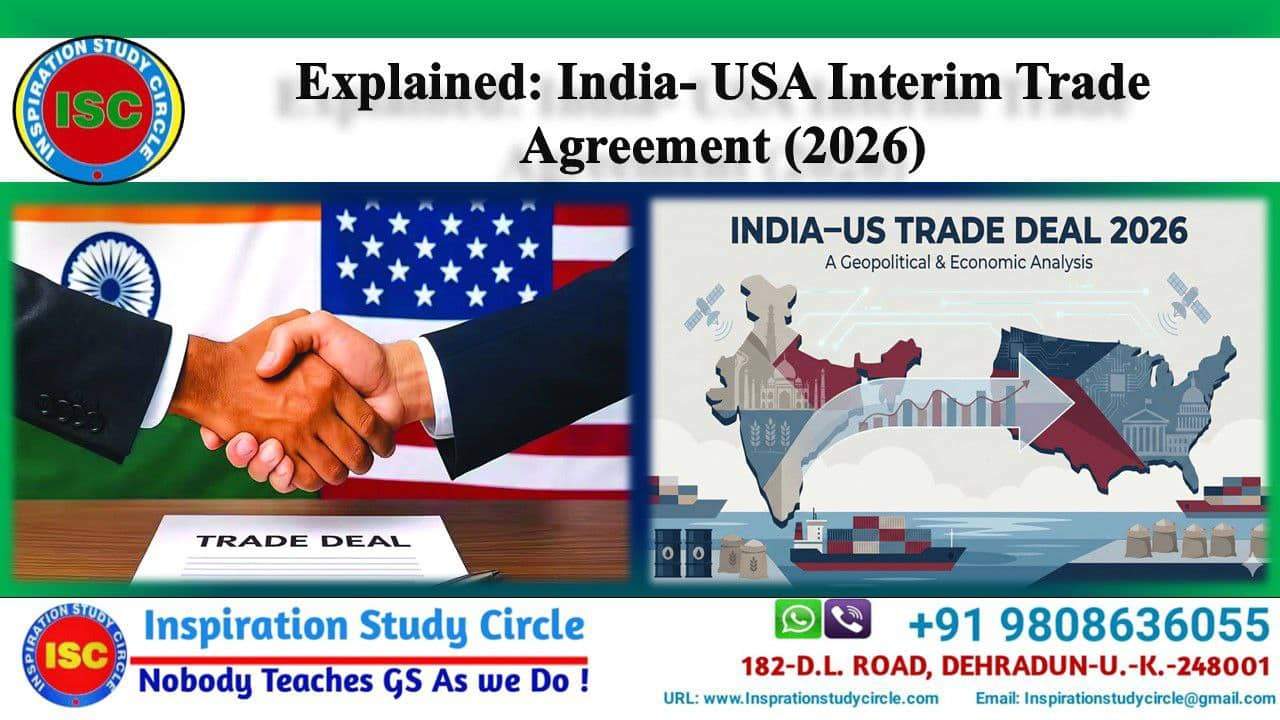
India- USA Interim Trade Agreement (2026)

Table of Contents

India- USA Interim Trade Agreement (2026)

In early February 2026, India and the United States reached a landmark Interim Trade Agreement framework to de-escalate severe trade tensions. The deal, announced following discussions between Prime Minister Narendra Modi and President Donald Trump, significantly reduces American tariffs on Indian goods in exchange for strategic energy pivots and increased market access for U.S. products.

Key Highlights of the Deal

  • Drastic Tariff Reduction: The U.S. slashed effective tariffs on Indian goods from a peak of nearly 50% down to 18%. This includes the removal of a 25% “punitive” duty imposed in 2025 due to India’s Russian oil purchases.
  • Energy Strategic Pivot: In a major diplomatic move, India committed to significantly reducing or halting Russian crude oil imports, shifting its procurement to the U.S. and potentially Venezuela.
  • $500 Billion Purchase Intent: India expressed its intent to purchase approximately $500 billion worth of U.S. goods over the next five years, focusing on energy (LNG, coal), aircraft, precious metals, and advanced technology like GPUs for data centers.
  • Market Access & Reciprocity: India will eliminate or reduce tariffs on U.S. industrial goods and specific food products (tree nuts, fruits, wine, spirits). In return, the U.S. will provide zero-duty access for select Indian exports like generic pharmaceuticals and gems after the full agreement is finalized.

Farmer Safeguards: The Indian government maintained a “negative list” for sensitive agricultural sectors; no tariff concessions were granted to the U.S. for dairy, poultry, staple grains (wheat, rice), or meat.

Economic & Strategic Impact

  • Export Competitiveness: Labour-intensive sectors like textiles, leather, and engineering goods are expected to see an immediate revival in orders due to the lower 18% tariff.
  • Geopolitical Alignment: The deal reaffirms the India-U.S. partnership as a critical counterweight to China in the Indo-Pacific and strengthens supply chain resilience in emerging technologies.
  • Market Response: Following the announcement, the Indian Rupee stabilised, and stock markets (Sensex and Nifty) responded positively due to reduced trade uncertainty. 

Significance of the Trade Agreement for India

The India-U.S. Interim Trade Agreement reached in February 2026 is a strategic breakthrough that ends a period of intense trade friction, specifically de-escalating the “tariff war” that peaked in late 2025. 

Economic Significance

  • Restored Export Competitiveness: The reduction of U.S. tariffs from a staggering 50% to 18% provides a 30-35% boost in price competitiveness for Indian goods. India now holds a more favourable rate than regional rivals like Vietnam (20%)Bangladesh (20%), and China (35%).
  • Immediate Relief for Labour-Intensive Sectors:
    • Textiles & Apparel: Exporters in hubs like Tirupur and Surat expect a revival in orders as the 18% floor restores margins previously eroded by punitive duties.
    • Gems & Jewellery: Secured 0% duty access for major categories like diamonds and platinum, boosting profitability for a sector that contributes significantly to India’s export earnings.

    • Leather & Footwear: Tariffs slashed to 18% open up a $42 billion U.S. market, potentially increasing India’s market share from 22% to nearly 30% this year.
  • Macroeconomic Stability: The deal has stabilised the Indian Rupee (INR) and boosted investor confidence, with the Sensex and Nifty reaching record highs following the announcement. It is expected to improve India’s current account dynamics by widening the trade surplus with the U.S. 

Strategic and Geopolitical Significance

  • Energy Pivot & Russia Relations: A core “linchpin” of the deal is India’s commitment to significantly reduce or halt Russian crude oil imports. While this secures tariff relief, it risks straining India’s “Special and Privileged Strategic Partnership” with Moscow and could increase India’s annual energy import bill by $8–12 billion if switching to more expensive U.S. or Venezuelan crude.
  • Counterweight to China: The agreement reaffirms India’s role as a primary U.S. ally and a critical counterweight to China in the Indo-Pacific, strengthening “friendshoring” efforts to move deep manufacturing into India.
  • Technology & Infrastructure: India has signaled an intent to purchase $500 billion in U.S. goods over five years, including high-tech GPUs for data centers and aviation products (estimated $70-80 billion in aircraft orders already placed). 

Challenges and Safeguards

  • Farmer Protection: India successfully excluded highly sensitive sectors like dairy, poultry, pulses, and staple grains (wheat/rice) from tariff concessions to prevent rural distress.
  • Regulatory Alignment: The framework includes a commitment to harmonise technical standards (SPS/TBT) within six months, which could lower compliance hurdles for Indian food and pharma exports if technical barriers aren’t used as “backdoor protectionism”. 

The Way Forward or the Next Steps

The current framework serves as a “stepping stone” toward a comprehensive Bilateral Trade Agreement (BTA), which both nations aim to formalise by March 2026. Future talks will address non-tariff barriers, digital trade rules, and regulatory standards for medical devices and telecommunications. 

The immediate path involves transitioning from the Interim Framework to a formal Bilateral Trade Agreement (BTA). Both nations have set a tight deadline of March 2026 to finalise the legal text.

Priority Action Items

  • Finalising the $500 Billion Order Book: India must formalise specific contracts for U.S. goods, particularly in energy (LNG/Coal) and aviation. This “purchase intent” is the cornerstone of keeping U.S. tariffs at the 18% floor.
  • SPS & TBT Harmonisation: Over the next six months, technical teams will work to align Sanitary and Phytosanitary (SPS) measures and Technical Barriers to Trade (TBT). This is crucial for Indian pharma and agri-exports to bypass non-tariff barriers at U.S. ports.
  • Energy Transition Logistics: India’s Ministry of Petroleum must secure long-term supply contracts with U.S. and Venezuelan entities to replace the Russian crude volumes, ensuring domestic fuel prices remain stable during the pivot.
  • The “Negative List” Enforcement: Indian negotiators will continue to define the boundaries of the sensitive sectors (Dairy, Poultry, Grains) to ensure these are legally shielded from U.S. competition in the final BTA text.

Strategic Milestones

  • Investment Protection Treaty: Parallel talks are expected to begin on a new Bilateral Investment Treaty (BIT) to provide legal certainty for U.S. tech giants (like NVIDIA and Microsoft) investing in Indian data centres and AI infrastructure.
  • Supply Chain Integration: A joint task force will be established to integrate Indian manufacturers into the U.S. defence and semiconductor supply chains, moving beyond simple “buyer-seller” dynamics.

How to study this topic for UPSC 2026?

To study the India-U.S. Interim Trade Agreement (2026) for the UPSC Civil Services Examination, you must integrate it across General Studies Paper II (International Relations) and Paper III (Economy). This deal is a classic example of “Geoeconomics” and “Strategic Autonomy” in a multipolar world. 

  1. 1. International Relations (GS Paper II)
  • Historical Context: Contrast the current “Strategic Alignment” with the “Cold Estrangement” (1947–1991). Note how ties evolved from “estranged democracies” to “strategic partners”.
  • The “Russia-China” Factor: Analyze the deal as a strategic de-escalation. The U.S. removed the 25% “punitive tariff” imposed in 2025 due to India’s Russian oil purchases, showing India’s ability to navigate the U.S.-Russia-China triangle.
  • Bilateral Frameworks: Link the deal to existing mechanisms like the 2+2 DialogueiCET (Critical & Emerging Tech), and the Quad
  1. Indian Economy (GS Paper III)
  • Trade Dynamics:
    • Tariff Arbitrage: Memorize the key numbers—tariffs dropped from a peak of 50% to 18%. Compare this with competitors: China (37%), Bangladesh (20%), and Vietnam (20%).
    • Export Potential: Focus on labour-intensive sectors like textiles, leather, and gems.
  • Energy Security: Evaluate the “Strategic Pivot” of shifting oil sourcing from Russia to the U.S. and its impact on India’s energy import bill and fiscal deficit.
  • Agriculture: Study the “Negative List”—how India protected its dairy, poultry, and staple grains (wheat/rice) while allowing access for tree nuts and fruits. 
  1. Key Themes for Answer Writing
  • Strategic Autonomy vs. Transactional Diplomacy: Discuss if India’s commitment to buy $500 billion in U.S. goods over five years compromises its independent foreign policy.
  • Friendshoring: Use the deal as an example of India positioning itself as a reliable alternative to China in global supply chains.
  • Digital Trade: Note the commitment to negotiate rules on data localisation and e-commerce, which have been long-standing points of friction.

Pro-Tip: For the 2026 Prelims (May 24th), focus on specific facts like the 18% tariff floor and the list of exempted agricultural items. For the Mains (August 21st), prioritise the geostrategic impact of the “Energy Pivot”. 

Disclaimer: The above information and views are taken from various government platforms, such as the ‘Press Information Bureau’ and news platforms such as “Indian Express”

INSPIRATION STUDY CIRCLE 

Recent Post​
Blank Form (#5)

Scroll to Top