Inspiration Study Circle

Inspiration Study Circle

Best IAS/PCS/UPSC Coaching in Dehradun

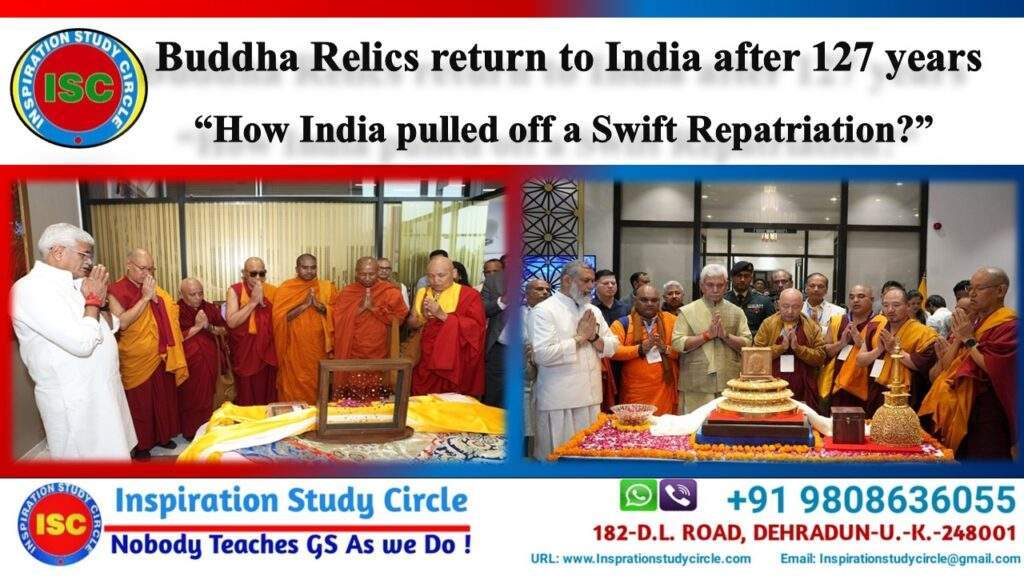
Buddha Relics Return to India after 127 Years "How India Pulled off a Swift Repatriation?"

Table of Contents

In January 2026, India marked a major cultural milestone with the formal return and exhibition of sacred Buddha relics that had been abroad for 127 years. The return of the holy Piprahwa Buddha relics to India after 127 years marks a major historical and cultural event, celebrated by the global Buddhist community and the Indian government. This repatriation, completed in July 2025, involved fragments and gems believed to be the Buddha’s mortal remains, which were discovered in 1898 and had been held by a private family collection in the UK.Buddha Relics Return to India after 127 years marks a historic and spiritual milestone for the country.

Buddha Relics Return to India after 127 Years "How India Pulled off a Swift Repatriation?"

Repatriation of the Piprahwa Relics (2025–2026)

The most significant recent return involves the Piprahwa Relics, which include bone fragments, over 300 gemstones, and sacred caskets discovered in 1898 in Uttar Pradesh. 

  • The Return: The relics were repatriated on July 30, 2025, following a successful intervention by the Indian government to halt an auction at Sotheby’s Hong Kong.
  • Public-Private Partnership: The return was facilitated by a collaboration between the Ministry of Culture and the Godrej Industries Group, which helped secure the relics from the Peppé family collection.
  • 2026 Exposition: On January 3, 2026, Prime Minister Narendra Modi inaugurated the grand international exhibition, “The Light & the Lotus: Relics of the Awakened One,” at the Rai Pithora Cultural Complex in New Delhi. This is the first time these repatriated gems have been displayed alongside relics from the National Museum and Indian Museum collections. 

Historical Significance of the Piprahwa Relics

The relics are of immense spiritual and archaeological value.

  • Discovery: They were unearthed in 1898 by British civil engineer William Claxton Peppé at the Piprahwa Stupa in Uttar Pradesh, a site widely believed to be ancient Kapilavastu, where Gautama Buddha spent his early life.
  • Inscriptions: An inscription in Brahmi script on one of the caskets explicitly links the remains to the Buddha and his own Shakya clan, who enshrined them after his Mahaparinirvana around the 3rd century BCE.
  • Division: After the Buddha’s cremation, his relics were originally divided into eight portions for different communities. The Piprahwa collection represents the share received by the Shakya clan. 

Repatriation Process and Exhibition

The process of bringing the relics back involved decisive action and collaboration.

  • Auction Intervention: In May 2025, the relics’ gem components were listed for auction at Sotheby’s Hong Kong. The Indian Ministry of Culture intervened with a legal notice, asserting the items were inalienable national heritage.
  • Public-Private Partnership: The auction was halted, and the items were secured through a unique partnership where the Godrej Industries Group purchased the collection and facilitated its return to India.
  • Grand Exposition: The returned relics were formally inaugurated by Prime Minister Narendra Modi in a grand international exhibition titled “The Light & the Lotus: Relics of the Awakened One” on January 3, 2026, at the Rai Pithora Cultural Complex in New Delhi. This exhibition marks the first time the newly returned gems have been displayed alongside related artefacts from the National Museum in Delhi and the Indian Museum in Kolkata, thereby reuniting the full collection since its original discovery.

How is it a Pivotal Shift for India?

The return of the sacred Piprahwa Buddha relics to India in 2025 and their grand 2026 exhibition represent a pivotal shift in India’s cultural and diplomatic strategy. This “civilizational reclamation” is considered a major step for the nation for the following reasons:

1. Reassertion of Cultural Sovereignty

  • Post-Colonial Victory: The repatriation of relics taken abroad in 1898 is seen as a symbolic victory over colonial-era displacement of heritage. Prime Minister Modi noted that the return of the addresses had historical damage to India’s spiritual and cultural fabric.
  • Moral and Legal Authority: By intervening in a high-profile auction at Sotheby’s Hong Kong, India demonstrated its resolve to treat sacred remains as inalienable heritage rather than tradable commodities. 

2. Strengthening Global "Soft Power"

  • Spiritual Diplomacy: India has successfully leveraged the relics to deepen ties with Buddhist-majority nations like Thailand, Vietnam, and Mongolia through international expositions.
  • Countering Regional Influence: This strategy reinforces India’s claim as the “Motherland of Dhamma” and its role as the global steward of Buddhist heritage, providing a values-based alternative to other regional cultural influences. 

3. Milestone in Heritage Repatriation

  • The Repatriation Record: The return of the Piprahwa relics is a landmark in a larger campaign that has seen 642 antiquities returned to India since 2014, a massive increase compared to previous decades.
  • New Public-Private Model: The collaboration with the Godrej Industries Group to secure the relics from auction established a new benchmark for how the government and private enterprise can work together to rescue national treasures.

4. Scientific and Archaeological Unity

  • Historic Reunification: For the first time in 127 years, the 2026 exhibition “The Light & the Lotus” reunites the various portions of the 1898 Piprahwa find (gems, bone fragments, and caskets) that were previously scattered across different museums and private collections.
  • Recognition of Languages: This cultural push is complemented by domestic policy, such as the 2024 granting of classical status to the Pali language, the medium of the Buddha’s original teachings. 

5. Economic and Social Impact

  • Spiritual Tourism: Reclaiming these relics supports the development of the Buddhist Circuit Project, aiming to attract millions of global pilgrims to sites like Sarnath and Kushinagar.
  • National Identity: The return is celebrated as a “moment of pride” that connects younger generations with India’s ancient civilizational values of peace and compassion.

India, the cradle of Buddhism, demonstrates its unwavering commitment to preserving and promoting the Buddha Dhamma through government-organised events like summits and commemorative programs, ensuring the global spread of the Buddha’s teachings of peace, compassion, and mindfulness. The Ministry of Culture, Government of India, plays a pivotal role in fostering these initiatives, hosting significant gatherings celebrating Gautam Buddha’s life and teachings. These efforts highlight India’s dedication to nurturing Buddhism’s relevance, strengthening its spiritual legacy, and inspiring future generations worldwide.

Demonstration of India’s Commitment on the World stage

The return of the Piprahwa Buddha relics and the subsequent 2026 grand exposition define India’s commitment on the world stage as a proactive “Global Custodian of Civilizational Heritage”. This milestone signals several key shifts in India’s international posture: 

1. Cultural Sovereignty and Post-Colonial Reclamation

The successful repatriation of relics that were abroad for 127 years is framed as a “civilizational reclamation. Prime Minister Modi stated in January 2026 that their return corrects historical damage where “slavery” led to the erosion of cultural identity. This move signals India’s commitment to protecting its sacred heritage from being treated as “lifeless antique pieces” or commodities in international auctions. 

2. Buddhist Diplomacy as a Global Moral Alternative

India is positioning the Buddha’s teachings of Ahimsa (non-violence) and Karuna (compassion) as a guiding philosophy for 21st-century geopolitics.

  • Dialogue over Conflict: By promoting the message that “this era is not of war but of Buddha,” India projects itself as a moral leader advocating for dialogue in a world grappling with division.
  • Soft Power Strategy: Reclaiming these relics strengthens India’s “soft power” by building “people-to-people” ties with Buddhist-majority nations. This strategy is increasingly used to counter regional competition in Asia and establish India as the “spiritual heartland” of Buddhism. 

3. Institutional and Ethical Leadership

The return sets a new benchmark for cultural diplomacy through:

  • Innovative Partnerships: The 2025 repatriation was achieved through an “exemplary public-private partnership” with the Godrej Industries Group, demonstrating a unique model for recovering lost heritage without state commercialisation of sacred objects.
  • Preservation Standards: India is showcasing a high-level commitment to heritage management, integrating modern science with spirituality to safeguard relics for future generations. 

4. Global Solidarity and Religious Harmony

India has transitioned from merely being the “birthplace” of Buddhism to becoming a “living carrier” of its tradition. 

  • International Expositions: In late 2024 and 2025, India shared relics for public veneration in Thailand, Vietnam, and Russia, attracting millions of devotees (e.g., 17.8 million in Vietnam).
  • Inclusive Heritage: The 2026 exposition, “The Light and the Lotus,” invites global scholars, diplomats, and monks to New Delhi, reinforcing India’s role as a unifying force in the global Buddhist discourse.

Recent International Expositions and Returns

Other sets of sacred relics, designated as National Treasures, have returned to India following global tours for public veneration: 

  • Russia (October 2025): Holy relics returned from a week-long exposition in Kalmykia, Russia, where they were displayed at the “Golden Abode of Buddha Shakyamuni”.
  • Bhutan (November 2025): Relics returned to India on November 25, 2025, after a 17-day exposition in Thimphu as part of the Global Peace Prayer Festival.
  • Thailand (March 2024): Relics of the Buddha and his disciples, Arahant Sariputra and Arahant Maudgalyayana, returned to India with state honours after being viewed by over four million devotees. 

How is this topic relevant for the Aspirants of UPSC 2026 and PCS 2026?

The return of the Piprahwa Buddha relics and the grand 2026 international exposition are highly relevant for UPSC CSE and State PCS aspirants, as they bridge static historical knowledge with dynamic current affairs across multiple GS papers.

1. GS Paper I: Indian Heritage and Culture

  • Art and Architecture: The relics are linked to the Piprahwa Stupa and the ancient city of Kapilavastu. Aspirants should focus on the architectural evolution of stupas from the 6th century BCE to the Mauryan period.
  • Ancient History (Buddhism): The 1898 discovery provided rare archaeological evidence, including a Brahmi script inscription, that directly linked found remains to the Shakya clan and Lord Buddha.
  • Chronology: The reunification of relics from various 19th and 20th-century excavations (1898 and 1972) offers a case study on the historical continuity of Buddhist sites in India.

2. GS Paper II: Governance and International Relations

  • Cultural Diplomacy & Soft Power: The repatriation is a landmark in India’s use of Buddhism to foster ties with nations like ThailandVietnam, and Mongolia. It supports India’s “Act East” and “Neighbourhood First” policies.
  • Antiquity Laws: The 2025 intervention at Sotheby’s Hong Kong highlights the legal and ethical frameworks for protecting heritage. Aspirants should understand the Antiquities and Art Treasures Act, 1972, and the role of the Archaeological Survey of India (ASI) in reclaiming “AA” category artefacts.
  • Public-Private Partnership (PPP): The collaboration with the Godrej Industries Group serves as a new administrative model for recovering national treasures without direct state purchase of sacred items. 

3. GS Paper IV: Ethics and Values

  • Moral Duty of the State: Reclaiming relics taken during the colonial period is framed as a moral obligation to restore a nation’s “civilizational soul”.
  • Commodification vs. Sacredness: The case provides a debate on whether sacred relics should be treated as commercial “antique collectables” or inalienable cultural heritage. 

4. State PCS (UPPSC Relevance)

  • Regional Significance: Since Piprahwa is located in the Siddharthnagar district of Uttar Pradesh, this topic is critical for the UP Special section of the PCS exams.
  • Buddhist Circuit Development: Aspirants should study the state-led initiatives to promote spiritual tourism at sites like SarnathKushinagar, and Kapilavastu.

5. Quick Facts for Prelims 2026

  • Discovery: Found in 1898 by William Claxton Peppé.
  • Exposition Title: “The Light and the Lotus: Relics of the Awakened One” (New Delhi, Jan 2026).
  • Recent Repatriation Count: Over 642 antiquities returned to India as of 2026. 

Disclaimer

The above information and views are taken from Press Information Bureau and various news platforms such as The Hindu and The Indian Express

Recent Post​
Blank Form (#5)

Leave a Comment

Your email address will not be published. Required fields are marked *

Scroll to Top