
Explained: The Sanchar Saathi App
Table of Contents
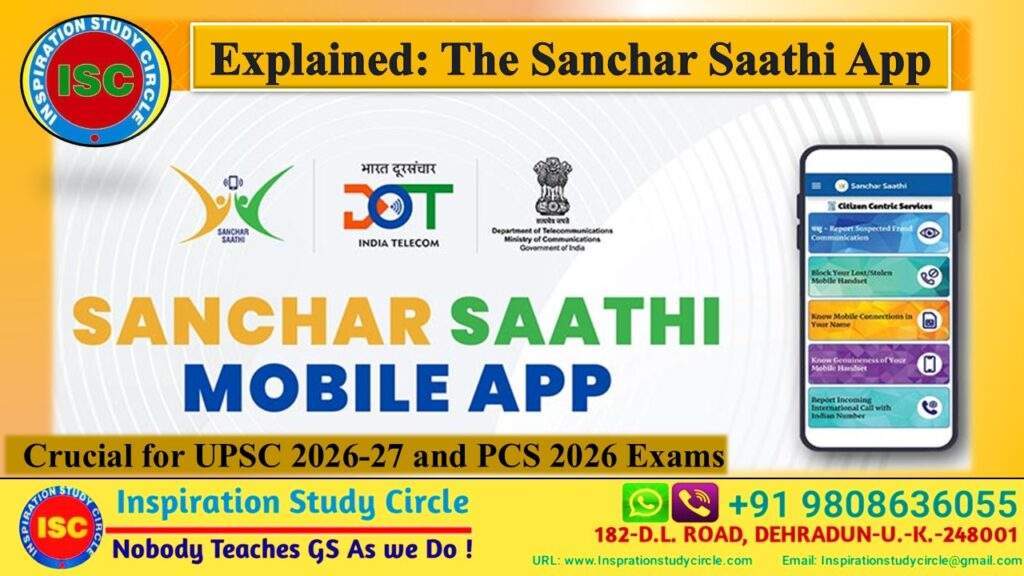
The Sanchar Saathi app is a security and user-protection platform developed by India’s Department of Telecommunications (DoT) to help users manage mobile connections, report fraud, and locate lost phones. It is available as a mobile app and a web portal.
History of the App
In May 2023, Indian Union telecom minister Ashwini Vaishnaw launched the portal.
On 28 November 2025, a government order gave major smartphone companies 90 days to ensure that this app is pre-installed on all new devices intended for sale in India, with a provision that users cannot disable it. This move was criticised by cybersecurity experts, who raised concerns regarding surveillance and data collection. One source has reported that Apple would not comply with this mandate due to privacy concerns. The main opposition party, the Indian National Congress, has demanded that the mandate be rolled back.
Communications Minister Jyotiraditya Scindia issued a statement saying that mobile phone users will have the option to delete this app if they do not wish to use it.
On Dec 3, 2025, the government revoked the order stating that “Given Sanchar Saathi’s increasing acceptance, the Government has decided not to make the pre-installation mandatory for mobile manufacturers”.
Key Features and Services
The Sanchar Saathi app, a citizen-centric platform developed by the Department of Telecommunications (DoT), offers several features designed to enhance mobile security and protect users from cyber fraud. The Sanchar Saathi platform offers several citizen-centric services:
- Block Your Lost/Stolen Mobile Handset: Users can block a lost or stolen phone across all Indian telecom networks using its unique 15-digit International Mobile Equipment Identity (IMEI) number. This renders the device unusable and helps law enforcement trace it. Once recovered, the device can be unblocked through the portal.
- Chakshu – Report Suspected Fraud Communication: This feature allows users to report suspected fraud communications received via calls, SMS, WhatsApp messages, or other platforms. This includes scams related to KYC updates, financial offers, job offers, and digital arrests, helping the DoT take action against the misuse of telecom resources.
- Know Mobile Connections in Your Name: This service enables citizens to check how many mobile connections are registered under their name. Users can report and block any unauthorised or unknown connections, preventing identity theft and misuse.
- Know the Genuineness of Your Mobile Handset: Users can verify the authenticity of their mobile device by checking its IMEI number. This helps prevent the use of counterfeit or blacklisted devices in the market.
- Report Incoming International Call with Indian Number: The app facilitates the reporting of international calls that appear as local Indian numbers (+91 numbers), a common tactic used in fraud.
- Track/Block Lost or Stolen Mobiles (CEIR): Users can block their lost/stolen mobile phones across the network, check a device’s genuineness via its IMEI number, and unblock found phones through the Central Equipment Identity Register (CEIR) module.
- Know Your Connections (TAFCOP): This service allows users to check all the mobile numbers registered under their name (linked via Aadhaar). Users can report any unknown or unused connections they find.
- Report Suspected Fraud Communication: The app enables citizens to report unsolicited commercial communications (UCC) or spam, helping to protect against fraudulent activities.
- Awareness Material: The platform provides information and updates on end-user security and common telecom-related threats.
These tools are available on the Sanchar Saathi portal and within the mobile application, empowering citizens with greater control over their telecom connections and security.
Controversy with the App
The recent controversy surrounding India’s Sanchar Saathi app stemmed from a now-reversed government mandate for its compulsory pre-installation on all new smartphones, which sparked significant concerns over user privacy, potential government surveillance, and data security.
Key Areas of Controversy
- Mandatory Pre-installation: The primary point of contention was a government order to mobile manufacturers to pre-install the app on all devices and prevent users from disabling or deleting it. This was seen by critics as a violation of user autonomy and the right to privacy. Following widespread public and political backlash, the government withdrew the mandatory order, clarifying that the app is optional and can be deleted.
- Privacy and Surveillance Concerns: Digital rights organisations, opposition parties, and cybersecurity experts raised alarms that a mandatory government app could serve as a tool for mass surveillance. Critics compared the situation to the Pegasus spyware scandal and argued that the app’s permissions and design could allow for “function creep,” where a seemingly benign app could be updated to expand its surveillance capabilities without further public debate.
- User Consent and Functionality: Critics argued that true consent involves “opting in,” not being forced to “opt out” of a pre-installed application. Some also questioned the app’s necessity, pointing out that many of its stated functions (like checking IMEI numbers) were already available through less intrusive means such as web portals or SMS services.
- Government Stance: The Ministry of Communications defended the app as a crucial cybersecurity and anti-spam tool designed to help citizens report fraud, check mobile connections, and trace lost phones. Officials repeatedly denied that the app was a “snooping” tool, emphasising that it only becomes active when the user voluntarily registers and uses its features.
Ultimately, the government reversed its decision to mandate pre-installation, citing the app’s “increasing acceptance” and a commitment to address public feedback, thus de-escalating the controversy. The app remains available for voluntary download and use.
Important Update
- The Indian government recently withdrew an orderthat would have made the pre-installation of the Sanchar Saathi app mandatory on all new smartphones following widespread criticism and privacy concerns. Installation is voluntary, and users can choose to download or delete the app at any time.
- The app is designed solely to protect mobile consumers and is not intended for surveillance.
Significance of this information for UPSC 2026 and PCS Exams
The Sanchar Saathi app is significant for UPSC candidates as a contemporary case study that touches upon several key areas of the syllabus, including e-governance, cybersecurity, data privacy, and government initiatives.
Here’s a breakdown of its relevance:
General Studies Paper-II: Governance, Constitution, Polity, Social Justice
- E-Governance and Citizen-Centric Administration: The app is a prime example of a government initiative leveraging technology to provide citizen-centric services efficiently. Candidates can analyse their role in simplifying processes like blocking lost phones and checking mobile connections, demonstrating practical e-governance in action.
- Government Policies and Interventions: The app and the recent controversy over its mandatory pre-installation provide a rich topic for discussing government policy formulation, implementation, and responsiveness to public feedback. This tests a candidate’s understanding of policy dynamics and the balance between state action and individual rights.
- Privacy and Constitutional Law: The debate around the app’s mandatory nature and potential surveillance concerns directly relates to the fundamental right to privacy (as established by the Supreme Court) and the Digital Personal Data Protection Act, 2023. UPSC questions could explore the legal and ethical dimensions of mass surveillance versus national security/citizen safety.
General Studies Paper-III: Technology, Economic Development, Security, Environment, Disaster Management
- Cybersecurity and Internal Security: The app is a direct tool to combat rising cyber fraud, identity theft, and financial crimes. Candidates can use the Sanchar Saathi platform as an example of a proactive measure within India’s cybersecurity framework (alongside CERT-In, NCIIPC, etc.) to enhance internal security.
- Role of ICT in Governance: The app highlights the use of Information and Communication Technology (ICT) for security and regulatory enforcement (e.g., enforcing TRAI rules and using the Central Equipment Identity Register or CEIR system).
- Digital India Initiative: The Sanchar Saathi app aligns with the broader goals of the Digital India program, which aims to make the country digitally empowered and secure.
Preliminary Examination
- Current Events of National Importance: As a recent, widely discussed government initiative with an associated controversy, the app is a high-probability current affairs topic for multiple-choice questions.
- Science and Technology & Governance: Questions could focus on its specific features like “Chakshu” or “CEIR” (Central Equipment Identity Register) system, or the ministry/department responsible for its launch (DoT).
In summary, the Sanchar Saathi app serves as a practical, real-world case study for understanding the complexities and implications of digital governance initiatives in modern India.
The Way Forward
The way forward for the Sanchar Saathi app focuses on rebuilding public trust through voluntary adoption and enhanced functionality, while strengthening the overall telecom security ecosystem.
Key areas for future development and strategy include:
- Prioritising Voluntary Adoption and Trust: The government has correctly shifted focus from mandatory installation to voluntary adoption, which aligns with citizen rights and the Digital Personal Data Protection Act, 2023. Rebuilding trust requires transparent policies on data usage, retention, and security to counter surveillance concerns.
- Enhancing Public Awareness: Significant efforts are needed for mass awareness campaigns to educate vulnerable populations about the app’s benefits and general cyber hygiene. This “Jan Bhagidari” (people’s participation) approach is crucial for the app’s effectiveness in curbing fraud.
- Technical Upgrades and Feature Expansion:
- Periodic Security Upgrades: The app will require regular updates to counter new and evolving cyber fraud techniques effectively.
- Integration with State Police: Closer integration with state police cyber cells could facilitate quicker tracing and action on reported cybercrimes.
- Improved User Experience: Making the app more user-friendly and accessible in all regional languages will increase its reach across India’s diverse population.
- Strengthening the Regulatory Framework:
- Robust Data Protection: Ensuring that strong privacy safeguards are embedded in the app’s design (“privacy by design”) will be vital to prevent “function creep” or potential misuse of data.
- International Cooperation: Collaboration with international agencies on tracing telecom fraud that originates abroad is a necessary step in combating transnational cybercrime.
The Sanchar Saathi app has shown promising results in blocking stolen devices and disconnecting fraudulent connections. Its long-term success lies in becoming a trusted, effective, and transparent tool for citizen safety, balancing security needs with individual privacy rights.
Recent Post

Classroom Program for UPSC 2027- 28
Inspiration Study Circle Classroom Program for UPSC 2027- 28 Table of Contents Classroom Program for UPSC 2027- 28 Greetings, Civil

A Beginner’s Guide to the IAS Syllabus in Hindi/English
A Beginner’s Guide to the IAS Syllabus in Hindi/English Table of Contents A Beginner’s Guide to the IAS Syllabus in

How to Choose the Best IAS Academy in Dehradun?
How to Choose the Best IAS Academy in Dehradun? Table of Contents Best IAS Academy in Dehradun The Crossroads of

Why Dehradun is the New Hub for IAS Preparation?
Why Dehradun is the New Hub for IAS Preparation? Table of Contents Let’s be honest—the dream of seeing your name

Civil Services After 12th: UPSC Foundation Course 2028-2029
Civil Services After 12th: UPSC Foundation Course 2028-2029 Table of Contents Civil Services After 12th UPSC Foundation Course Inspiration Study

Foreign Contribution (Regulation) Amendment Bill 2026
Foreign Contribution (Regulation) Amendment Bill 2026 Table of Contents Foreign Contribution (Regulation) Amendment Bill 2026 The Foreign Contribution (Regulation) Amendment Bill,