Inspiration Study Circle

Inspiration Study Circle

Best IAS/PCS/UPSC Coaching in Dehradun

India in the Iran War 2026

Table of Contents

India in the Iran War 2026

India has remained neutral in the 2026 Iran War, which began on 28 February 2026 when the United States and Israel launched airstrikes on Iran. India condemned strikes on American bases, without mentioning Iran, while facing a domestic energy crisis linked to the conflict following the closure of the Strait of Hormuz by Iran.

The Ministry for External Affairs expressed its concerns and requested that all three nations observe a ceasefire. Prime Minister Narendra Modi spoke with Gulf leaders, namely King Abdullah II, King Hamad bin Isa Al Khalifa, and Crown Prince Mohammed bin Salman and condemned the strikes and attack on sovereignty without mentioning Iran. Modi also spoke with the Israeli Prime Minister Benjamin Netanyahu. The Indian government did not condemn the assassination of Khamenei, just like in similar previous cases.

An introduction to the Iran War 2026

The 2026 Iran War began on 28 February 2026, when the United States and Israel launched a massive, coordinated military offensive codenamed Operation Epic Fury (U.S.) and Operation Roaring Lion (Israel). The conflict was initiated as a surprise “decapitation strike” against the Iranian leadership and strategic military infrastructure, primarily aimed at dismantling Iran’s nuclear program and its regional proxy network.

Key Developments and the General Immediate Impact:

  • Assassination of Leadership: The initial wave of strikes killed several top Iranian officials, most notably Supreme Leader Ali Khamenei and former security official Ali LarijaniMojtaba Khamenei was subsequently appointed as the new Supreme Leader.
  • Military Scale: In the first 12 hours alone, the U.S. and Israel conducted nearly 900 strikes. Iran responded with hundreds of retaliatory ballistic missiles and drone strikes targeting Israel, U.S. military bases (particularly in Bahrain, Qatar, and Kuwait), and regional U.S. allies like Saudi Arabia and the UAE.
  • Global Energy Crisis: Iran’s closure of the Strait of Hormuz—a chokepoint for 20% of the world’s oil—triggered a massive global energy shock. Brent crude oil prices surged over 50% in a single month, reaching more than $120 per barrel.
  • Casualties and Displacement: Estimates of the death toll vary widely. Reports suggest over 6,000 Iranian military personnel and hundreds of civilians have been killed. In Lebanon, more than 1,000,000 people have been displaced as the conflict escalated into a full-scale war between Israel and Hezbollah. 

Background and Context:

The war followed years of escalating tensions and failed diplomatic efforts: 

  • Nuclear Tensions: The conflict followed the collapse of the 2015 JCPOA nuclear deal and years of “maximum pressure” sanctions.
  • Domestic Unrest: Before the war, Iran faced its largest anti-government protests since 1979, which the regime suppressed with extreme violence, leading to thousands of deaths in January 2026.
  • Previous Conflicts: The 2026 war followed a brief “Twelve-Day War” in June 2025 between Israel and Iran, which had already weakened Iranian air defences.

The Impact of the War on India

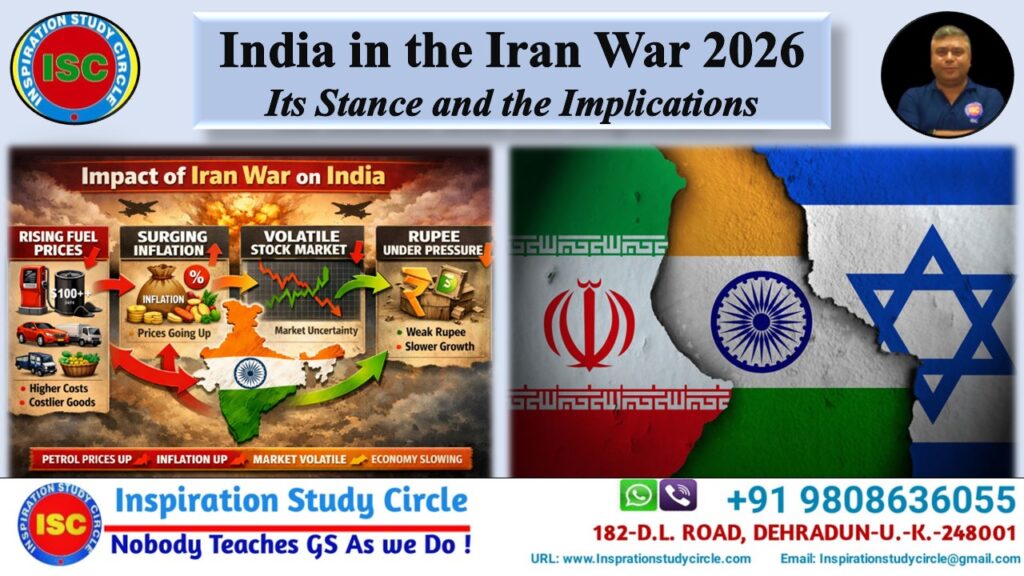
The Iran war (which began in late February 2026) has significantly impacted India across its economy, energy security, and foreign policy. As a major importer of energy from the Middle East, India has faced immediate supply shocks and inflationary pressures. 

Economic and Financial Impact:

  • GDP and Inflation: Economists estimate that if the conflict persists through the next fiscal year (FY27), India’s real GDP growth could drop by 1 percentage point, while retail inflation could rise by 1.5 percentage points from baseline estimates.
  • Currency and Trade: The Indian rupee has faced severe pressure, breaching the 94 per dollar mark in March 2026. The trade deficit is expected to rise significantly as the cost of energy imports surges.
  • Stock Market: Indian benchmark indices, such as the Nifty 50, fell by more than 10% in March 2026 as foreign investors pulled out capital due to regional instability.

Energy Security and Domestic Shortages:

India is highly vulnerable to disruptions in the Strait of Hormuz, through which nearly 50% of its crude oil and 90% of its LPG (cooking gas) imports typically pass. 

  • Cooking Gas Crisis: Domestic LPG prices increased by 60 per cylinder, while commercial LPG hiked by over 195, leading to black market prices reaching up to 4,000 in some areas.
  • Fuel and Travel: Jet fuel (ATF) prices doubled, crossing 2 lakh per kilolitre for the first time, causing a sharp surge in domestic and international airfares.
  • Strategic Diversification: To mitigate shortages, India has resumed direct oil imports from Iran for the first time since 2019 and is increasing reliance on discounted Russian crude under US waivers. 

Sector-Specific Disruptions:

  • Hospitality: Approximately 20% of restaurants in cities like Mumbai have partially or fully shut down due to the lack of commercial cooking gas.
  • Manufacturing: Activity slumped to a 4.5-year low in March 2026. Industries such as ceramics in Gujarat suspended production for weeks due to gas shortages.
  • Agriculture: Fertiliser plants have seen gas supply restricted to 70%, raising concerns about crop yields and future food inflation.
  • Exports: Roughly 400,000 tonnes of Basmati rice were reported stuck in transit or at ports due to maritime route closures.

Humanitarian and Geopolitical Concerns:

  • Diaspora Safety: Nearly 9 million Indians work in the Gulf region. The conflict has caused immense anxiety regarding their safety and a projected 30% drop in remittances in the short term.
  • Diplomatic Balancing: India has maintained a “studied silence,” urging restraint while prioritising the safety of its citizens. However, critics suggest this quiet strategy has allowed regional rivals like Pakistan to take a more prominent role as mediators. 

India and Iran Relations

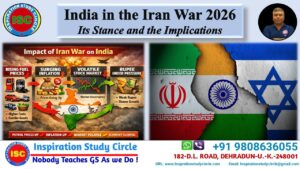
India and Iran share a deep, complex relationship that has shifted from ancient civilizational ties to a modern partnership centred on energy and regional connectivity. However, the 2026 Iran war has severely tested this bond, forcing India into a delicate balancing act between its strategic interests in Tehran and its partnerships with the US and Israel.

Recent Strategic & Diplomatic Developments (2026):

The outbreak of hostilities on February 28, 2026, following US-Israeli strikes, has reshaped bilateral engagement: 

  • Stance on the Conflict: India has maintained official neutrality, calling for “dialogue and diplomacy”. While it has not openly condemned the strikes on Iran or the assassination of its leadership, it has condemned attacks on merchant shipping and American bases.
  • Diplomatic Gestures: In a sign of continued engagement, Indian Foreign Secretary Vikram Misri visited the Iranian embassy in March 2026 to offer condolences for the death of Supreme Leader Ayatollah Ali Khamenei.
  • Maritime Friction: Tensions spiked following the US sinking of the Iranian warship IRIS Dena shortly after it participated in an Indian Navy exercise, leading to internal debates about India’s role as a “net security provider” in the region. 

Key Pillars of the Relationship:

Despite the war, the relationship continues to rest on three critical areas: 

  • Energy Resumption: After a five-year halt due to previous sanctions, India resumed direct oil imports from Iran in early 2026. A major shipment of 600,000 barrels reached Gujarat in April 2026 to help mitigate domestic fuel shortages caused by the conflict.
  • Chabahar Port: This remains India’s most strategic project in Iran, providing a trade route to Afghanistan and Central Asia that bypasses Pakistan. While a 10-year development contract was signed in 2024, the project currently faces extreme uncertainty as US sanctions waivers are set to expire on April 26, 2026.
  • Regional Connectivity: Both nations are founding members of the International North-South Transport Corridor (INSTC), intended to link Mumbai to Russia via Iran. The war and related sanctions have stalled key components, such as the Chabahar-Zahedan railway line.

Major Challenges & Friction Points:

  • US Sanctions & Tariffs: New 25% US tariffs on countries trading with Iran have placed over $500 million of Indian investment at risk, complicating further cooperation.
  • Kashmir & Minority Issues: Relations have been occasionally strained by the Iranian leadership’s comments on the “suffering” of Muslims in India, which New Delhi has rejected as interference in its internal affairs.
  • Geopolitical Balancing: India’s growing defence ties with Israel and strategic partnership with the US often conflict with its need for Iranian energy and connectivity, requiring a “de-hyphenated” foreign policy approach. 

Conclusion

In a nutshell, the India-Iran relationship is a high-stakes balancing act. While India relies on Iran for energy security and a strategic gateway to Central Asia via the Chabahar Port, the 2026 conflict has forced New Delhi to walk a tightrope—maintaining ties with Tehran while navigating US sanctions and its own growing partnership with Israel.

Ultimately, India’s approach remains pragmatically neutral: prioritising its own economic stability and the safety of its diaspora over taking sides in the regional power struggle.

Disclaimer: The above information and views are taken from various news platforms such as The Hindu and the Indian Explorer.

FOR MORE BLOGS : 

  1. The Constitutional Boundary of SC Status
  2. Detailed Geography and aps for UPSC 2026
  3. Explained: India AI Impact Summit 2026

Recent Post​
Blank Form (#5)

Scroll to Top