
ISC Explained: Nobel Prize 2026
ISC Explained: Nobel Prize 2026 Table of Contents ISC Explained: Nobel Prize 2026 The 2026 Nobel Prizes have been announced

Inspiration Study Circle
Best IAS/PCS/UPSC Coaching in Dehradun
Inspiration Study Circle
Best UPSC/IAS/PSC/UKPCS Coaching in Dehradun
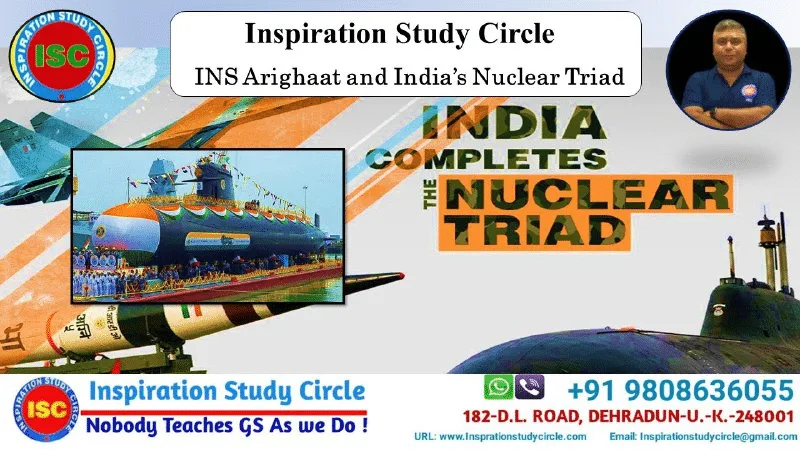
INS Arighaat is India’s second nuclear-powered ballistic missile submarine (SSBN), belonging to the Arihant class. It was launched in November 2017 and commissioned into service on 29 August 2024.
INS Arighaat is an upgraded variant of the Arihant-class submarine. It has an increased indigenous content of around 70% compared to its predecessor, INS Arihant. It is the second nuclear-powered ballistic missile submarine made by India under the Advanced Technology Vessel (ATV) project to build nuclear submarines at the Ship Building Centre in Visakhapatnam.
Etymology: The submarine was originally known as INS Aridhaman but was renamed INS Arighaat upon its launch. “Arighaat” translates to “destroyer of the enemy” in Sanskrit. It has the code name S3.
The submarine was quietly launched in 2017 and little has been publicly announced about its capabilities and current status. According to reports released in early 2021, she was to be commissioned in late 2021 alongside INS Vikrant.
Name | INS Arighaat |
Builder | Shipbuilding Centre (SBC), Visakhapatnam, India |
Laid down | 2011 |
Launched | 19 November 2017 |
Commissioned | 29 August 2024 |
Status | In active service |
General characteristics | |
Class and type | |
Type | |
Displacement | 6,000 tonnes |
Length | 111.6 m |
Beam | 11 m |
Draft | 9.5 m |
Installed power | 1 x CLWR-B1 Compact Light-water reactor, 83 MW |
Propulsion | |
Speed | Surfaced: 12–15 knots (22–28 km/h) Submerged: 24 knots (44 km/h) |
Range | Unlimited except by food supplies |
Endurance | Unlimited except by food supply and maintenance |
Test depth | Between 300 m (980 ft) to 400 m (1,300 ft) |
Sensors and |
|
Armament |
|
INS Arighaat, India’s second nuclear-powered ballistic missile submarine (SSBN), plays a crucial role in strengthening India’s nuclear deterrence capabilities and enhancing its nuclear triad.
In summary, the induction of INS Arighaat significantly bolsters India’s nuclear deterrence, strengthens its nuclear triad, and contributes to the overall security and strategic balance in the region. It is a testament to India’s technological advancements and its commitment to maintaining a credible and reliable nuclear force.
India’s nuclear triad refers to the country’s ability to launch nuclear weapons from three different platforms – land, air, and sea. This capability is considered crucial for maintaining a credible nuclear deterrence. The nuclear triad in India refers to the country’s three-pronged military force structure for delivering nuclear weapons:
The development of this nuclear triad is seen as crucial for India to maintain a credible and survivable nuclear deterrent, in line with its “no-first-use” nuclear doctrine. The triad provides India with the ability to deliver nuclear warheads via land, air, and sea, enhancing the survivability of its nuclear forces against a potential first strike.
While India’s nuclear triad is still evolving and faces challenges in terms of matching the capabilities of its rivals like China, the commissioning of INS Arighat represents a significant step forward in strengthening India’s nuclear deterrence and strategic posture.
Recent bolg: –
ISC Explained: Nobel Prize 2026 Table of Contents ISC Explained: Nobel Prize 2026 The 2026 Nobel Prizes have been announced
Los Mejores Casinós Durante Línea Content Supervisión Constante De Los Casinos Regulados La Selección De Juegos De Los Mejores Casinos”
Los Mejores Casinós Durante Línea Content Supervisión Constante De Los Casinos Regulados La Selección De Juegos De Los Mejores Casinos”
1win Azərbaycan Rəsmi Saytı: Kazino, Mərc Və 600%-dək Xoş Bonus Content In Mobil Tətbiqi: Quraşdırma Üçün 200 1w Qazanma Sikkəsi
Inside Aviator: The Addictive Betting Online Game Pushing Kenyans Directly Into Debt Content Perfect For The Two Beginners And Experienced
Inside Aviator: The Addictive Betting Online Game Pushing Kenyans Directly Into Debt Content Perfect For The Two Beginners And Experienced