Inspiration Study Circle

Inspiration Study Circle

Best IAS/PCS/UPSC Coaching in Dehradun

Military Exercises of India 2025 for UPSC 2026-27

Table of Contents

Military Exercises of India 2025 for UPSC 2026-27

Military Exercises of India 2025 for UPSC 2026-27

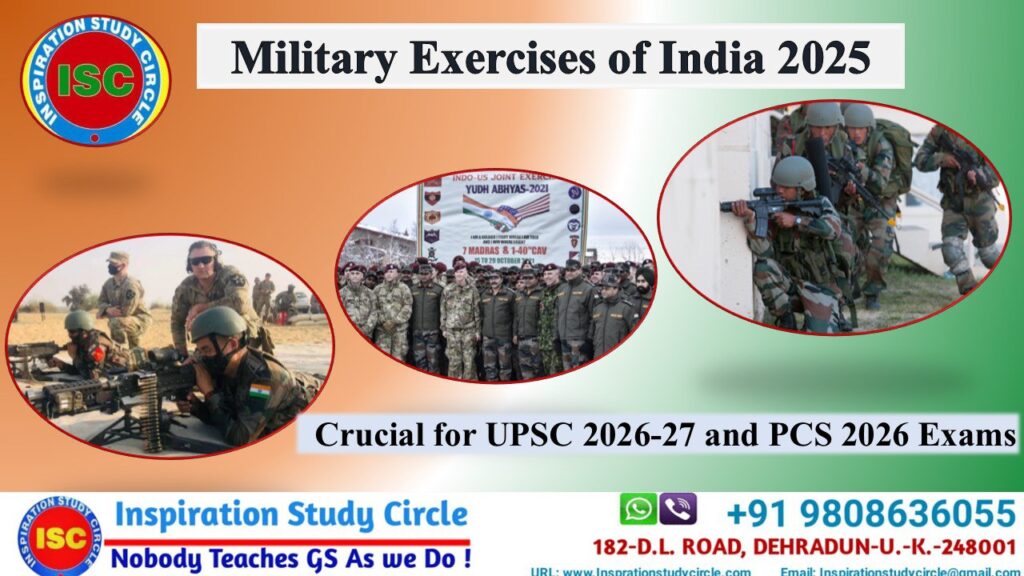
military exercisetraining exercisemanoeuvre, or war game is the employment of military resources in training for military operations. Military exercises are conducted to explore the effects of warfare or test tactics and strategies without actual combat. They also ensure the combat readiness of garrisoned or deployable forces before deployment from a home base.

Military exercises focus on the simulation of real, full-scale military operations in controlled hostile conditions in attempts to reproduce wartime decisions and activities for training purposes or to analyse the outcome of possible wartime decisions.

Military exercises involving multiple branches of the same military are known as joint exercises, while military exercises involving two or more countries are known as combinedcoalitionbilateral, or multilateral exercises, depending on the nature of the relationship between the countries and the number of them involved. These exercises allow for better coordination between militaries and observation of enemy tactics, and serve as a visible show of strength and cooperation for the participating countries.

History of Military Exercises

The use of military exercises and war games can be found to date back to as early as the early 19th century, wherein it was the officers of the Prussian Army who created the contemporary, tactical form of wargames that have since been more widely used and developed by other military conglomerations throughout the world. Non-tactical forms of wargames have existed for much longer, however, in the forms of tabletop games such as chess and Go.

The modern use of military exercises grew out of the military need to study warfare and to reenact old battles for learning purposes. 

Military Exercises of India

India conducts numerous military exercises, including large-scale domestic drills like Bharat Shakti and Trishul, which focus on joint warfare capabilities. It also participates in bilateral exercises with specific countries, such as Shakti with France, Dharma Guardian with Japan, and Tiger Triumph with the United States. Additionally, India participates in multilateral exercises, such as La Perouse with multiple nations, and conducts large-scale naval exercises, including TROPEX. 

Domestic exercises

  • Bharat Shakti: A tri-service exercise to showcase joint warfare with indigenous weapons. 
  • Gagan Shakti: A large Indian Air Force exercise testing full-spectrum air operations and joint operations with the Army and Navy. 
  • Dakshin Shakti: A tri-service integrated exercise for simulating war scenarios in the southern coastal region. 
  • Vayu Shakti: A biennial Indian Air Force firepower demonstration. 
  • Trishul: A large, ongoing tri-service exercise led by the Indian Navy, focusing on joint operations across land, air, and sea, and testing indigenous platforms. 

Bilateral exercises

Multilateral exercises

  • La Perouse: Includes India, Australia, the United States, France, Japan, and the United Kingdom. 
  • Bright Star: A multinational exercise led by the United States and Egypt. 
  • RIMPAC: Pacific-focused exercise. 
  • Pitch Black: Involves India and 18 other nations, hosted by Australia. 

Tarang Shakti: A large air force exercise with multiple international partners.

Naval exercises

  • TROPEX: The Navy’s Theatre Level Operational Exercise, involving Army, Air Force, and Coast Guard units.
  • Samudra Shakti: India-Indonesia.
  • SIMBEX: India-Singapore.
  • IND-INDO CORPAT: India-Indonesia coordinated patrol. 

Military Exercises of India in 2025

India participated in numerous military exercises during the 2024-2025 period, including bilateral and multilateral drills with countries like the USA, France, Singapore, and Japan. Key exercises in this timeframe include “Yudh Abhyas” with the USA, “Shakti” with France, “Dharma Guardian” with Japan, “Cyclone” with Egypt, and the multilateral exercise “Tarang Shakti”. These exercises covered a wide range of operations, from land-based counter-terrorism to naval and air force cooperation. 

Key exercises by partner country

  • United States: “Yudh Abhyas” (land), “Red Flag” (air), “Sea Dragon” (naval), “Bright Star” (multilateral), and “Tiger Triumph” (land and sea).
  • France: “SHAKTI” (land), “Varuna” (naval), and “La Perouse” (multilateral naval).
  • Japan: “Dharma Guardian” (land) and “Sea Dragon” (naval).
  • Singapore: “SIMBEX” (naval), “Bold Kurukshetra” (mechanised infantry), and “La Perouse” (multilateral naval).
  • Egypt: “Cyclone” (land).
  • Sri Lanka: “SLINEX” (naval).
  • Oman: “Al Najah V” (land).
  • Russia: “INDRA” (naval).
  • Maldives: “Ekuverin” (land).
  • Uzbekistan: “DUSTLIK VI” (land).
  • Nepal: “Surya Kiran” (land). 

Key exercises by focus and type

  • Land: “Yudh Abhyas” (counter-terrorism, peacekeeping), “Shakti” (counter-terrorism), “Dharma Guardian” (counter-terrorism, jungle warfare), “Cyclone” (counter-terrorism), “Al Najah V” (land), “Ekuverin” (land), “DUSTLIK VI” (land), and “Bold Kurukshetra” (mechanized infantry).
  • Naval: “SIMBEX” (fleet coordination), “SLINEX” (fleet operations), “Varuna” (naval), “IBSAMAR VIII” (naval), “La Perouse” (multilateral naval security), “Sea Dragon” (naval), “INDRA” (naval), and “Tiger Triumph” (naval).
  • Air: “Red Flag” (air), “Tarang Shakti” (air), and “Indradhanush” (air).
  • Cyber: “Cyber Suraksha” (cybersecurity).
  • Multilateral: “La Perouse” (naval), “Tarang Shakti” (air), “Bright Star” (tri-service), “Sea Dragon” (naval), and “IFR 2025” (naval). 
  •  

Studying Military Exercises for UPSC 2026- 27 and PCS Exams

  • Studying military exercises is important for UPSC 2026- 27 and PCS 2026- 27 because they test and improve military capabilities, foster international cooperation, and provide crucial insights into national security, defence diplomacy, and geopolitics. Knowledge of these exercises is relevant to the UPSC/PCS 2026- 27 exams, particularly for GS Paper 3, and helps in understanding strategic signalling, interoperability, and India’s role in global defence. 

    Benefits for UPSC preparation

    • Relevance to GS Paper 3: Military exercises fall under the security and disaster management sections of UPSC 2026 General Studies Paper 3.
    • Understanding Geopolitics: They provide insights into a nation’s foreign policy, alliances, and strategic relationships with other countries.
    • Strategic Signalling: Participation in exercises can be a form of “strategic signalling,” conveying a nation’s alignment and strengthening political ties with other nations.
    • Knowledge of National Security: Studying exercises helps in assessing a country’s security preparedness, its approach to counter-terrorism, and its ability to respond to other threats.
    • Assessment of Military Capabilities: Exercises are a way to evaluate a military’s capabilities, interoperability, and readiness without engaging in actual combat. 

    Key areas of study

    • Bilateral and Multilateral Exercises: Understand the purpose, participating countries, and recent outcomes of key exercises like Yudh Abhyas (India-US), Shakti (India-France), and Malabar (India, US, Japan).
    • Purpose: Focus on the specific goals of each exercise, such as counter-terrorism, peacekeeping, humanitarian aid, or disaster relief.
    • Interoperability: Learn how exercises improve coordination, communication, and tactical understanding between different military units or even different countries’ forces.
    • Technology and Innovation: Observe how these exercises can lead to the exchange of knowledge and the adoption of new technologies, including cyber warfare and space-based operations. 

    Why study them for the exam

    • Current Affairs: Questions often appear in prelims and mains based on recent or recurring exercises.
    • Analytical Questions: Mains questions may ask you to critically analyse the benefits and drawbacks of military exercises in the context of India’s foreign policy and national security.
    • Connecting the Dots: Studying exercises allows you to connect a wide range of topics, including defence, diplomacy, economy, and internal security, in your answers. 
Recent Post​
The Sustainable Harnessing and Advancement of Nuclear Energy for Transforming India (SHANTI) Act, 2025

The SHANTI Act 2025

The SHANTI Act 2025 Table of Contents The SHANTI Act 2025 The Sustainable Harnessing and Advancement of Nuclear Energy for Transforming

Read More »
Blank Form (#5)

Scroll to Top