
The Viksit Bharat – Guarantee for Rozgar and Ajeevika Mission (Gramin) Bill, 2025
Table of Contents
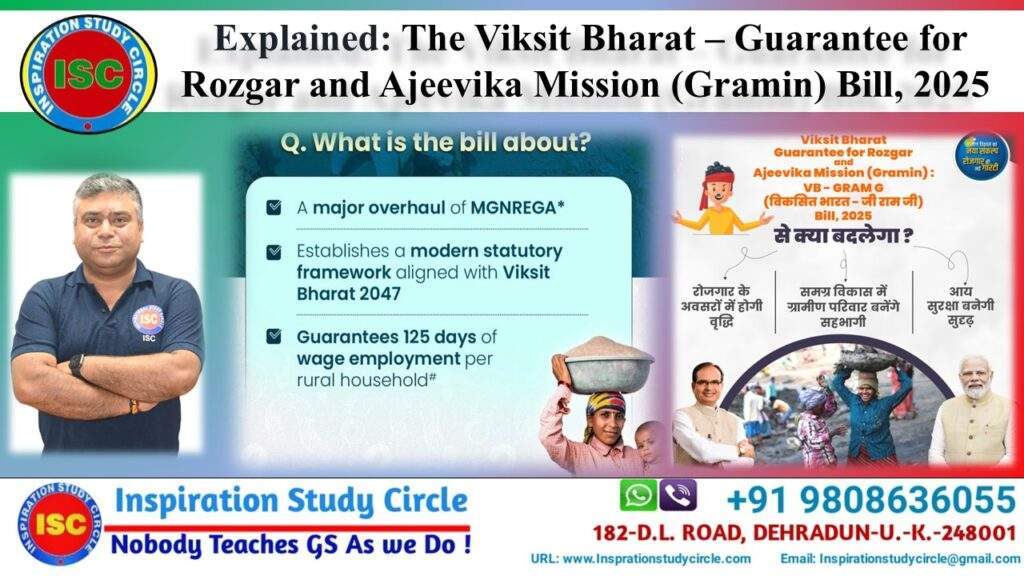
The Viksit Bharat – Guarantee for Rozgar and Ajeevika Mission (Gramin) Bill, 2025 (abbreviated as VB-G RAM G) was introduced in the Lok Sabha on December 16, 2025. It is a landmark legislation designed to overhaul India’s rural employment framework by repealing and replacing the Mahatma Gandhi National Rural Employment Guarantee Act (MGNREGA), 2005.
Key Features of the Bill
- Enhanced Employment Guarantee: Increases the statutory wage employment guarantee from 100 days to 125 days per rural household in each financial year.
- Funding Pattern Shift: Changes the funding structure from a mostly central-funded model to a cost-sharing model. For most states, the ratio will be 60:40 (Centre: State), while for North Eastern and Himalayan states, it will be 90:10.
- Seasonal Farm Labour Provision: States can notify a total of 60 days in a financial year during peak sowing and harvesting seasons when work under the scheme will be paused to ensure agricultural labor availability.
- Infrastructure Priority: Works are integrated into a new Viksit Bharat National Rural Infrastructure Stack, focusing on four verticals: water security, core rural infrastructure, livelihood infrastructure, and extreme weather mitigation.
- Bottom-Up Planning: All projects must be identified through Viksit Gram Panchayat Plans (VGPPs), which aim for saturation-oriented and convergence-based development.
Governance and Accountability
- Unemployment Allowance: Retains the provision that if employment is not provided within 15 days of a request, the State Government must pay an unemployment allowance.
- Digital Governance: Mandates the use of biometric authentication, geospatial technology for monitoring, and real-time mobile-based dashboards.
- Transparency: Requires Weekly Disclosure meetings at Gram Panchayat Bhavans to publicly present the status of works, payments, and grievances.
- Social Audits: Strengthens regular social audits by the Gram Sabha to ensure high-integrity implementation.
Current Status
Union Minister Shri Shivraj Singh Chouhan introduced the bill, and it is currently under consideration in Parliament as of December 2025. It marks a strategic shift from a purely demand-driven framework to a supply-driven model aligned with the “Viksit Bharat 2047” vision.
The implications for India’s economy, governance, and rural population include:
Economic and Livelihood Impact
- Income Enhancement: Raising the statutory guarantee from 100 to 125 days provides a 25% increase in potential earnings for approximately 8 crore beneficiary households.
- Faster Liquidity: Mandatory weekly wage payments (replacing the former 15-day cycle) improve cash flow for rural workers, reducing their dependence on high-interest local money lenders.
- Productive Asset Creation: Unlike MGNREGA’s often fragmented works, all projects are now integrated into a National Rural Infrastructure Stack. This focuses on water security, core infrastructure, and climate resilience to drive long-term rural productivity.
Impact on Agriculture
- Labour Availability: The 60-day agricultural pause during peak sowing and harvesting seasons addresses a long-standing grievance of farmers regarding labour shortages caused by public works.
- Wage Stabilisation: By stopping public works during peak seasons, the bill aims to prevent artificial wage inflation, thereby helping to stabilise food production costs.
Fiscal and Governance Shift
- Shared Financial Burden: Shifting to a 60:40 Centre-State cost-sharing model (90:10 for Himalayan and NE states) imposes a significant new financial liability on states, which previously only bore a fraction of material and administrative costs.
- Normative Allocation vs. Demand: The transition from demand-driven budgeting to normative allocations capped by the Centre allows for better fiscal discipline but may limit the scheme’s ability to respond to sudden economic shocks or droughts.
- Digital Accountability: Heavy reliance on AI-enabled fraud detection, biometric authentication, and real-time GPS monitoring aims to eliminate “leakages” but raises concerns about “exclusion errors” for workers in remote areas with poor connectivity.
- Legal and Social Concerns
- Dilution of Rights: Critics argue that moving from a “justiciable right” to a budget-capped “schematic entitlement” weakens the legal claim to work, especially if state or central funds are exhausted mid-year.
- Vulnerable Populations: While the bill includes “special cards” for marginalised groups like the elderly and persons with disabilities, the 60-day seasonal pause may disproportionately affect landless labourers who have no other source of income during those periods.
Impact of the Bill on Citizens of India
Direct Impact on Rural Workers
- Increased Income Potential: The bill raises the statutory employment guarantee from 100 to 125 days per rural household annually, representing a 25% increase in guaranteed work opportunities.
- Faster Wage Access: It mandates weekly wage disbursements (previously a 15-day cycle), providing rural families with quicker liquidity and reducing reliance on high-interest local debt.
- Targeted Support for Vulnerable Groups: The bill introduces “Special Gramin Rozgar Guarantee Cards” and specialised work categories for marginalised citizens, including women, the elderly, persons with disabilities, and transgender persons.
- Statutory Protections: It retains the unemployment allowance, ensuring workers receive daily compensation from the State if employment is not provided within 15 days of a request.
Impact on Farmers and Agriculture
- Ensured Labour Availability: By allowing states to pause public works for up to 60 days during peak sowing and harvesting seasons, the bill addresses long-standing complaints about rural labour shortages during critical farming periods.
- Wage Stabilisation: The seasonal pause aims to prevent artificial wage spikes during peak agricultural cycles, helping farmers manage production costs.
- Enhanced Farm Infrastructure: The mission prioritises water security, irrigation, and storage assets (e.g., warehouses, drying yards), which are intended to reduce post-harvest losses and improve long-term farm resilience.
Governance and Transparency Benefits
- Curbing Corruption: The bill mandates the use of biometric authentication, AI-based fraud detection, and real-time GPS monitoring to ensure that wages reach legitimate workers and assets are actually built.
- Weekly Public Disclosures: Gram Panchayats must hold weekly meetings to publicly present the status of works, payments, and grievances, giving citizens direct oversight of local development.
- Durable Asset Creation: Citizens benefit from high-quality community infrastructure—such as all-weather roads and climate-resilient water systems—integrated into a national infrastructure “stack”.
Key Concerns for Citizens
- Reduced Legal Flexibility: Moving from a “justiciable right” to a “budget-capped” model means that if a state exhausts its fixed “normative allocation,” citizens may find it harder to demand work even if their 125-day entitlement is not met.
- Exclusion Risks: The heavy reliance on digital and biometric systems may disadvantage citizens in remote areas with poor connectivity or those with faded fingerprints from manual labour.
- Impact of the 60-Day Pause: While it helps farmers, landless labourers who do not own farms may face a total loss of income during the 60-day pause if they cannot find private agricultural work during those periods.
The Current Debate Around the Viksit Bharat – Guarantee for Rozgar and Ajeevika Mission (Gramin) Bill, 2025
As of December 18, 2025, the Viksit Bharat – Guarantee for Rozgar and Ajeevika Mission (Gramin) Bill, 2025, is at the centre of an intense parliamentary and public debate. While the government frames it as a necessary modernization to achieve Viksit Bharat 2047, the opposition and farmers’ groups have characterized it as a “death knell” for the rights established under MGNREGA.
1. Political Controversy: Rebranding & Legacy
- Removal of Mahatma Gandhi’s Name: A major flashpoint in the Lok Sabha is the omission of “Mahatma Gandhi” from the new legislation’s title. Opposition leaders, including members of the Congress party, staged protests at the Gandhi statue in Parliament, calling it an “insult” to his legacy.
- Government Defence: Union Minister Shivraj Singh Chouhan countered that the government is fulfilling Gandhi’s dream of self-reliant villages (Gram Swaraj) through actual development rather than just using a name.
2. Federalism and Financial Concerns
- Increased State Burden: Under MGNREGA, the Centre bore 100% of unskilled wage costs. The new 60:40 cost-sharing model (90:10 for NE/Himalayan states) is being heavily criticised by states and NDA allies like the TDP, who argue that fund-starved states will struggle to implement the scheme.
- Normative vs. Demand-Driven: Critics argue the shift from a “demand-driven” model (where work is provided based on worker need) to a “normative allocation” (budget capped by the Centre) violates the fundamental right to work and may leave workers stranded if state budgets run out mid-year.
3. Operational and Livelihood Debates
- The 60-Day “Blackout” Period: The provision to pause public works for up to 60 days during peak farming seasons is highly contentious.
- Proponents: Argue it helps farmers by preventing labor shortages and stabilizing agricultural wages.
- Opponents: The Samyukt Kisan Morcha (SKM) and other groups argue this robs landless laborers of their statutory right to work when they may need it most, effectively turning a “right” into a “contingent” provision.
- Digital Exclusion: Fears persist that mandatory biometric and AI-based monitoring will exclude vulnerable populations—such as the elderly, women, and those in remote areas with poor internet connectivity.
4. Procedural Objections
- Bypassing Scrutiny: The Opposition has strongly demanded that the Bill be referred to a Parliamentary Standing Committee for detailed examination, accusing the government of “rushing” the legislation through a “brute majority” without adequate consultation with stakeholders.
The Way Forward
To balance the goal of rural modernization with the protection of worker rights, a pragmatic way forward for the VB-G RAM G Bill should focus on three key pillars:
1. Financial and Federal Safeguards
- Contingency Fund for States: To address concerns over the 60:40 funding split, the Centre could establish a “Social Security Buffer Fund.” This would provide interest-free loans or grants to financially stressed states to ensure wage payments are never halted due to state-level budget deficits.
- Flexibility in Cost-Sharing: The cost-sharing ratio could be phased in over 3–5 years, allowing states to adjust their fiscal planning without an immediate shock to rural employment.
2. Protecting Vulnerable Workers during "Pause" Periods
- Labor Substitution Support: During the 60-day agricultural pause, the government should ensure that landless laborers who are not hired by private farmers receive a “partial sustenance allowance.”
- Skill Training Integration: These 60 days could be utilised for mandatory skill development or literacy programs, where workers are paid a stipend to learn new trades, turning the “blackout” period into a period of human capital growth.
3. Inclusive Technology & Oversight
- Hybrid Attendance Systems: To prevent digital exclusion, “Offline-First” biometric systems or manual fallback registers should be legally permitted in areas with low connectivity (Grey Zones) to ensure no worker is denied wages due to technical failure.
- Gram Panchayat Empowerment: Instead of a top-down “National Stack,” Gram Sabhas should retain the final say in project selection. Strengthening the Weekly Disclosure Meetings with independent civil society observers would ensure that the shift to a supply-led model doesn’t overlook local community needs.
By evolving from a “welfare-only” model to a “livelihood-plus-infrastructure” model without compromising the legal guarantee of work, the government can turn this legislative friction into a consensus-based path toward Viksit Bharat.
Disclaimer: The above article is based on the facts, figures, and information taken from “The Hindu” news platform and “PIB”.
Recent Post
Why Dehradun is the New Hub for IAS Preparation?
Why Dehradun is the New Hub for IAS Preparation? Table of Contents Let’s be honest—the dream of seeing your name

Civil Services After 12th: UPSC Foundation Course 2028-2029
Civil Services After 12th: UPSC Foundation Course 2028-2029 Table of Contents Civil Services After 12th UPSC Foundation Course Inspiration Study

Foreign Contribution (Regulation) Amendment Bill 2026
Foreign Contribution (Regulation) Amendment Bill 2026 Table of Contents Foreign Contribution (Regulation) Amendment Bill 2026 The Foreign Contribution (Regulation) Amendment Bill,

India in the Iran War 2026
India in the Iran War 2026 Table of Contents India in the Iran War 2026 India has remained neutral in the 2026

The Constitutional Boundary of SC Status: The Latest Supreme Court Judgement
The Constitutional Boundary of SC Status: The Latest Supreme Court Judgement Table of Contents In a significant judgement delivered on

Detailed Geography and Maps for UPSC 2026
Detailed Geography and Maps for UPSC 2026 Table of Contents Detailed Geography and Maps for UPSC 2026 Mastering map-based questions