
Strait of Hormuz: The World’s Main Artery under Pressure
Table of Contents
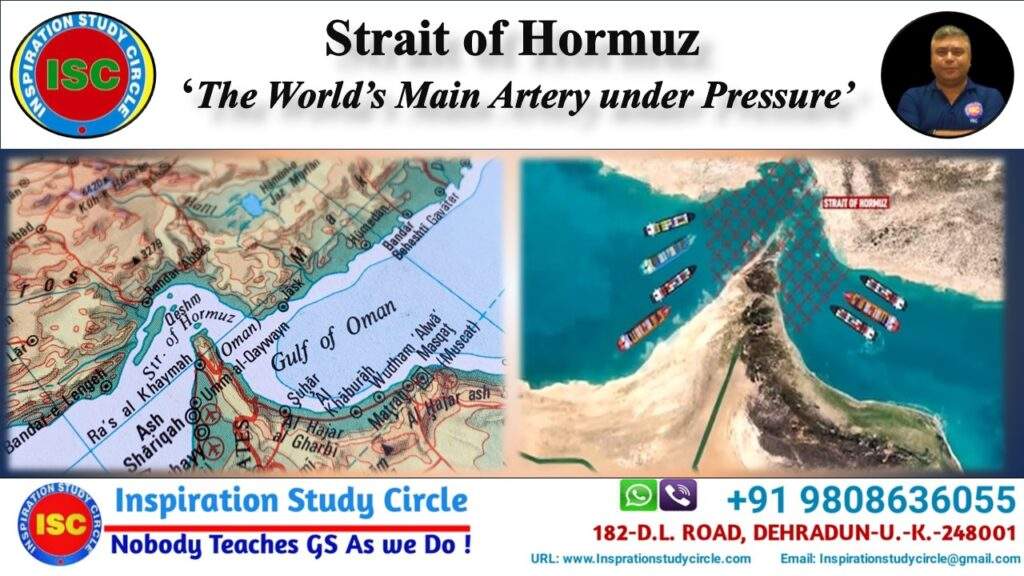
The Strait of Hormuz is currently the centre of a major international crisis. As of April, 2026, it is under a U.S. naval blockade aimed at Iranian ports, while Iranian forces continue to restrict broader commercial traffic following months of conflict.
Current Conflict & Security (April 2026)
The waterway is presently a high-risk combat zone due to the ongoing 2026 Iran War:
- U.S. Blockade: Following the failure of peace talks on April 12, President Trump declared a blockade on all ships entering or leaving Iranian ports.
- Mine Clearance: U.S. Navy destroyers like the USS Frank E Petersen are conducting operations to clear sea mines reportedly laid by Iran’s Revolutionary Guard (IRGC).
- Restricted Traffic: While Iran has officially agreed to a ceasefire, it continues to demand tolls exceeding $1 million per ship and has restricted passage for vessels linked to the U.S. and its allies.
- Naval Presence: Indian and Pakistani warships are operating in proximity (within 18 nautical miles) to escort their respective commercial tankers.
Geographic & Strategic Profile
- Located between Iranand Oman, the strait is the only sea passage from the Persian Gulf to the open ocean.
- Dimensions: Approximately 167 km long and 39 km wide at its narrowest point.
- Chokepoint: Roughly 20–25% of the world’s seaborne oiland 20% of its liquefied natural gas (LNG) pass through this corridor daily.
- Shipping Lanes: Uses a Traffic Separation Schemeconsisting of two-mile-wide inbound and outbound lanes separated by a two-mile buffer.
Economic Impact
- The ongoing disruptions have caused significant global economic strain:
- Oil Prices: Brent crude surpassed $120 per barrelin March 2026 due to the conflict.
- Supply Shortages: India’s LPG imports have dropped by half, and Europe is warned of having only weeks of jet fuel reserves left.
- Alternative Routes: Pipelines through Saudi Arabia and the UAE can only bypass about 5 to 5.5 million barrels per day, far below the strait’s 20 million capacity.
The Impact on the Indian Economy
The impact on the Indian economy is multi-layered, as the Strait of Hormuz is India’s most critical energy lifeline. While India has diversified its crude sourcing, its dependence on the strait for cooking gas (LPG) and industrial gas (LNG) remains a “strategic liability”.
Energy & Inflation: The "Double Whammy"
The combined effect of a weaker Rupee and high oil prices is driving an “inflationary spiral” across sectors.
- LPG/Cooking Gas Crisis: Roughly 90% of India’s LPG imports transit the Strait of Hormuz. Since the blockade began in March 2026, domestic 14.2 kg cylinder prices in Delhi jumped by ₹60 to ₹913, with black market prices reportedly far higher.
- Crude Oil Diversification: India now sources 70% of its crude outside the Strait (up from 55%) by increasing purchases from Russia, the U.S., and Africa. However, Brent crude above $100–$120/barrel still adds billions to the import bill.
- Natural Gas Shortages: Nearly 60% of LNG imports, mainly from Qatar, are affected. This has forced 30–40% supply cuts to industrial and fertiliser plants.
Macroeconomic Impact
The crisis is forcing major financial institutions to rewrite India’s growth narrative.
- GDP Downgrades: Goldman Sachs slashed its FY 2026-27 growth projection from 7% to 5.9%. Moody’s and Barclays also warned of growth slowing by up to 1.0 percentage points in severe stress scenarios.
- Currency Pressure: The Indian Rupee breached the 92/USD markin March 2026. Analysts at MUFG suggest it could slide toward 95–97 if the crisis is prolonged.
- Trade & Deficit: Every $10/barrel increase in oil prices adds roughly $13–$14 billionto India’s annual import bill. The Current Account Deficit (CAD) is projected to widen to 2% of GDP.
Sectoral Vulnerabilities
- Agriculture: Reduced gas supply to fertiliser plants threatens the 2026 harvest, while rice and tea exports to the Gulf are stalled due to insurance risks and payment channel suspensions.
- Remittances: The Middle East accounts for 38% of India’s total remittances ($135.4B in FY25). Conflict-driven economic slowing in Gulf states or a migrant exodus would severely impact these inflows.
- Manufacturing & Aviation: High fuel costs are crushing margins in aviation (ATF accounts for 30–40% of costs) and energy-intensive industries like paints, chemicals, and ceramics.
Impact on the Indian Geography and Connectivity
The Strait of Hormuz crisis impacts India’s “functional geography”—the way it uses its maritime space and resources—more than its physical landmass. As of April 2026, the crisis has effectively “shifted” India’s maritime activity further south and east to avoid the high-risk northern Arabian Sea.
1. Maritime Redirection and Ports
The blockade has forced a major tactical shift in how India’s western coastline operates:
- Western Port Congestion: Major ports like Mumbai and Kandla are experiencing “geometric delay” as shipments arrive in unpredictable clusters due to rerouting.
- Avoidance Zones: Large tankers are being rerouted away from the northern Arabian Sea toward safer southern routes, often bypassing the traditional direct paths to Gulf ports.
- Inland Logistics Stalls: These maritime disruptions ripple inland, causing congestion in warehouses and delaying transport networks that link coastal hubs to the rest of India.
2. Environmental and Coastal Risks
The heavy concentration of stalled tankers (over 150 ships reported waiting) creates a “ticking time bomb” for the Indian Ocean’s ecology:
- Oil Spill Threats: A single attack on a tanker could release millions of litres of oil. Strong regional currents can carry these pollutants toward neighbouring waters, potentially threatening India’s western coastal ecosystems.
- Coastal Livelihoods: Any significant spill would devastate India’s western fisheries, coral reefs, and mangroves, which are vital for coastal protection and the livelihoods of millions of fishermen.
- Soot and Air Quality: Large-scale fires from targeted oil infrastructure release black carbon (soot) that can travel hundreds of kilometres, potentially affecting air quality over the Indian subcontinent.
3. Strategic Connectivity Projects
The crisis has physically stalled India’s major trans-regional geographic links:
- Chabahar Port: India’s strategic gateway to Central Asia is currently under “strategic uncertainty.” Militarization of the nearby strait deters investors and shipping lines from using this hub.
- IMEC Corridor: The envisioned India-Middle East-Europe Economic Corridor—designed to link Indian ports to Europe via the Gulf—is effectively frozen as the maritime leg through the Arabian Sea has become a combat zone.
4. Resource Geography
The crisis is forcing a re-evaluation of India’s internal energy geography:
- Strategic Reserves: India is relying on its Strategic Petroleum Reserves (SPR) located at Visakhapatnam, Mangaluru, and Padur to buffer the immediate supply shock.
- Shift in Sourcing: Geographically, India is looking “away” from the West, increasing imports from the U.S., West Africa, and Russia via alternative sea lanes that entirely bypass the Hormuz chokepoint.
Indian Navy’s Operation Sankalp
Operation Sankalp (meaning “Commitment”) is a continuous maritime security mission by the Indian Navy launched on June 19, 2019. Its primary goal is to safeguard Indian-flagged merchant vessels and ensure the uninterrupted flow of trade and energy supplies through critical chokepoints like the Strait of Hormuz, Gulf of Oman, and Persian Gulf.
Key Objectives & Scope
- Trade Security: Protecting India’s massive energy imports; nearly 62% of India’s oil comes from the Gulf region.
- Anti-Piracy: Responding to the resurgence of piracy off the coast of Somalia and in the Gulf of Aden.
- Anti-Terrorism & Counter-Drone: Addressing unconventional threats such as missile and drone attacks from non-state actors like Houthi rebels.
- Maritime Safety: Serving as the “First Responder” for any distress calls in the Indian Ocean Region (IOR), regardless of the crew’s nationality.
Major Achievements (as of April 2026)
The operation has significantly expanded its scope since late 2023 due to heightened regional tensions:
- Lives Saved: Rescued over 110 lives, including 45 Indian seafarers.
- High-Profile Rescues:
- MV Ruen (March 2024): A major 40-hour operation involving the destroyer INS Kolkata, MARCOS (Marine Commandos), and an IAF C-17, resulting in the surrender of 35 pirates and the rescue of 17 crew members.
- MV Al Kambar (March 2024): Rescued an Iranian fishing vessel and its 23 Pakistani crew members from armed pirates.
- Cargo & Escorts: Safely escorted over 1.5 million tons of critical commodities and provided a sense of security to more than 450 merchant vessels.
- Narcotics Seizure:Intercepted and seized more than 3,000 kg of narcotics.
Strategic Importance
The Indian Navy executes this mission independently, maintaining strategic autonomy rather than joining large multinational military coalitions. It involves close coordination between the Ministry of Defence, the Ministry of External Affairs, and shipping authorities. The use of advanced stealth frigates like INS Talwar and destroyers like INS Visakhapatnam highlights India’s status as a “Preferred Security Partner” and a growing blue-water navy.
Operation Sankalp, the ‘Strait’ in Crisis, and the Current Situation
As of April 2026, Operation Sankalp has been intensified and supplemented by Operation Urja Suraksha (“Energy Protection”) to manage a severe crisis in the Strait of Hormuz. The crisis, triggered by regional warfare in February 2026, has led to a significant blockade of the waterway, though India has secured a unique “friendly nation” status to maintain its energy lifelines.
Current Status of the Hormuz Crisis (April 2026)
- Selective Blockade: Since February 28, 2026, the Strait has been effectively closed to most traffic following major airstrikes on Iran. However, India is one of only five nations (including China and Russia) granted conditional passage by Iran.
- Stranded Vessels: As of late March, roughly 22 Indian-flagged ships and over 600 seafarers were stranded within the Persian Gulf.
- Operational Transition: While Operation Sankalp continues its broad security mission, the Indian Navy launched Operation Urja Suraksha on March 23, 2026, specifically to provide close-protection escorts for LPG and crude oil tankers through the volatile Strait.
Indian Navy’s Active Measures
The Navy has shifted from “passive monitoring” to a “high-tempo” escort posture to ensure national energy security:
- Naval Shield & Escorts: At least five frontline warships (destroyers and frigates) are permanently deployed near the Gulf of Oman to take over escort duties the moment tankers exit the Strait.
- “Safe Corridor” Guidance: Navy officials provide precise, route-specific instructions to merchant vessels, often guiding them through Iran-controlled channels (such as the Qeshm–Larak route) to avoid potential underwater mines and missile threats.
- Identification Protocols: Under Navy direction, India-bound tankers now clearly display “INDIAN” on their hulls using the Automatic Identification System (AIS) to signal their “friendly” status and prevent accidental targeting.
- Recent Successes: The LPG tankers Jag Vikram (April 11, 2026), Shivalik, and Nanda Devi have completed transits under naval watch, easing domestic fuel shortages.
Strategic & Diplomatic Context
India’s ability to maintain shipping during the 2026 crisis is attributed to back-channel diplomacy led by the National Security Advisor and the External Affairs Ministry. By refusing to join U.S.-led naval coalitions in favour of an independent posture, India has maintained the strategic autonomy necessary to secure its energy interests without escalating regional tensions.
FOR MORE BLOGS :
Disclaimer: The above information and views are taken from various news and information platforms such as Wikipedia, The Hindu, and the Indian Explorer.
Recent Post

ISC Explained: Nobel Prize 2026

Foundation Course for UPSC 2027- 28
ISC Explained: The Coordinated G7 Emergency Oil Release

UKPSC and UPPSC- PCS 2026 Prelims Test Series

ISC Explained: