Classroom Program for UPSC 2027- 28
Inspiration Study Circle Classroom Program for UPSC 2027- 28 Table of Contents Classroom Program for UPSC 2027- 28 Greetings, Civil

अगर आप UPSC की तैयारी शुरू कर रहे हैं, तो सबसे पहले syllabus देखकर घबराना बिल्कुल normal है। I’ve seen hundreds of students walk into my office with a look of pure confusion, holding a massive stack of books and asking, “Sir, shuruat kahan se karein?” (Sir, where do we begin?).
Let’s be honest: The UPSC IAS full syllabus looks like an endless ocean at first glance. Whether you are from a Hindi medium background or an English medium one, that first “Syllabus Shock” is real. But here’s a secret I tell every student at Inspiration Study Circle Dehradun: The syllabus isn’t your enemy; it’s your map. Without it, you are just a traveler lost in a forest.
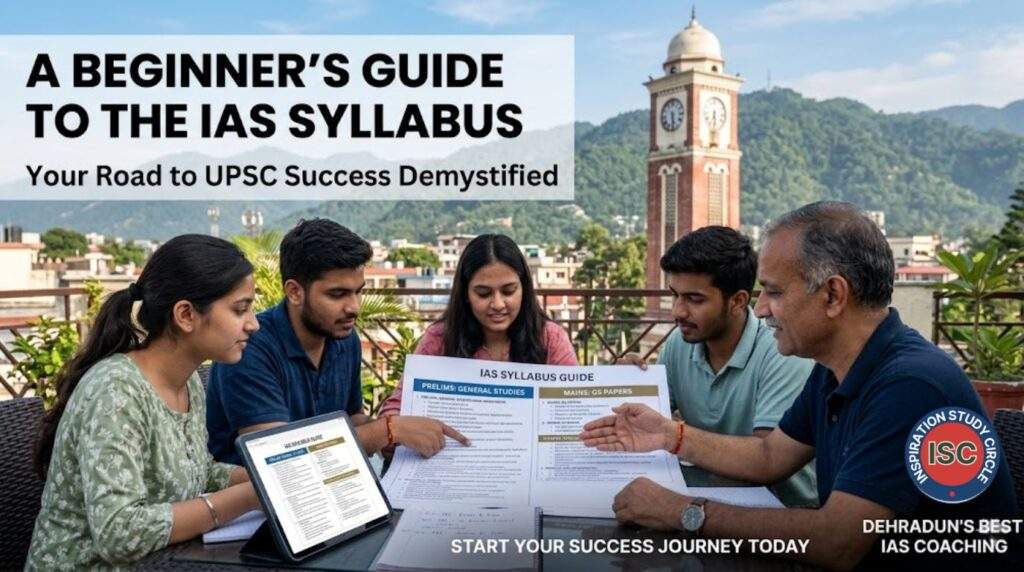
In this IAS syllabus for first timers guide, I am going to break down this “beast” into simple, bite-sized pieces. No heavy jargon, no scary words—just a heart-to-heart mentor talk to help you understand the IAS exam pattern and syllabus for 2026.
Before we dive into the topics, you need to understand the “Levels” of the game. Think of UPSC like a three-story building. You can’t reach the top without climbing each floor.
| Stage | Name | No. of Papers | Total Marks | Nature |
| Stage 1 | Prelims | 2 | 400 | Qualifying / Screening |
| Stage 2 | Mains | 9 | 1750 | Merit-based (Ranking) |
| Stage 3 | Interview | Personality Test | 275 | Merit-based (Ranking) |
Note: Your final rank is decided by your Mains + Interview scores. Prelims is just the entry ticket.
The IAS prelims syllabus Hindi and English versions are identical in terms of content. This stage consists of two objective-type papers held on the same day.
This is the paper that decides if you make it to the Mains. The UPSC prelims GS paper syllabus covers:
The CSAT syllabus for IAS is often the biggest fear for students who hate math. But don’t worry—it’s only qualifying. You just need to score 33% (66 marks out of 200).
Once you clear the Prelims, you enter the “Maha-Kumbh” of exams. The IAS mains syllabus English and Hindi versions are vast because this stage tests your thinking capacity, not just your memory.
| Paper | Subject | Marks | Focus Area |
| Paper A | Compulsory Indian Language | 300 | Qualifying (Hindi, Tamil, etc.) |
| Paper B | English Language | 300 | Qualifying (Basic English) |
| Paper 1 | Essay | 250 | Creative & Analytical Writing |
| Paper 2 | GS I | 250 | History, Geography, Society |
| Paper 3 | GS II | 250 | Constitution, Governance, IR |
| Paper 4 | GS III | 250 | Economy, Science, Environment |
| Paper 5 | GS IV | 250 | Ethics, Integrity & Aptitude |
| Paper 6 | Optional I | 250 | Subject of your choice |
| Paper 7 | Optional II | 250 | Same subject as Paper 6 |
One question I hear every day is: “Sir, kya Hindi medium wale IAS ban sakte hain?” (Can Hindi medium students become IAS?).
The answer is a resounding YES. The IAS syllabus Hindi medium is exactly the same as the English one. UPSC is looking for officers, not linguists. Whether you read Hindi mein IAS syllabus or the IAS syllabus English version, the key is how you express your thoughts.
The Hybrid Approach: Most of our successful students use an IAS syllabus Hindi English mixed approach—understanding concepts in their mother tongue and writing in the language they are most comfortable with.
Choosing an optional is like choosing a life partner—you have to live with it for a long time! The Optional subjects guide beginners usually suggests picking something you are genuinely interested in.
Check the IAS optional list Hindi or English to see the 25+ subjects available, from Literature to Public Administration.
Aman came to us as a complete beginner. He spent the first three months just buying books he saw on YouTube. He was overwhelmed and ready to quit.
We sat him down and gave him an Easy IAS syllabus explained session. We told him: “Stop reading books, start reading the syllabus.” He printed the IAS prelims topics 2026 and pasted them on his wall. Every time he read a news article, he matched it to a syllabus topic. Within 6 months, his mock scores jumped from 40 to 95. He cleared his Prelims because he knew what not to read.
Priya had only 4 hours a day to study. She couldn’t afford to waste time. She used a Start IAS prep syllabus guide to identify “High Yield Topics.” Instead of reading all of History, she focused on Modern India and Art & Culture, as per the Prelims syllabus breakdown. By sticking strictly to the syllabus, she managed to cover in 4 hours what others were struggling to cover in 10.
The “CSAT is Easy” Myth: Every year, brilliant students fail because they didn’t look at the CSAT syllabus for IAS until the last week.
If I were starting today, here is my IAS syllabus step by step plan for you:
Step 4: The Integration Phase. Connect current affairs to your static syllabus. If there’s a strike by farmers, look up “Issues related to direct and indirect farm subsidies” in GS Paper 3.
While institutes like ABC Civil Academy or North India IAS Institute might provide you with notes, the “Inspiration” factor is what keeps you going. At Inspiration Study Circle Dehradun, we believe that beginners shouldn’t be thrown into a sea of facts.
We take pride in being a “Syllabus-First” institute. We don’t just teach you; we train you to decode the exam. Before we discuss the “Industrial Revolution,” we make sure you understand why it’s in the UPSC mains GS papers. This mentor-led approach is why many consider us the best IAS coaching in Dehradun.
UPSC journey starts not with books, but with understanding the syllabus. It’s okay to feel small in front of this giant exam. Every IAS officer you see today once stood exactly where you are—confused, nervous, and holding a syllabus copy.
The mountains of Dehradun are silent witnesses to thousands of success stories. Let yours be the next one. Don’t just study hard; study smart by making the syllabus your best friend.
Remember, at Inspiration Study Circle Dehradun, we don’t just help you clear an exam; we help you find the officer within. If you’re feeling stuck or just want a friendly chat about how to start, my doors are always open. Let’s decode your dream together.
It’s a combination of General Studies (History, Polity, etc.) and Aptitude (Math/Reasoning) for Prelims, followed by deep descriptive papers for Mains.
Absolutely. Many toppers every year come from Hindi medium backgrounds. The key is quality content and clear expression.
The core syllabus remains the same, but the “Topics in News” (Current Affairs) change. Always check the latest IAS prelims topics 2026 for updates.
Yes, you only need 33% to pass. However, if you don’t pass CSAT, your GS Paper 1 won’t even be checked!
You can find it on the official UPSC website or visit the Inspiration Study Circle Dehradun website for a simplified, student-friendly version.
Subjects like History, Geography, and Sociology are often recommended for beginners as they have a lot of overlap with the General Studies papers.

Inspiration Study Circle Classroom Program for UPSC 2027- 28 Table of Contents Classroom Program for UPSC 2027- 28 Greetings, Civil

A Beginner’s Guide to the IAS Syllabus in Hindi/English Table of Contents A Beginner’s Guide to the IAS Syllabus in

How to Choose the Best IAS Academy in Dehradun? Table of Contents Best IAS Academy in Dehradun The Crossroads of

Why Dehradun is the New Hub for IAS Preparation? Table of Contents Let’s be honest—the dream of seeing your name

Civil Services After 12th: UPSC Foundation Course 2028-2029 Table of Contents Civil Services After 12th UPSC Foundation Course Inspiration Study

Foreign Contribution (Regulation) Amendment Bill 2026 Table of Contents Foreign Contribution (Regulation) Amendment Bill 2026 The Foreign Contribution (Regulation) Amendment Bill,