
Why Dehradun is the New Hub for IAS Preparation?
Why Dehradun is the New Hub for IAS Preparation? Table of Contents Let’s be honest—the dream of seeing your name

Inspiration Study Circle
Best IAS/PCS/UPSC Coaching in Dehradun
Inspiration Study Circle
Best UPSC/IAS/PSC/UKPCS Coaching in Dehradun
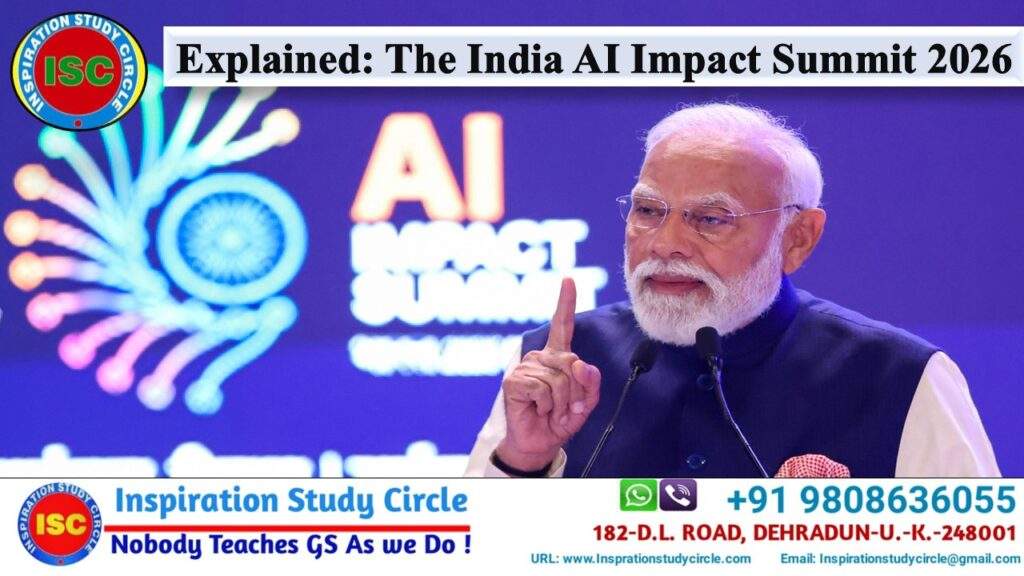
The India AI Impact Summit 2026 is a major international gathering currently taking place in New Delhi at Bharat Mandapam. Running from February 16 to 21, 2026, it is the first global AI summit hosted in the Global South, following previous safety-focused summits in the UK, South Korea, and France.
Artificial Intelligence (AI) stands at the threshold of fundamentally reshaping human civilisation, pushing the boundaries of what we can achieve. This technological revolution opens unprecedented opportunities for advancements across every domain of human endeavour, while profoundly challenging the very foundations of society in an increasingly complex and evolving geopolitical order. For developing countries, AI offers an unprecedented opportunity to leapfrog traditional developmental pathways. The multi-modal and multi-lingual capabilities of AI create new possibilities through which access to benefits can be made available at scale. As a result, AI is seen not merely as a technological advancement but as a strategic tool to enable inclusive growth and expand access to opportunities that have historically been out of reach for large segments of the population.
Despite the high-level commitments, a fundamental gap persists between global aspirations and the reality on the ground. The Global AI Divide continues to widen, with AI resources and capabilities concentrated among select nations and corporations. This concentration fundamentally limits the development of social, cultural, and linguistically contextual AI solutions, constraining AI’s potential to accelerate progress toward our collective development goals, especially for the Global South.
Simultaneously, AI’s rapid proliferation across society is creating new challenges that demand urgent attention: disrupting traditional employment patterns, exacerbating existing biases, and driving exponential increases in energy consumption. These developments underscore the urgent need to move beyond aspirational frameworks toward concrete, measurable impact that addresses both AI’s promise and its perils.
The summit was inaugurated by Prime Minister Narendra Modi on 19 February 2026. The opening ceremony was also addressed by French President Emmanuel Macron and United Nations Secretary-General António Guterres.
The summit drew delegations from over 100 countries, including more than 20 heads of state, 60 ministers, and nearly 300,000 participants. It featured more than 300 curated exhibition pavilions and live demonstrations, showcasing products of over 600 startups and companies, and dedicated pavilions for 13 countries, including India’s own. Notable attendees from the technology industry included Google CEO Sundar Pichai, OpenAI CEO Sam Altman, Anthropic CEO Dario Amodei, Accenture CEO Julie Sweet, DeepMind Technologies CEO Demis Hassabis, HCL Technologies Chairperson Roshni Nadar Malhotra, and Reliance Industries Chairman Mukesh Ambani. Representatives from multilateral institutions included Sangbu Kim of the World Bank. Alongside the summit, PM Modi hosted bilateral meetings with Secretary-General António Guterres and the heads of 15 countries.
The summit is built around the theme of Sarvajana Hitaya, Sarvajana Sukhaya (Welfare for All, Happiness for All) and is anchored by three “Sutras” (guiding principles):
This theme addresses the ethical and social dimensions of AI, ensuring it enhances rather than replaces human dignity.
This theme focuses on using AI as a tool for environmental survival and addressing the massive energy consumption of data centres.
The goal here is to ensure AI drives economic growth across all sectors, not just the tech industry.
The India AI Impact Summit 2026 (February 16–21) concluded with major sovereign technology launches and historic investment pledges aimed at making AI a “global common good”.
Global and domestic tech giants announced massive capital infusions to build India’s AI infrastructure:
India asserted itself as an AI creator with key, localised technology debuts:
A new ethical framework, the M.A.N.A.V. Vision (focused on moral, accountable, national, accessible, and valid systems), was introduced.
| Chakra | Focus Areas |
| Human Capital | Advancing equitable skilling and inclusive workforce transitions for an AI-enabled future of work. |
| Inclusion for Social Empowerment | Advancing AI systems that are inclusive by design, empowering diverse communities and ensuring equitable representation. |
| Safe and Trusted AI | Building globally trusted AI systems anchored in transparency, accountability, and shared safeguards for innovation. |
| Science | Harnessing AI to accelerate frontier science, foster scientific collaboration, and translate breakthroughs into shared global progress. |
| Resilience, Innovation, and Efficiency | Driving sustainable, resource-efficient AI systems that strengthen climate resilience and sustainability. |
| Democratizing AI Resources | Promoting equitable access to foundational AI resources for inclusive innovation and sustainable development worldwide. |
| AI for Economic Development & Social Good | Leveraging AI to enhance productivity, innovation, and inclusive development across economies and societies. |
The India AI Impact Summit 2026 is a pivotal moment for India, marking its transition from a technology consumer to a global norm-setter and infrastructure leader. It represents a “Jio Moment” for artificial intelligence, aiming to make computing as accessible and affordable as mobile data.
The India–AI Impact Summit 2026 reinforces India’s position as a pivotal platform for shaping the global AI agenda. Anchored in the Seven Chakras and the Three Sutras of People, Planet, and Progress, the Summit advances a development-oriented framework for artificial intelligence.
By linking policy with implementation and innovation with public purpose, the Summit establishes a structured approach to responsible AI deployment. It aligns technological advancement with inclusive growth and sustainable development.
The Summit positions India as a convenor and partner in global AI cooperation, supporting shared standards, collaborative frameworks, and scalable solutions for the public good. It marks a transition from dialogue to delivery, reinforcing India’s commitment to responsible, inclusive, and development-focused AI pathways.
Disclaimer: The above information and views are taken from various news platforms such as The Press Information Bureau and the official page of the India AI Impact Summit.
For more blogs:
Why Dehradun is the New Hub for IAS Preparation? Table of Contents Let’s be honest—the dream of seeing your name
Civil Services After 12th: UPSC Foundation Course 2028-2029 Table of Contents Civil Services After 12th UPSC Foundation Course Inspiration Study

Foreign Contribution (Regulation) Amendment Bill 2026 Table of Contents Foreign Contribution (Regulation) Amendment Bill 2026 The Foreign Contribution (Regulation) Amendment Bill,

India in the Iran War 2026 Table of Contents India in the Iran War 2026 India has remained neutral in the 2026

The Constitutional Boundary of SC Status: The Latest Supreme Court Judgement Table of Contents In a significant judgement delivered on

Detailed Geography and Maps for UPSC 2026 Table of Contents Detailed Geography and Maps for UPSC 2026 Mastering map-based questions