Inspiration Study Circle

Inspiration Study Circle

Best IAS/PCS/UPSC Coaching in Dehradun

India’s 100th Ramsar Site - Surha Tal

Table of Contents

India’s 100th Ramsar Site- Surha Tal

India’s Historic 100th Protected Wetland: Surha Tal

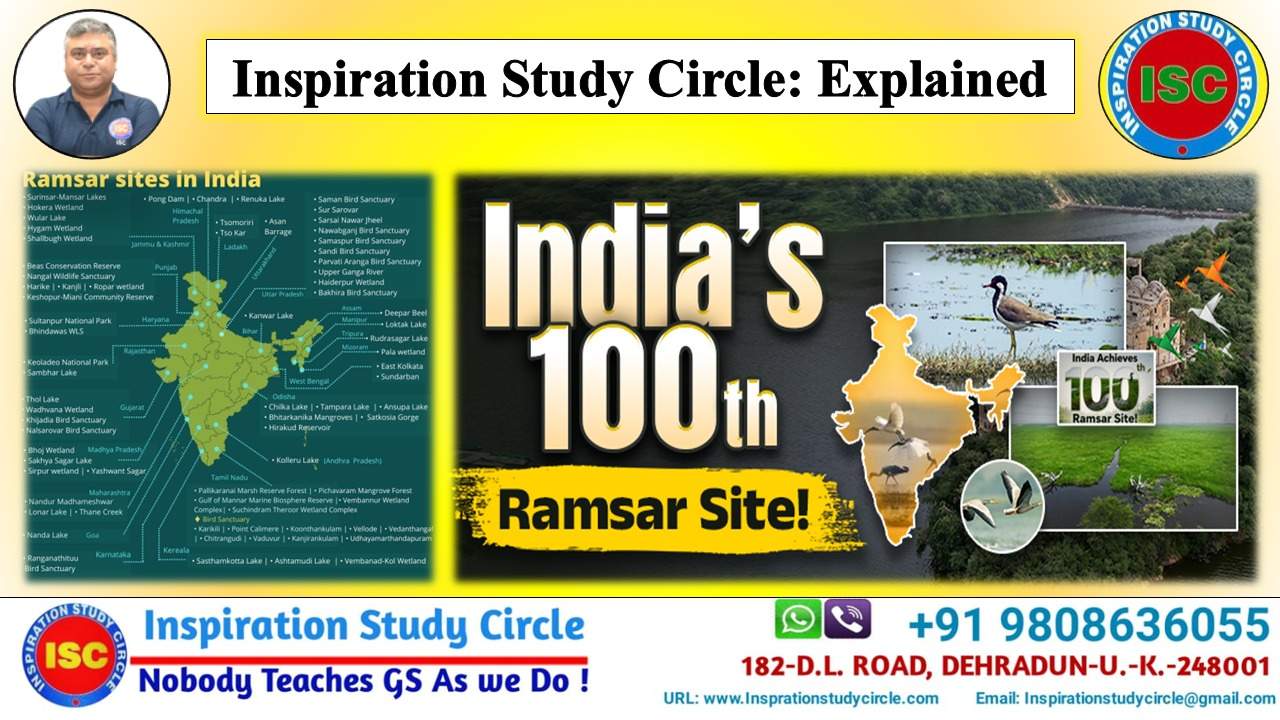
On World Environment Day (5 June 2026), India reached a major conservation milestone by registering its 100th Ramsar site: the Jai Prakash Narayan Bird Sanctuary, locally referred to as Surha Tal. This addition cements India’s position as the nation with the highest number of internationally recognised wetlands in Asia, ranking third on the global leaderboard.

Geographical Profile and Origin

  • Location: The sanctuary is situated within the Ballia district of eastern Uttar Pradesh, positioned in the fertile middle plains of the Ganga River basin.
  • Natural Formation: Surha Tal is a massive, permanent freshwater oxbow lake. It was created centuries ago when a looping bend of the Ganges River naturally separated from the main river channel.
  • Size Variations: The core protected zone spans roughly 3,432 hectares. During the summer and winter, it stays confined to this area, but heavy monsoon rains cause it to expand across nearly 25,000 hectares of neighbouring marshes and low-lying floodplains.

Ecological Importance and Wildlife

  • Avian Migration: Positioned right on the Central Asian Flyway (CAF), the lake serves as a vital winter haven and a rest stop for thousands of migratory birds travelling from remote regions in Siberia and Central Asia.
  • Key Bird Species: The waters provide sanctuary for several threatened birds, including the sarus crane, bar-headed goose, Indian river tern, and common pochard.
  • Aquatic Diversity: The habitat supports a thriving underwater ecosystem featuring 221 distinct plant species and 66 types of fish, which include vulnerable native species like Bagarius bagarius and Wallago attu.
  • Predators: This abundant fish population makes the lake an ideal hunting and breeding ground for the rare fishing cat.

Historical Roots

The wetland encompasses land originally belonging to 45 local villages. The Uttar Pradesh state government first established it as a protected wildlife bird sanctuary in 1991. Later, in 2002, the site was formally renamed to honour the prominent Indian freedom fighter and political figure, Jai Prakash Narayan.

The Ecosystem of Jai Prakash Narayan Bird Sanctuary

The ecosystem of the Jai Prakash Narayan Bird Sanctuary (Surha Tal) thrives with dynamic biodiversity, categorised across distinct ecological layers.

Avian Life (Waterbirds and Migrants):

The sanctuary serves as an essential international transit point and nesting territory on the Central Asian Flyway (CAF).

  • Global Travellers: Thousands of long-distance flyers journey yearly from Central Asia and freezing Siberian zones to spend the winter months here.
  • High-Profile Visitors: The oxbow lake hosts the bar-headed goose, renowned for flying over the Himalayas, alongside the majestic sarus crane.
  • At-Risk Waterfowl: It acts as a critical haven for threatened species like the vulnerable Indian river tern (Sterna aurantia) and the common pochard (Aythya ferina).

Underwater Inhabitants (Fish Species):

The permanent freshwater body nurtures a dense aquatic population with 66 documented fish species.

  • Indigenous and Threatened Varieties: The lake plays a vital role in preserving fragile native freshwater fish, notably housing the vulnerable Bagarius bagarius (goonch) and Wallago attu (shark catfish).
  • Ecosystem Foundation: This large biomass of fish underpins the entire local food web, sustaining both avian and mammalian predators.

Mammals, Reptiles, and Amphibians:

While primarily celebrated for its birds, the marshy terrain supports diverse land and semi-aquatic wildlife.

  • The Apex Wetland Predator: Due to the massive abundance of fish, the sanctuary provides ideal breeding and hunting territories for the vulnerable fishing cat (Prionailurus viverrinus).
  • Creeping and Amphibious Fauna: Researchers have documented seven unique reptile species and three distinct amphibian species navigating the marshy edges and seasonal floodplains.

Wetland Flora (Plant Life):

The botanical backdrop consists of a massive variety of green cover, tracking over 221 plant species.

  • Vegetation Zones: The plant life ranges from submerged or floating weeds inside the main lake to dense reeds, extensive marshes, and grasses thriving across the seasonally submerged floodplains.
  • Ecological Purpose: This rich flora offers crucial cover, nesting materials, and foraging options for the bird and fish populations.

When and why was it named Jai Prakash Narayan Bird Sanctuary?

The sanctuary was officially renamed the Jai Prakash Narayan Bird Sanctuary by the Uttar Pradesh government in 2002 to pay tribute to the legendary Indian freedom fighter, socialist leader, and political reformer, Jai Prakash Narayan (popularly known as “JP” or Lok Nayak).

The decision to name this specific wetland after him stems from deep geographical and historical connections:

1. Birthplace and Deep Regional Roots

Jai Prakash Narayan was born in Sitabdiara, a large village located right on the border of Bihar and the Ballia district of Uttar Pradesh. Because the bird sanctuary (Surha Tal) is situated entirely within the Ballia district, renaming the area was a way for the state to honour its most iconic local son and freedom fighter.

2. Commemorating His Birth Centenary

The official renaming via the state government gazette took place in December 2002. This timing directly coincided with the global birth centenary celebrations of Jai Prakash Narayan, who was born on 11 October 1902.

3. A Legacy of Grassroots Empowerment

Known as the architect of the “Total Revolution” movement, JP dedicated his life to empowering rural communities, farmers, and marginalised populations. Because the Surha Tal wetland serves as a socio-economic lifeline for 45 surrounding villages—providing daily livelihood through sustainable fishing, agriculture, and water usage—naming the protected site after a champion of grassroots peoples’ rights carried immense symbolic value.

Importance of Ramsar Sites in India

Ramsar sites—wetlands designated as having international importance—play an indispensable role in India’s ecological stability, economic security, and climate resilience.

1. Climate Resilience and Carbon Storage

  • Carbon Sinks: India’s Ramsar wetlands act as highly efficient carbon traps. They bury organic matter underwater, preventing greenhouse gases from escaping into the atmosphere.
  • Temperature Buffers: By retaining massive volumes of water, these ecosystems cool the local microclimate. This regulates temperature spikes in surrounding agricultural zones.

2. Natural Disaster Mitigation

  • Flood Controls: Acting like giant natural sponges, wetlands absorb heavy monsoon torrents. They dramatically reduce flash flooding in downstream urban and rural settlements.
  • Coastal Shields: Mangrove-rich Ramsar sites, such as Sundarbans or Bhitarkanika, serve as physical barriers. They absorb the devastating energy of cyclones, tidal waves, and sea surges.

3. Safeguarding Water and Soil

  • Aquifer Recharge: These water bodies act as primary feeding mechanisms for groundwater systems. They slowly filter surface water back down into deep underground aquifers.
  • Natural Purification: Wetland vegetation filters out dangerous agricultural runoff, heavy metals, and pollutants. This naturally purifies water before it reaches human communities.
  • Erosion Prevention: The complex root structures of wetland plants anchor the shoreline soil. This prevents valuable topsoil from washing away into river systems.

4. Biodiversity and Wildlife Conservation

  • Migratory Refuges: India sits directly under the Central Asian Flyway. Ramsar sites serve as critical international rest stops, feeding zones, and winter homes for millions of trans-continental birds.
  • Genetic Reservoirs: These habitats protect unique evolutionary life, sheltering vulnerable endemic species. Examples include the rare fishing cat, the Ganges river dolphin, and the endangered Eld’s deer.

5. Socio-Economic Lifelines

  • Livelihood Anchors: Millions of rural Indians rely directly on these wetlands for survival. They provide sustainable grounds for inland fishing, lotus harvesting, and livestock grazing.
  • Ecotourism Catalysts: Recognition as a Ramsar site boosts international and domestic tourism. This creates green jobs for local guides, hospitality businesses, and boat operators.

About World Environment Day

World Environment Day, celebrated annually on June 5th, is the primary United Nations outreach day for promoting global awareness and action for the environment. It serves as a vital reminder that collective, everyday actions are essential for preserving our planet and combating urgent ecological crises.

Established by the United Nations General Assembly in 1972 during the Stockholm Conference on the Human Environment, the first event was held in 1973. Over the decades, it has grown into a massive global platform. Millions of people, along with businesses, governments, and non-governmental organisations across more than 150 countries, participate in this event. The core purpose is to inspire individuals to become active champions of sustainable development and to realise that our local actions can drive profound global change.

How are Ramsar Sites declared in India?

In India, Ramsar sites are officially declared and designated by the Secretariat of the Ramsar Convention on Wetlands based in Switzerland. However, the process is entirely driven and managed by the Ministry of Environment, Forest and Climate Change (MoEFCC), which serves as the nodal agency for India.

The declaration involves a multi-stage collaborative process between regional and international bodies:

  • State Governments / UT Administrations: Local authorities identify a wetland and evaluate it against the 9 strict global criteria set by the Ramsar Convention. They compile a detailed proposal package including maps and environmental data.
  • The MoEFCC: The State government forwards the proposal to the Indian Ministry of Environment, Forest and Climate Change. The Ministry reviews the data, coordinates with the Ministry of External Affairs (MEA) for clearance, and officially submits the nomination to the international platform.
  • The Ramsar Secretariat: The international body evaluates the proposal. If it qualifies, the Secretariat enters it into the Ramsar List of Wetlands of International Importance, granting it the prestigious designation.
Recent Post​
Blank Form (#5)

Scroll to Top