
Explained: RBI Monetary Policy
Table of Contents
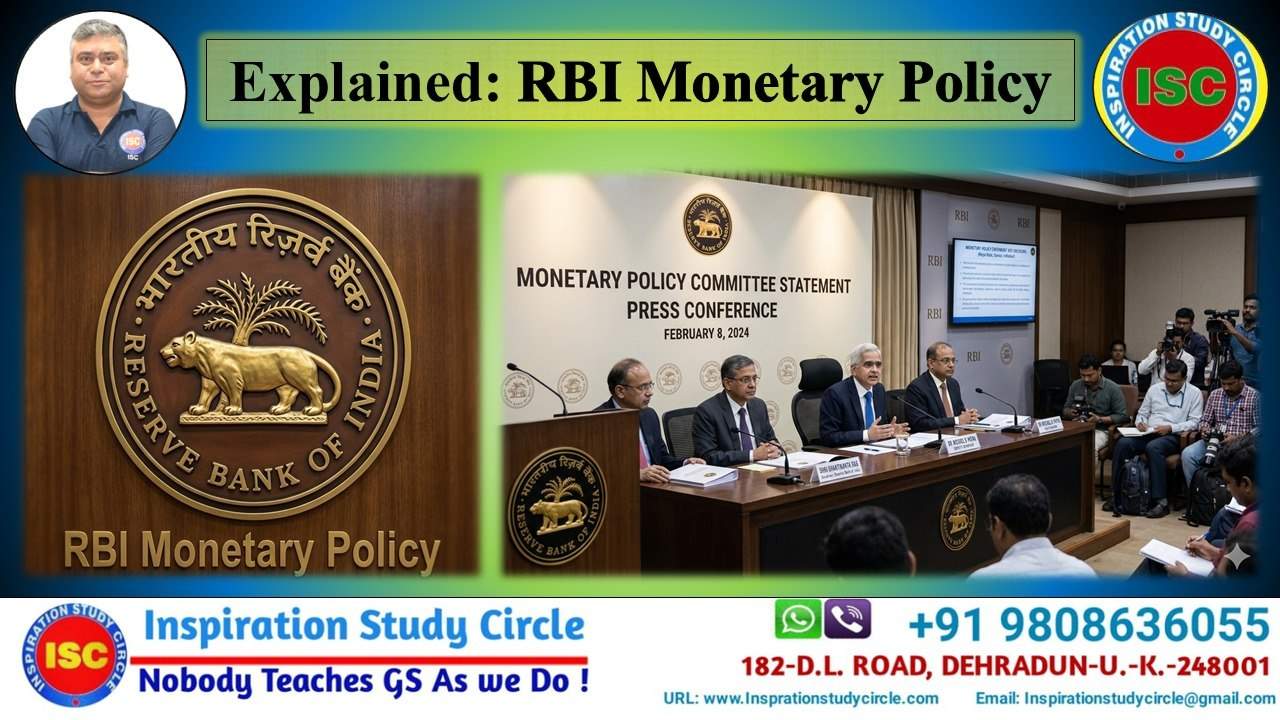
Monetary policy is the process by which the monetary authority of a country, generally the central bank, controls the supply of money in the economy. In India, the central monetary authority is the Reserve Bank of India (RBI).
Monetary policy committee
The Reserve Bank of India Act, 1934 (RBI Act) was amended by the Finance Act, 2016, to provide a statutory and institutionalised framework for a Monetary Policy Committee, for maintaining price stability, while keeping in mind the objective of growth. The Monetary Policy Committee is entrusted with the task of fixing the benchmark policy rate (repo rate) required to maintain inflation within the specified target level. As per the provisions of the RBI Act, three of the six Members of the Monetary Policy Committee will be from the RBI, and the other three Members will be appointed by the Central Government.
The Reserve Bank of India’s (RBI) Monetary Policy Committee (MPC) unanimously decided to keep the benchmark repo rate unchanged at 5.25% and maintained its neutral policy stance during its latest meeting, which concluded on June 5, 2026. Led by Governor Sanjay Malhotra, the central bank opted for a cautious approach to balance domestic economic stability against heightening global supply shocks and a depreciating rupee.
Current Key Policy Rates:
Following the June 2026 policy review, the key operational rates remain as follows:
- Repo Rate: 5.25%
- Standing Deposit Facility (SDF) Rate: 5.00%
- Marginal Standing Facility (MSF) Rate: 5.50%
- Bank Rate: 5.50%
- Cash Reserve Ratio (CRR): 3.00%
- Statutory Liquidity Ratio (SLR): 18.00%
Key Macroeconomic Projections (FY 2026–27):
| Metric | New Projection | Previous Projection | Rationale |
| Real GDP Growth | 6.6% | 6.9% | Slowing domestic momentum and global trade disruptions. |
| CPI Headline Inflation | 5.1% | 4.6% | Higher baseline crude assumptions adjusted to $95/barrel. |
| Core Inflation | 3.7% – 4.7% | Stable | Non-food, non-fuel underlying price pressures remain largely benign. |
Core Policy Rationale & Tactical Measures
1. Addressing Supply-Side Shocks Over Demand: The MPC noted that raising interest rates to combat globally driven energy spikes would inflict an unnecessary cost on domestic growth. Because core inflation is well-contained, the central bank chose to look past immediate commodity volatility.
2. Shoring Up the Indian Rupee: To counteract the rupee hitting record lows near ₹97 per dollar, the RBI deployed targeted capital inflow mechanisms rather than aggressive rate hikes. These include raising equity investment limits for NRIs and OCIs, removing Foreign Portfolio Investor (FPI) restrictions on specific government securities (G-Secs), and extending banking hedging support.
3. Implications for Borrowers and Depositors: With the status quo intact, retail borrowers will see home, auto, and personal loan EMIs remain steady for now. Fixed deposit (FD) interest rates are expected to plateau, shifting fixed-income market sentiment toward accrual-driven returns rather than capital gains from rapid rate cuts.
The general impact on the Country
The general impact on India following the June 2026 RBI monetary policy prioritises economic stability over aggressive growth. By maintaining a status quo repo rate of 5.25% and implementing targeted capital inflows, the central bank aims to insulate the domestic market from heavy external pressures.
The broad ripple effects across various sectors of the Indian economy are broken down below:
1. Corporate Sector and Earnings Growth
- Protected Profit Margins: Keeping borrowing costs steady safeguards domestic corporations from immediate spikes in capital costs.
- Tempered Capex Expectations: The downward revision of GDP growth to 6.6% indicates a cooling economy. Large businesses will likely defer ambitious capital expenditure (Capex) expansions due to weakening global trade and high crude oil projections ($95/barrel).
- Sector-Specific Pressure: Margin stress will rise for oil-dependent manufacturing, automotive, and aviation firms due to unmitigated energy costs.
2. Retail Consumers and Real Estate
- No Immediate EMI Relief: Home, auto, and personal loan borrowers tracking floating-rate structures will not see lower Monthly Instalments (EMIs).
- Stable Housing Demand: The property market benefits from predictable finance rates, ensuring that inventory transactions do not freeze due to erratic changes in the cost of money.
- Sticky Consumer Expenses: High credit card rates and structural inflation mean daily consumer expenses will likely remain high, keeping a lid on discretionary rural and urban household spending.
3. Banking and Financial Markets
- Stable NIMs: Banks will maintain consistent Net Interest Margins (NIMs) because loan book rates and short-term deposit payouts will stay balanced.
- Shift to Debt Accruals: Fixed income markets will prioritise high-yield accrual strategies over trading capital gains because rate cuts are off the table until inflation sinks safely back into target zones.
- Selective Equity Performance: Banking, financial, and stable IT stocks will likely serve as defensive safe havens. Conversely, high-beta sectors highly sensitive to global trade will remain highly volatile.
4. Forex and External Trade Balance
- Incremental Rupee Stabilisation: Opening up fully accessible government security (G-Sec) tenors and sweetening NRI/OCI equity limits will marginally cushion the rupee. However, the absence of a hawkish rate signal could mean the currency continues to experience minor depreciation toward record lows near ₹97/USD.
- Import-Driven Pressures: As global freight disruptions persist, India’s trade deficit may swell slightly, forcing energy importers to absorb higher transactional costs.
Importance for UPSC and PCS Exams
For UPSC (Civil Services Examination) and State PCS aspirants, the RBI’s Monetary Policy is an essential pillar of the Indian Economy syllabus (GS Paper III in Mains and Economics in Prelims). It tests a candidate’s ability to link static core concepts with complex, dynamic global current affairs.
The June 2026 policy statement serves as an excellent case study across Prelims and Mains in the following ways:
1. High-Yield Areas for Prelims (Conceptual & Factual)
Prelims questions frequently test the definitions, operations, and mechanics of monetary tools. This policy provides critical conceptual fodder:
- Policy Stance Mechanics: You must understand what a “Neutral Stance” means. In UPSC terms, a neutral stance signifies that the RBI can move interest rates in either direction (hike or cut) based on incoming data, unlike an accommodative or hawkish stance.
- The Liquidity Framework: Questions regularly appear on the asymmetric relationship between the Repo Rate (5.25%), SDF (5.00%), and MSF (5.50%). You must know that the Standing Deposit Facility (SDF) acts as the floor for liquidity absorption without requiring government securities as collateral.
- Statutory Composition of the MPC: The structural setup of the 6-member Monetary Policy Committee (amended via the RBI Act, 1934, in 2016), its voting pattern (this was a unanimous vote), and its accountability to the government if inflation breaches the 2%–6% target band for three consecutive quarters are favourite Prelims testing points.
- Capital Inflow Frameworks: Note the external sector tools utilised: loosening Foreign Portfolio Investment (FPI) limits on G-Secs, and FCNR(B) deposit hedging. Prelims often test the difference between FPI and FDI behaviours during global crises
2. High-Yield Areas for Mains (Analytical & Applied)
GS Paper III requires you to analyse complex macroeconomic issues. The June 2026 policy provides real-world arguments for several frequently asked essay and mains topics:
A. Dilemma of Cost-Push vs. Demand-Pull Inflation
- The Core Concept: The RBI raised headline inflation projections to 5.1% due to exogenous supply shocks (Middle East conflict driving crude to $95/barrel) while core inflation remained benign at around 3.7%–4.7%.
- Mains Application: Use this as a textbook example in answers discussing the limitations of monetary policy. You can argue how traditional interest rate hikes are ineffective against supply-side/imported inflation and why the RBI chose a “pause” to protect a cooling domestic GDP (revised to 6.6%) rather than aggressively stifling demand.
B. External Sector Management and Exchange Rate Volatility
- The Core Concept: The Indian Rupee hit a historic low near ₹97/USD, prompting structural capital-attraction tweaks (NRI/OCI equity limits, FPI tax exemptions) over immediate rate defence.
- Mains Application: This directly fits into questions about Balance of Payments (BoP) and currency depreciation management. It highlights a critical policy shift: using capital account liberalisation and banking incentives to stabilise the currency rather than draining forex reserves or dampening growth with high interest rates.
C. Monetary Policy Transmission Gaps
- The Core Concept: The MPC noted that its previous 125 bps easing cycle since early 2025 had not fully transmitted into the banking credit ecosystem.
- Mains Application: This can be cited when writing about banking reforms or structural bottlenecks in India. It illustrates why a central bank often adopts a “wait-and-watch” data-dependent stance—to allow commercial banks time to align their lending and deposit rates.
Quick Summary Revision Table for Your Notes
| Topic / Tool | June 2026 Status / Metric | UPSC Relevance / Keywords |
| Repo / SDF / MSF | 5.25% / 5.00% / 5.50% | Liquidity Corridor, Collateral requirements. |
| Policy Stance | Neutral | Data-dependent, directional flexibility. |
| Growth Forecast | 6.6% (Downgraded from 6.9%) | Global headwinds, structural vs. cyclical slowdown. |
| CPI Inflation | 5.1% (Upgraded from 4.6%) | Headline vs. Core Inflation, Crude Oil baseline ($95/bbl). |
| Rupee Measure | FPI G-Sec access, NRI/OCI limits | External Sector Stability, Capital Account Management. |
Disclaimer: The above-written article contains facts and arguments analysed from web platforms and pages like Wikipedia, RBI, and editions of The Hindu and The Indian Express.