Inspiration Study Circle

Inspiration Study Circle

Best IAS/PCS/UPSC Coaching in Dehradun

The Corruption Perceptions Index, and The Henley Passport Index

Table of Contents

The Corruption Perceptions Index, and The Henley Passport Index

A. The Corruption Perceptions Index

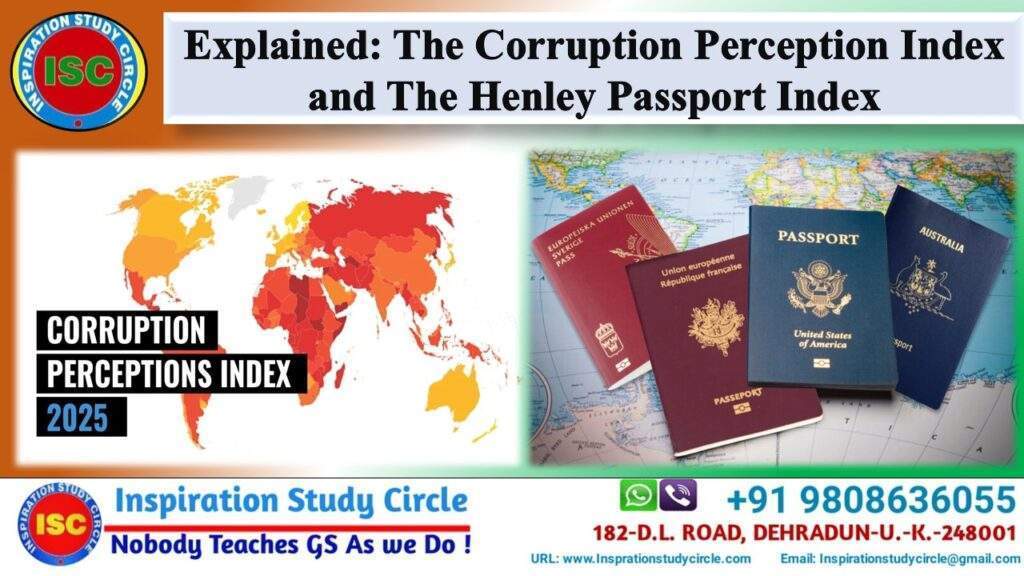
The 2025 Corruption Perceptions Index (CPI), published by Transparency International on February 10, 2026, revealed a global decline in integrity, with the average score dropping to 42, the lowest in over a decade. 

Corruption globally is worsening, even in advanced democracies, as the number of countries scoring above 80 has decreased from 12 a decade ago to just five this year, according to Transparency International’s 2025 Corruption Perception Index (CPI).

The index evaluated 182 countries based on perceived public sector corruption, using a scale from zero (highly corrupt) to 100 (very clean).

It revealed a troubling downward trend, with the global average score falling to 42 out of 100—the lowest in over ten years.

Additionally, it further pointed out that 122 countries, which are more than two-thirds of the total, scored under 50 in the 2025 CPI.

Denmark, maintaining its eight-year streak, tops the CPI 2025 with the highest score of 89, followed closely by Finland (88) and Singapore (84).

In contrast, the countries with the lowest scores suffer from severely repressed civil societies and high levels of instability. South Sudan and Somalia, both scoring 9, tied at rank 181. Venezuela ranks slightly higher at 180 with a score of 10, placing these three nations at the bottom of the index.

However, there are some signs of progress, with the report indicating that around 31 countries have substantially lowered their levels of corruption since 2012. Estonia (rank: 12, score: 76), Bhutan (rank: 18, score: 71), South Korea (rank: 31, score: 63), and more have shown the long-term gains of sustained anti-corruption measures.

India’s Performance:

  • Rank: India ranked 91st out of 182 countries.
  • Score: Its score improved slightly to 39/100, up from 38 in the previous year.
  • Progress: India climbed 5 places from its 2024 rank of 96, largely attributed to expanded digital public infrastructure.
  • Comparison: India outperformed neighbours like Pakistan (136th) and Bangladesh (150th) but lagged behind Bhutan (18th) and China (75th). 

Global Trends & Observations:

  • Widespread Corruption: 122 out of 182 countries scored below 50, indicating serious systemic issues.
  • Democracy Link: Full democracies averaged a score of 71, while authoritarian regimes averaged only 32.
  • Significant Movers: Countries like UzbekistanTanzania, and Ukraine showed long-term improvement, whereas Sweden and the United Kingdom saw declines.

Significance of the Corruption Perception Index for India:

In February 2026, the Corruption Perceptions Index (CPI) 2025 showed India‘s rank improved to 91st out of 182 countries, up five spots from 96th in 2024. Despite this climb, India’s score of 39/100 remains below the global average of 42, signifying that corruption is still viewed as a deep-rooted structural challenge.

  1. Indicator of Governance Reform
  • Success of Digitalisation: India’s recent rank improvement is largely attributed to the expansion of Digital Public Infrastructure (DPI) and e-governance, which have reduced “middleman” corruption in welfare delivery.
  • Legislative Benchmark: The index serves as a metric for the effectiveness of laws like the Prevention of Corruption (Amendment) Act 2024 and the empowerment of the Central Vigilance Commission (CVC) with AI-powered forensic tools. 
  1. Economic and Investment Impact
  • Investor Confidence: Global businesses and risk-assessment firms use CPI scores to gauge regulatory risk and the ease of doing business. A score consistently below 50 can weigh on foreign direct investment (FDI) decisions.
  • Economic Drag: Experts note that systemic corruption continues to be a heavy drag on India’s economic growth and social trust, leading to diverted public funds from essential services like healthcare and infrastructure. 
  1. Global Reputation and Diplomacy
  • Democratic HealthTransparency International uses the index to link corruption levels with the strength of democratic institutions. India’s score reflects concerns over political financing and the weakening of institutional checks.
  • Journalist Safety: The 2025 report specifically listed India as a dangerous country for journalists investigating corruption, noting that 90% of journalist killings worldwide occur in countries with scores below 50. 
  1. Comparative Regional Standing

South Asian Context: India consistently outperforms neighbours like Pakistan (136th) and Bangladesh (150th), but it continues to lag behind Bhutan (18th) and China (75th)

B. The Henley Passport Index

The Henley & Partners Henley Passport Index 2026 has delivered a surprising update for Indian travellers. While India’s passport dropped slightly in total visa-free access, it still climbed 10 places in global rankings

The Henley & Partners Henley Passport Index ranks 199 passports based on access to 227 destinations worldwide.

The ranking is based on data from the International Air Transport Association (IATA) and includes,

  • Visa-free entry
  • Visa on arrival
  • Electronic Travel Authorisation (ETA)

Singapore continues to hold the title of the world’s most powerful passport, granting its citizens visa-free or visa-on-arrival access to 192 destinations.

India’s Performance in 2026:

The Indian passport has shown a significant surge, climbing 10 places to rank 75th globally in February 2026, up from 85th in 2025. 

  • Visa-Free Score: Indian citizens can now travel to 56 countries without a prior visa.
  • Rank vs. Access: Interestingly, while India’s rank improved due to the relative decline of other nations, its total visa-free destinations actually decreased from 57 in 2025 to 56 in early 2026.
  • Recent Changes: India lost visa-free access to Iran (suspended in November 2025) and Bolivia (shifted to an e-visa system in January 2026), but gained access to The Gambia.

Notable Trends:

  • The UAE Surge: The United Arab Emirates has been the strongest performer over the last 20 years, climbing 57 places since 2006 to reach 5th place in 2026.
  • US/UK Decline: Both the US and UK have experienced long-term declines, falling from the joint 1st spot they held in 2014 to 10th and 7th, respectively.
  • Bottom of the ListAfghanistan remains the world’s weakest passport at 101st, with access to only 24 destinations

The Henley Passport Index is based on exclusive data from the International Air Transport Association (IATA)

Significance of the Henley Passport Index for India

In the February 2026 update of the Henley Passport Index

India’s jump to 75th place (up from 85th in 2025) carries significant weight across diplomatic, economic, and practical travel domains. 

  1. Indicator of Diplomatic Soft Power
  1. Economic and Business Significance
  • Corporate Mobility: For India’s booming IT and consulting sectors, even marginal improvements are critical. Easier access to short-haul markets like Thailand, Malaysia, and Indonesia reduces trip-planning time and processing fees for executives.
  • Investment Appeal: Passport strength is increasingly linked to economic influence and GDP. A more mobile workforce is viewed as a vital tool for global power goals and international trade.
  1. Practical Value for Citizens
  • Reduced Barriers: Higher rankings translate into “fewer forms, shorter waiting times, and more spontaneous travel”. It simplifies international movement for students, professionals, and tourists who no longer face document-heavy pre-departure processes for 56 destinations.
  • Transit Ease: Recent gains, such as Germany lifting airport transit visa requirements for Indians, significantly ease long-haul travel to North America and the UK.
  1. Strategic Limitations and Challenges
  • The “Relative” Rise: Analysts note that India’s 10-place jump is partly due to the relative decline of other nations’ mobility rather than a massive surge in new visa-free destinations.
  • Policy Volatility: The index highlights the fragility of travel access; for instance, India lost visa-free status to Iran and Bolivia in 2026 due to security and fraud concerns, despite its overall higher rank.

Disclaimer: The above information and views are taken from various news platforms such as The Indian Express and The Hindu.

 You may also like : 

  1. India- USA Interim Trade Agreement (2026)
  2. Explained: India- EU FTA “The Mother of All Deals”
  3. UPPSC- 2026 Calendar Released
Recent Post​
Blank Form (#5)

Scroll to Top