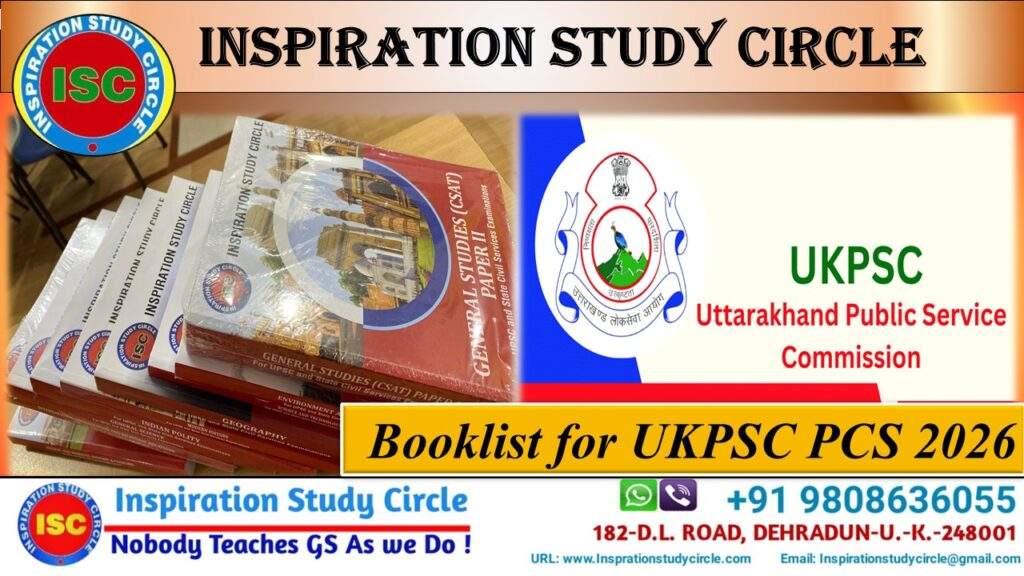
Booklist for UKPSC PCS 2026- ISC’s Roadmap to Success
Table of Contents
Booklist for UKPSC PCS 2026- ISC’s Roadmap to Success
For a comprehensive UKPSC PCS 2026 preparation, your booklist must be divided into three clear tiers: the Foundational NCERTs, Standard Reference Books, and Supplementary Resources for current affairs and advanced topics.
Reading the correct books for UKPSC PCS 2026 is the difference between strategic preparation and aimless hard work. With an overwhelming amount of study material available, sticking to authoritative sources—like NCERTs and Standard References—ensures you build a precise conceptual framework that aligns with the UKPSC PCS’s evolving patterns. Using the wrong resources leads to “information overload” and the retention of irrelevant data, which wastes precious time. For a 2026 aspirant, mastering a limited set of high-quality books is essential to develop the deep, analytical clarity required to tackle both the Prelims and the Mains effectively.
Inspiration Study Circle (ISC), best ukpsc coaching in dehradun, Best has curated a definitive, high-yield roadmap for UKPSC PCS 2026 by integrating foundational NCERTs, elite reference materials, and specialised magazines. This strategy prioritises conceptual depth and active revision techniques to eliminate academic clutter for a targeted, top-rank approach. For more details, visit the Inspiration Study Circle website.
Foundational NCERT Books (Classes 6–12)
NCERTs are indispensable for building a base. They should be your first point of study before moving to complex standard books.
• History
Classes 6–8: Our Past (Parts I, II, III).
Classes 9–10: India and the Contemporary World (Parts I & II).
Class 11: Themes in World History.
Class 12: Themes in Indian History (Parts I, II, III).
Note: Old NCERTs by RS Sharma (Ancient), Satish Chandra (Medieval), and Bipin Chandra (Modern) are often preferred by toppers for their narrative depth.
• Geography
Classes 6–10: Basics like The Earth Our Habitatand Contemporary India.
Class 11: Fundamentals of Physical Geography(Crucial) and India: Physical Environment.
Class 12: Fundamentals of Human Geographyand India: People and Economy.
• Polity
Class 11: Indian Constitution at Work(Core foundational book) and Political Theory.
Class 12: Politics in India since Independenceand Contemporary World Politics.
• Economy
Class 11: Indian Economic Development.
Class 12: Introductory Macroeconomics (Skip Microeconomics unless required for optionals).
• Society & Culture
Sociology NCERTs (Classes 11 & 12) for GS Paper I social issues.
Class 11 Art: An Introduction to Indian Art.
Standard Reference Books (Mains & Prelims)
These books are used to gain the specialised knowledge required for the civil services syllabus.
Indian Polity: Indian Polity by M. Laxmikanth is the primary resource for both stages. Supplement with Introduction to the Constitution of India by D.D. Basu for deeper constitutional theory.
Modern History: A Brief History of Modern India by Spectrum (Rajiv Ahir) is best for factual Prelims data. For Mains analysis, refer to India’s Struggle for Independence by Bipin Chandra.
Economy: Indian Economy by Ramesh Singh or Nitin Singhania.
Geography: Certificate Physical and Human Geography by G.C. Leong is essential for physical geography concepts.
Art & Culture: Indian Art and Culture by Nitin Singhania.
Environment: Environment by Shankar IAS Academy or D.R. Khullar.
Ethics and Integrity: Lexicon for Ethics, Integrity & Aptitude or study material from Inspiration Study Circle.
Uttarakhand State GS Book by Inspiration Study Circle
For the UKPSC PCS 2026 exam, mastering Uttarakhand-specific General Studies (GS) is critical, as these questions can account for 30% to 40% of your Prelims score. The Uttarakhand State GS book by Inspiration Study Material is a high-impact resource because it specifically addresses the “silent maker or breaker” of the exam: deep knowledge of the state’s geography, history, and economy.
Why This Book is Essential for 2026:
High Weightage Preparation: With state-specific questions potentially increasing to 30% of the paper, this material ensures you don’t fall into the “Metro City Trap” of focusing only on national-level facts while ignoring the local context.
Comprehensive State Coverage: The material from Inspiration Study Circle covers the essential pillars required for both Prelims and Mains:
History & Culture: Detailed evolution of the state, including the Garhwal and Kumaon regions.
Geography & Environment: Focus on mountains, rivers, and ecological challenges unique to Uttarakhand.
Economy & Polity: In-depth analysis of the state’s economic structure, administrative framework, and Panchayati Raj institutions.
Exam-Oriented Layout: The content is designed by experienced faculty to highlight areas that historically yield the maximum number of questions.
Bridging Prelims and Mains: Unlike generic GK books, this study material provides the descriptive depth needed for Mains Paper 2 and Paper 3, where answers can often feel “hollow” without specific state examples.
Class 11: Indian Economic Development.
Class 12: Introductory Macroeconomics (Skip Microeconomics unless required for optionals).
Strategic Benefits:
Competitive Edge: A solid grasp of this material can provide a 15–20 mark edge over candidates who treat state GK as a secondary subject.
Updated for 2026 Trends: The material is aligned with the shifted trend of the UKPSC, which now seeks officers with a deep understanding of the “Soil of Uttarakhand” rather than just general aptitude.
Simplified Learning: The book uses simplified but detailed explanations, often supplemented by daily and monthly current affairs specific to the state.
Current Affairs & Advanced Topics
Newspapers: Read either The Hindu or The Indian Express daily. Focus on editorials and the “Explained” sections.
Magazines: Yojana (Official government perspective) is a must. Kurukshetra is useful for rural development.
International Relations: Pax Indica by Shashi Tharoor or Pushpesh Pant.
Internal Security: Challenges to Internal Security of India by Ashok Kumar (IPS).
CSAT (GS Paper II): Quantitative Aptitude by R.S. Aggarwal and Analytical Reasoning by M.K. Pandey. Inspiration Study Circle too Provides a Comprehensive Course on CSAT, with descriptive topics and a wide range of questions.
Solved Papers: Compilations of Previous Year Questions (PYQs) from several online sources available are critical for understanding exam patterns.
Atlases: Use the Oxford Student Atlas or Orient Blackswan Atlas for map-based preparation.
About UKPSC PCS 2026- 2027
The UKPSC PCS 2026 is the nationwide competitive test for recruitment to elite services of the Uttarakhand Public Service Commission. Scheduled to officially begin soon for UKPCS 2026, this cycle is expected to see thousands of applicants competing for limited vacancies in a three-stage selection process.
Analytical Shift: A small fraction of the exam is moving away from rote memorisation toward analytical and application-based questions.
CSAT Complexity: The qualifying Paper II (CSAT) is becoming increasingly challenging, requiring dedicated preparation beyond basic numeracy.
Current Affairs Integration: Expect deeper linkages between static subjects and current events from at least 18 months preceding the exam.
Importance of Reading and Revision for UKPSC PCS 2026
Reading and revision are the twin pillars of UKPSC PCS success. With the UKPSC PCS 2026 syllabus being vast and dynamic, initial reading builds the necessary conceptual foundation and contextual awareness. However, given the human forgetting curve, first-time reading is never enough. Revision is what converts information into long-term memory, allowing for quick recall during the high-pressure environment of the Prelims and coherent answer writing in the Mains. Without multiple rounds of revision, even the best resources remain unutilized. For 2026, a strategy of “limited resources, maximum revision” is essential to master the complex interlinkages between static subjects and evolving current affairs.
To prepare for UKPSC PCS 2026, your revision should follow a “Spiral Model”—returning to the same topics with increasing frequency and depth. Since you have ample time, the focus is on consolidating the foundation now so that 2026 is purely about peak performance.
The 3-2-1 Revision Rule
3 Stages of Reading: First read (understanding), Second read (underlining), Third read (note-making).
2 Daily Slots: 45 mins in the morning (previous day’s work) and 45 mins at night (today’s work).
1 Weekly Reset: Sunday is for zero new topics—only revising the past 6 days.
A Sample "Active" Revision Day
Morning (8:00 AM):15-minute “Mental Map” of yesterday’s topics (Recalling without looking at books).
Evening (9:00 PM):Convert today’s 10 pages of reading into 1 page of “Micro-Notes” (Flowcharts/Bullet points).
Weekend:Scan all Micro-Notes from the week. If you can’t explain a term to yourself, re-read that section.
The "Golden Rule" for 2026
Do not let your notes pile up. Use digital tools for “Active Recall” on the go. If you revise a topic 5 times before the exam, it becomes permanent.
What can the Inspiration Study Circle provide?
Success in UKPSC PCS 2026 requires more than just gathering information; it demands a strategic consolidation of data into exam-ready insights. The Inspiration Study Circle (ISC), best PCS Coaching in Dehradun provides a critical advantage through its meticulously curated notes and monthly magazines, which are designed to bridge the gap between static textbooks and dynamic current affairs.
By using ISC’s smart-class-integrated materials, aspirants benefit from “To The Point” GS modules that supplement live lectures, making complex concepts easier to retain through diagrams and maps. Ultimately, these resources act as a “structured roadmap,” providing the discipline and expert analysis necessary to navigate the unpredictability of the civil services exam.
ISC’s detailed, documented material is a “pinnacle” for aspirants, offering simplified yet exhaustive coverage of the entire Prelims and Mains syllabus. These notes eliminate the need for random multiple sources, which often lead to confusion, and instead focus on areas that yield maximum questions. For a long-term goal like 2026, their Monthly Current Affairs Magazines—which draw on authoritative outlets such as The Hindu, PIB, and The Indian Express—help students build a layered understanding of geopolitical and economic shifts over time.