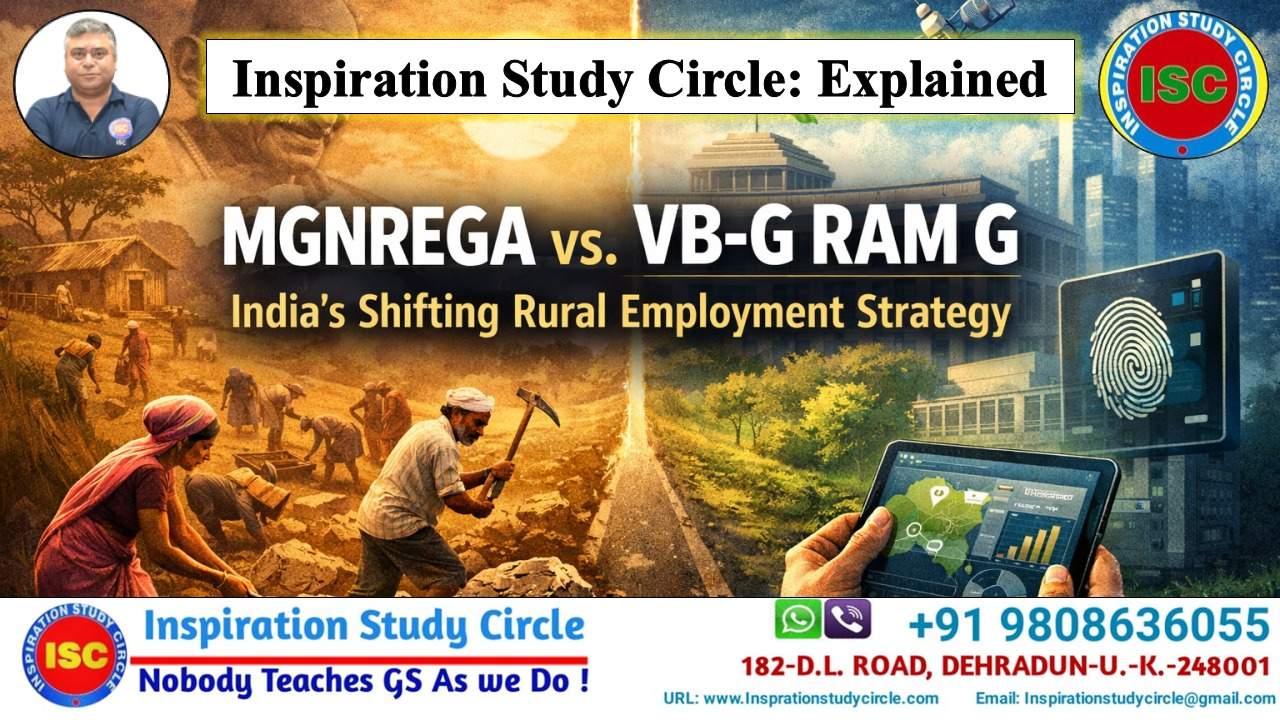
The Viksit Bharat–Guarantee for Rozgar and Ajeevika Mission (Gramin) (VB-G RAM G) Act replaced the Mahatma Gandhi National Rural Employment Guarantee Act (MGNREGA). VB-G RAM G increases the statutory employment guarantee from 100 to 125 days per household and sets a minimum daily wage of at least ₹300.
While both provide a statutory safety net, the transition shifts the framework from a demand-driven model to a more structured, outcome-oriented approach. Key differences include:
Funding Structure:MGNREGA funds unskilled wages 100% centrally. VB-G RAM G introduces cost-sharing, with states bearing 40% (and 10% for North-Eastern/Himalayan states).
Work Allocation: Instead of open-ended demand, VB-G RAM G introduces normative state allocations and work pauses of up to 60 days during peak agricultural seasons to prevent farm labour shortages.
Asset Creation: VB-G RAM G aligns decentralised Gram Panchayat plans with national frameworks (PM Gati Shakti) to focus on four priority infrastructure verticals (water security, core rural infrastructure, livelihood-related assets, and climate mitigation).
Technology: The new act mandates rigorous digital governance, including biometric attendance, geo-tagging, and AI-enabled tracking to reduce leakages.
The funding for the Viksit Bharat–Guarantee for Rozgar and Ajeevika Mission (Gramin) (VB-G RAM G) marks a major shift in how India finances rural employment. Instead of relying heavily on central government payouts for wages, it operates as a structural, co-funded Centrally Sponsored Scheme (CSS).
How is VB-G RAM G funded?
Fixed Cost-Sharing Ratios: The financial liability is divided between the Union and State governments across all expense categories (including labour wages, materials, and administrative overheads).
General Category States: Split 60% from the Centre and 40% from the State.
North-Eastern & Himalayan States: Split 90% from the Centre and 10% from the State.
Union Territories (without legislatures): Funded 100% by the Central Government.
Normative Resource Allocation: Rather than letting states draw unlimited funds based on unpredictable, real-time demand, the central government pre-allocates budgets annually. This allocation uses objective parameters, such as the regional poverty index, infrastructure deficits, and formulas adapted from the 16th Finance Commission’s horizontal devolution rules.
National Rural Infrastructure Stack: Central financial assistance is funnelled through an integrated digital system. Budgets are tied closely to multi-layered village development strategies (Viksit Gram Panchayat Plans) mapped out via geographic information and satellite technologies.
Comparative Analysis: VB-G RAM G vs. MGNREGA:
The financial transition moves away from an open-ended safety net to a highly structured budget partnership. The core differences include:
Comparison Metric
Legacy Framework (MGNREGA)
Modern Framework (VB-G RAM G)
Wage Funding Source
100% financed by the Central Government for all unskilled labour.
Shared financial liability based on the 60:40 or 90:10 state-matching rules.
Material & Admin Costs
States contributed a heavy percentage (typically 25% for materials and 100% for unemployment allowances).
The entire operational cost (wages, materials, administration) falls under the unified CSS ratio.
Budgeting Philosophy
Demand-Driven: Budgets were elastic; the Centre was legally required to provide funds whenever workers asked for jobs.
Supply-Driven / Normative: Budgets are pre-defined annually based on strict structural criteria and regional poverty data.
Financial Burden on States
Minimal strain on poorer states, as their primary wage liabilities were completely covered by New Delhi.
Significant fiscal pressure; states experience an estimated six-fold increase in financial obligations to back up the scheme.
Asset Spending Focus
Small-scale decentralised works (ad hoc check dams, desiltation, individual farm levelling).
Capital-intensive projects tied to four national asset verticals (water systems, transport links, storage facilities, climate adaptation).
Fiscal Accountability
Flexible fund-utilisation certificates with a higher tolerance for manual discrepancies.
Rigid AI-driven fraud screening, GPS verification, and real-time biometric tracking before releasing funds.
The Shift from MGNREGA to VB-G RAM G
The operational shift between MGNREGA and the Viksit Bharat–Guarantee for Rozgar and Ajeevika Mission (Gramin) (VB-G RAM G) officially began nationwide on July 1, 2026. The transition relies on structural policies, strict cutoff timelines, and digital infrastructure adjustments to prevent rural job disruptions.
The transition is unfolding across several key operational fronts:
1. The Six-Month Hybrid Window
To prevent sudden employment disruptions, the central government invoked an order allowing states a six-month interim transition period.
States that have not yet fully notified the new VB-G RAM G framework can temporarily run their existing MGNREGA machinery.
However, they must immediately adopt three mandatory rules from the new law: expanding the guarantee to 125 days, enforcing the 60:40 or 90:10 state-matching fund ratio, and restricting projects to the new climate/infrastructure asset verticals.
2. Immediate Capital Injection
The transition is backed by rapid central funding to establish baseline confidence. The Union Government has already rolled out an initial release of ₹25,863 crore directly to state accounts to jumpstart the program without causing technical or operational delays.
3. Immediate Implementation of the Wage Floor
The statutory minimum wage floor of ₹300 per day went into effect immediately on July 1st. While states like Haryana, Goa, and Kerala already paid well over this amount and experienced small percentage adjustments, poorer states with historically low MGNREGA wages—such as Uttar Pradesh (+₹48), Bihar (+₹45), and Madhya Pradesh (+₹39)—had to enforce steep overnight increases to hit the new legal baseline.
4. Job Card Mapping
A major logistical challenge is moving millions of rural households onto the new identity infrastructure.
Interim Validation: Existing e-KYC-verified MGNREGA Job Cards remain temporarily valid to ensure workers are not locked out of seeking immediate work.
The New Standard: Over the transition period, these legacy cards are systematically being audited, cancelled, and replaced by the newly issued Gramin Rozgar Guarantee Cards.
5. Spillover Work Prioritisation
To avoid wasting past public expenditure, the Ministry of Rural Development ordered that incomplete legacy MGNREGA projects must be prioritised for completion first. No state can start large-scale capital works under the new framework until its existing, half-built village assets are fully finished and logged into the Viksit Bharat National Rural Infrastructure Stack.
6. Political and Fiscal Negotiations
The transition is facing resistance on the ground, creating a landscape of active negotiation between the Centre and states.
State Opposition: Even some BJP-ruled states (like Madhya Pradesh), alongside opposition-led states (like Bihar and Jharkhand), have openly protested the steep 40% fiscal demand.
Policy Shifts: Some states that initially rejected the transition entirely—such as the AAP-led government in Punjab—have reversed course and officially notified the state-level VB-G RAM G framework to avoid losing access to central funds altogether.
What qualifies as an approved asset under the four infrastructure verticals?
Under the Viksit Bharat–Guarantee for Rozgar and Ajeevika Mission (Gramin) (VB-G RAM G) framework, approved assets must be durable, capital-productive, and part of the localised village maps known as Viksit Gram Panchayat Plans.
The Ministry of Rural Development has catalogued 318 distinct categories of development works across four strategic verticals:
1. Water Security Works (107 Permitted Categories)
Projects in this vertical focus strictly on systematic water harvesting, conservation, and groundwater recharge:
Farm ponds and community storage tanks.
Check dams and boulder-packed check dams for stream management.
Deep recharge pits and decentralised rainwater harvesting structures.
Canal lining and field channels to reduce irrigation water waste.
The way forward for VB-G RAM G requires balancing fiscal sustainability with robust rural social security through five targeted actions:
Ease State Fiscal Strain: Provide interest-free bridging loans via NABARD to less wealthy states to prevent wage delays under the new 60:40 cost-sharing model [India.gov.in Spotlight].
Upgrade Grassroots Tech: Deploy offline-capable biometric tools to Gram Rozgar Sahayaks [PIB Portal Framework Release, India.gov.in Spotlight] and run village bootcamps to map projects using PM Gati Shakti spatial data.
Localise Seasonal Pauses: Allow districts to customise the 60-day agricultural work pause based on local crop cycles rather than rigid statewide schedules.
Enhance Skill Certification: Partner with the Skill India Mission to certify manual labourers in masonry, solar maintenance, and advanced construction needed for complex infrastructure.
Smooth the Identity Transition: Launch extensive village awareness campaigns to help workers transition from legacy job cards to new Gramin Rozgar Guarantee Cards without losing work.
Disclaimer: The above-written article contains facts and arguments analysed from web platforms and pages like Wikipedia, PIB, and editions of The Hindu and The Indian Express.