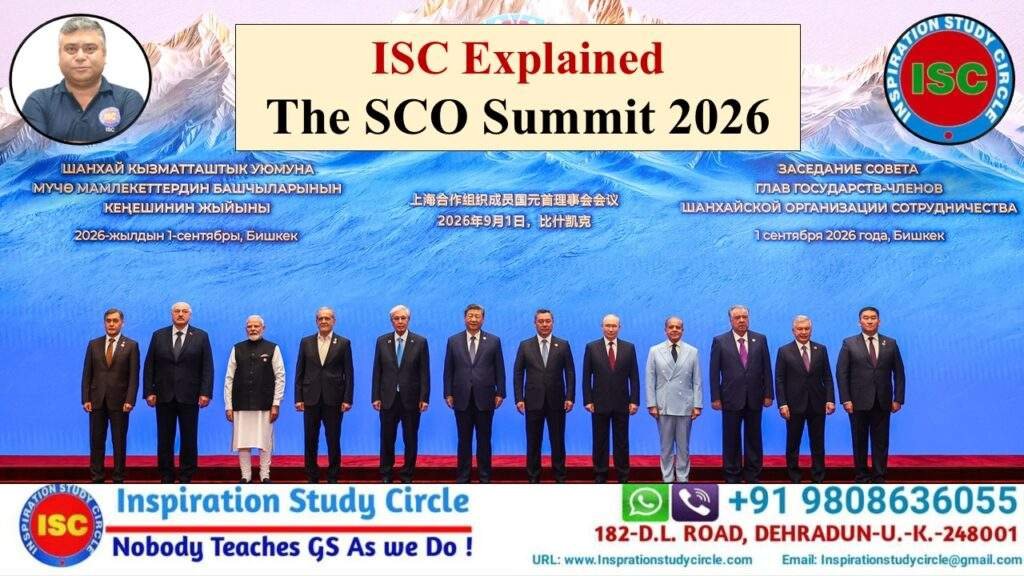
The 26th Shanghai Cooperation Organisation (SCO) Summit was held from August 31 to September 1, 2026, in Bishkek, Kyrgyzstan. Hosted at the newly built Rys Ordo Congress Hall, the event marked the 25th anniversary of the organization’s founding. It brought together leaders from all 10 member states—including India, China, Russia, Pakistan, Iran, Belarus, and the Central Asian republics.
The summit concluded under the presidency of Kyrgyz President Sadyr Japarov, who handed over the rotating SCO chairmanship to Pakistan for the 2026–2027 term.
Theme and Formats
Official Summit Theme:“25 Years of the SCO: Together for Sustainable Peace, Development and Prosperity.”
“SCO Plus” Debut: The summit featured the first-ever expanded “SCO Plus” format meeting, which included member states, observer nations, dialogue partners, and international organisations like the UN. Its theme focused on creating a just world order and a multipolar world.
Marking a quarter-century since the organization’s founding in 2001, the theme structured the summit’s debates and outcomes into three primary, interconnected pillars.
1. Sustainable Peace and Global Rebalancing
The “Sustainable Peace” element underscored a collective push toward global multipolarity and strategic autonomy. For the first time, the summit incorporated the expanded “SCO Plus” format, explicitly dedicated to discussing a “just world order” and a multipolar framework.
Under this banner, member states emphasised resolving regional vulnerabilities without external Western intervention. This translated into concrete institutional security reforms. The summit finalised the structure for the Universal Centre for Countering Challenges and Threats to the Security of SCO Member States, expanding the bloc’s traditional anti-terror focus into a unified mechanism against cybersecurity breaches, transnational crime, and synthetic drug trafficking.
Furthermore, the peace pillar targeted geopolitical friction. India utilised this platform to advocate for a zero-tolerance approach to cross-border terrorism, demanding an end to double standards in global counter-terrorism. Simultaneously, the theme allowed the bloc to collectively condemn unilateral economic sanctions, which member states argued undermine global security and international law.
2. Connected Development and Economic Sovereignty
The “Development” aspect of the theme addressed the changing realities of Eurasian supply chains and economic dependencies. A core focus was the adoption of the 2026–2030 Action Plan for Ports and Logistics Centres, aimed at building independent transport corridors across Central Asia, Russia, China, and South Asia.
However, development also exposed internal strategic nuances. While China and Pakistan used the theme to champion infrastructure expansion, India maintained its principled stance that regional connectivity must respect national sovereignty, reiterating its opposition to projects passing through contested territories.
Crucially, economic development was tied to financial sovereignty. Driven by a mutual desire to bypass Western-dominated financial networks, the summit utilised the theme to push for a reformed international financial architecture, focusing on increasing trade in local currencies and developing independent clearing systems.
3. Prosperity, Innovation, and Cultural Exchange
The “Prosperity” pillar looked toward future-focused industries and societal well-being. Recognising the global energy transition, the bloc established the SCO Green Technology Corridor (2026–2030) to facilitate clean energy sharing, tech transfers, and sustainable environmental practices across borders.
To make the organisation more accessible and globally integrated, the summit implemented structural modernisations, most notably adopting English as an official working language alongside Chinese and Russian. Prosperity was also framed through human connection; the designation of Lahore, Pakistan, as the SCO Tourism and Cultural Capital and India’s announcement of the upcoming SCO Civilisation Dialogue Forum highlighted a joint effort to build soft-power ties, ensuring that the bloc’s next 25 years are anchored in shared social and cultural progress.
Significance for the UPSC/PCS Exams
The Shanghai Cooperation Organisation (SCO) is a highly critical topic for the Civil Services Examination, primarily falling under the UPSC Mains General Studies Paper II (GS-2) syllabus under Bilateral, Regional, and Global Groupings and Agreements Involving India and/or Affecting India’s Interests. It also frequently features in the GS-1 Geography / History (Eurasian dynamics) and Preliminary Examination (mapping, member states, and institutional mechanisms).
Understanding the SCO requires a structured approach across its evolutionary background, structural architecture, India’s strategic core, and the friction points it creates for Indian foreign policy
1. Evolutionary Background and Core Pillars
The organisation evolved from the “Shanghai Five” framework established in 1996 (comprising China, Russia, Kazakhstan, Kyrgyzstan, and Tajikistan) to resolve post-Soviet border disputes.
The Transition (2001): With Uzbekistan’s entry in 2001, it was re-established as the SCO.
The Core Philosophy: It operates on the “Shanghai Spirit”, which emphasises mutual trust, consensus, equality, respect for cultural diversity, and common development.
The “Three Evils”: The foundational security mandate focuses heavily on combating Terrorism, Separatism, and Extremism.
2. Institutional Framework for Prelims
UPSC Prelims often tests structural details, geography, and membership timelines.
SCO Secretariat: Based in Beijing, China, managing administrative affairs.
RATS (Regional Anti-Terrorist Structure): Located in Tashkent, Uzbekistan, facilitating intelligence sharing and counter-terrorism coordination.
Official Languages: Russian and Chinese. Crucially for current updates, English was proposed/adopted as a third official working language during recent summits to broaden international integration.
3. Mains Dimension: Strategic Significance for India
For analytical Mains questions, India’s involvement is evaluated through geopolitical, economic, and security lenses:
Central Asian Footprint: Central Asia is India’s “extended neighbourhood.” The SCO serves as a gateway to checkmate geographical isolation caused by Pakistan’s denial of land access.
Counter-Terrorism Platform: Through RATS, India acquires a structured multilateral framework to extract actionable intelligence and hold regional states accountable for cross-border terror.
Eurasian Counter-Weight: It enables India to engage simultaneously with Russia and China, asserting its strategic autonomy while managing Western relationships (like the Quad).
The “SECURE” Agenda: Coined during India’s chairmanship, this framework shapes India’s core narrative: Security, Economic cooperation, Connectivity, Unity, Respect for sovereignty/territorial integrity, and Environmental protection.
4. Critical Challenges and Geopolitical Paradoxes
A high-scoring Mains answer must critically examine the internal contradictions of the bloc:
Challenge Category
Strategic Friction Points
The China-Pakistan Axis
Beijing often uses the SCO to project regional dominance via its Belt and Road Initiative (BRI). India consistently opposes this because the China-Pakistan Economic Corridor (CPEC) violates Indian sovereignty in PoK.
The Connectivity Deficit
Unlike China’s robust financial outlays across Central Asia, India faces severe infrastructure bottlenecks and limited capital deployment. Projects like the International North-South Transport Corridor (INSTC) or the Chabahar Port remain slow-moving.
Diplomatic Tightrope Walk
The West often views the SCO as an anti-Western or revisionist bloc led by Moscow and Beijing. India must balance its engagement here while solidifying defence and trade pacts with the US and Europe.
Bilateral Spillover
SCO bylaws prohibit bilateral disputes from dominating the forum, yet structural animosity with Pakistan and border standoffs with China inevitably dilute cohesive policymaking.
5. Way Forward for India
In the conclusion, emphasise that India cannot afford to leave the Eurasian space empty for China to dominate. India’s approach should focus on demanding a “zero-tolerance” framework against terror financing, insisting that any connectivity projects respect state sovereignty, and expanding cultural diplomacy, soft power, and technical cooperation (e.g., the SCO Young Scientists Forum) to build independent equity in Central Asia.
Analytical Framework: The Paradox of India's Dynamic Engagement
To secure marks in the GS-2 paper, your blog must highlight the deep diplomatic contradictions India navigates within the SCO. Use this structural breakdown to explain how India converts a highly challenging forum into a calculated strategic asset:
The Eurasian Sovereignty Dilemma: India remains the lone dissenter inside the SCO regarding endorsement of China’s Belt and Road Initiative (BRI). Your blog should emphasise that India uses the SCO floor to state its position clearly: Connectivity initiatives must respect territorial integrity.
The Anti-Western Friction: With the inclusion of Iran and Belarus, the SCO’s political centre of gravity has leaned heavily anti-Western. India’s active participation proves its commitment to Strategic Autonomy—showing Washington that New Delhi will secure its Eurasian land interests independently of Western geopolitical blocs.
Preventing an Absolute Vacuum: If India leaves or dilutes its participation, the SCO morphs into a completely unmonitored backyard for China and Pakistan to co-author regional security architectures that could actively hurt Indian interests.
Mains Practice Question- Model Question
Question:
“India’s membership in the Shanghai Cooperation Organisation (SCO) is a classic manifestation of its multi-aligned foreign policy, navigating complex structural paradoxes.” Critically analyze India’s strategic gains and vulnerabilities within the SCO.(15 Marks, 250 Words)
Answer Structure Blueprint for Students:
Introduction (30 words): Define the SCO as a premier Eurasian security and economic architecture and mention India’s entry timeline (2017) to show its role as a key regional anchor.
Body Paragraph 1: Strategic Gains (80 words): Focus on institutional counter-terrorism benefits through RATS, accessing energy corridors in Central Asia, and maintaining vital ties with Russia.
Body Paragraph 2: Structural Vulnerabilities (80 words): Highlight the weaponization of the platform by the China-Pakistan axis, the violation of Indian sovereignty via CPEC, and navigating the anti-West image.
Conclusion (60 words): End with a forward-looking quote or perspective on how continental security is inseparable from maritime security, requiring India to remain a proactive stakeholder inside Eurasia.
Disclaimer: The above information and views are taken from various news and information platforms such as Wikipedia, The Hindu, and the Indian Explorer.