ISC Explained:
SC’s split verdict on the Chief Election Commissioner and Other Election Commissioners Act, 2023
Table of Contents
On 23 September 2026, a two-judge bench of the Supreme Court of India delivered a split verdict on whether to refer the constitutional challenges against the Chief Election Commissioner and Other Election Commissioners Act, 2023 to a larger 5-judge Constitution Bench. The core issue concerns how the Chief Election Commissioner (CEC) and Election Commissioners (ECs) are chosen, and whether the current selection panel compromises the independence of the Election Commission of India.
Background & The Legal Dispute
The dispute arises from changes in appointment procedures:
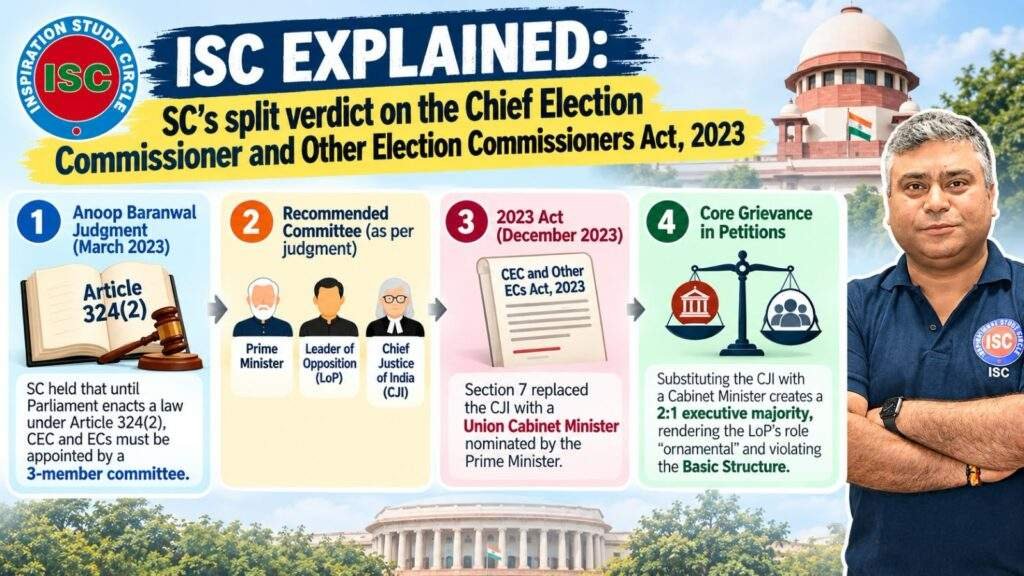
2023 Precedent: The Supreme Court mandated an independent committee (PM, Leader of the Opposition, and the CJI) for appointments in the absence of parliamentary legislation.
2023 Act: Parliament replaced the CJI on the panel with a Union Cabinet Minister nominated by the PM.
Petitioners’ View: Critics argue the executive holds a 2-1 majority (PM and Minister vs. LoP), threatening the neutrality of the Election Commission.
The Split Verdict
Justices Dipankar Datta and Satish Chandra Sharma disagreed on referring the case:
Justice Dipankar Datta rejected referring the matter to a larger bench, holding that the current bench could hear it, though he prima facie questioned the panel’s neutrality.
Justice Satish Chandra Sharma supported referring it to a 5-judge bench, noting it involves substantial constitutional interpretation under Article 145(3).
The future implications of the same
The recent split verdict by the Supreme Court of India carries far-reaching implications for the future of Indian democracy, institutional autonomy, and the legal framework governing constitutional bodies.
Because the two-judge bench could not reach a consensus on whether to refer the matter to a larger bench, the immediate impact is that the 2023 law remains fully operational for now. However, the legal and institutional ripples of this verdict will shape several critical areas moving forward:
1. Institutional Independence of the ECI
The central question under review is whether the Election Commission of India (ECI) can remain completely insulated from executive influence.
Executive Dominance: Under the Chief Election Commissioner and Other Election Commissioners Act, 2023, the selection committee consists of the Prime Minister, a PM-nominated Cabinet Minister, and the Leader of the Opposition (LoP). Critics argue that a 2-to-1 majority in favor of the government risks turning the selection process into a mere formality.
The “Perception Test”: As Justice Dipankar Datta noted in his opinion, an appointment panel heavily weighted toward the ruling executive fails the “perception test” of neutrality. In future elections, any controversial decision made by an ECI appointed under this framework could face intense public scrutiny regarding its bias or independence.
2. Escalation to a 5-Judge Constitution Bench
The split directly shifts the battlefield to a higher judicial forum.
Definitive Legal Clarification: The Chief Justice of India (CJI) is now tasked with forming a larger Constitution Bench (likely 5 judges) to hear the case. This larger bench will eventually deliver a definitive, binding ruling on whether Parliament has the absolute right to override prior judicial directives under the guise of statutory power.
Defining Separation of Powers: The future ruling will draw a hard line regarding the Separation of Powers in India. It will determine whether the judiciary can permanently enforce structural neutrality on selection panels, or if the legislature retains total supremacy in designing appointment laws under Article 324(2).
3. Push for Structural Judicial Reforms
Interestingly, this split verdict highlighted a major bottleneck within the Supreme Court itself regarding prolonged delays in deciding critical constitutional cases.
The Call for a Permanent Bench: Both judges noted that key constitutional references often sit unresolved for years, or even decades.
Institutional Speed: The verdict has renewed momentum for a permanent 5-judge Constitution Bench within the Supreme Court. If implemented, this would allow major democratic and constitutional challenges to be addressed swiftly, ensuring that controversial laws do not remain active indefinitely without final judicial validation.
4. Impact on Future Electoral Validity
Until the larger bench rules on the validity of Section 7 of the 2023 Act, all upcoming state and national elections will be overseen by commissioners appointed via the executive-led panel. If the future Constitution Bench eventually strikes down the 2023 law as unconstitutional, it could retroactively cloud the perceived legitimacy of the appointments made under it, creating unprecedented political and legal complications.
Significance for the UPSC/PCS Exams
1. For Prelims: Conceptual & Factual Clarity
Prelims questions will likely focus on the statutory mechanics and articles of the Constitution. You should master:
Article 324(2): Understand that the Constitution leaves the appointment of CEC/ECs to the President, subject to any law made by Parliament.
Article 145(3): The constitutional provision mandating that any case involving a “substantial question of law as to the interpretation of the Constitution” must be heard by a minimum of 5 judges.
The Evolution of the Selection Committee:
Pre-2023: Executive-driven (President acted on the advice of the Prime Minister and Council of Ministers).
Anoop Baranwal Case (March 2023): SC created a temporary triad panel: PM + Leader of Opposition (LoP) + Chief Justice of India (CJI).
The 2023 Act: Parliament replaced the CJI with a Union Cabinet Minister nominated by the PM.
Split Verdict Mechanics: If a two-judge bench splits 1:1, the matter is referred to the CJI as the “Master of the Roster” to assign it to a larger bench. The ruling does not create a legal precedent.
2. For Mains: Analytical Depth
The Mains’ Exam questions will test your ability to balance arguments regarding institutional integrity and legislative intent.
The Core Debate (Independence vs. Sovereignty):
Arguments for the Petitioner: An appointment panel with a 2:1 executive majority violates the “Basic Structure” doctrine (specifically, free and fair elections and judicial independence). It fails the public perception of neutrality.
Arguments for the Government: Article 324(2) explicitly gives Parliament the power to make laws on this matter. The judiciary cannot permanently usurp legislative domain; doing so violates the Separation of Powers.
Judicial Pendency Analysis: You can quote this verdict in essays or GS II answers regarding judicial reforms. Mention how both judges highlighted the issue of “constitutional silence” and delays in setting up larger benches, making a strong case for a permanent Constitution Bench.
Way Forward Approach: In Mains, always conclude with a balanced approach. Suggest international best practices (like in South Africa or the UK, where selection panels are entirely independent or involve wider cross-party consensus) to ensure the Election Commission of India (ECI) remains beyond political reproach.
Syllabus Mapping (UPSC GS Paper II)
Constitutional Bodies: Appointment, powers, functions, and responsibilities of various Constitutional Bodies (Election Commission of India).
Separation of Powers: Dispute redressal mechanisms, institutional checks and balances, and the interplay between the Judiciary and the Legislature.
Judiciary: Structure, organization, and functioning of the Supreme Court; roles of a Constitution Bench and the Chief Justice as the ‘Master of the Roster’.
Disclaimer: The above information and views are taken from various news and information platforms such as Wikipedia, The Hindu, and the Indian Explorer.