Inspiration Study Circle

Inspiration Study Circle

Best IAS/PCS/UPSC Coaching in Dehradun

ISC Explained: The 18th BRICS Summit 2026- India

Table of Contents

ISC Explained: The 18th BRICS Summit 2026- India

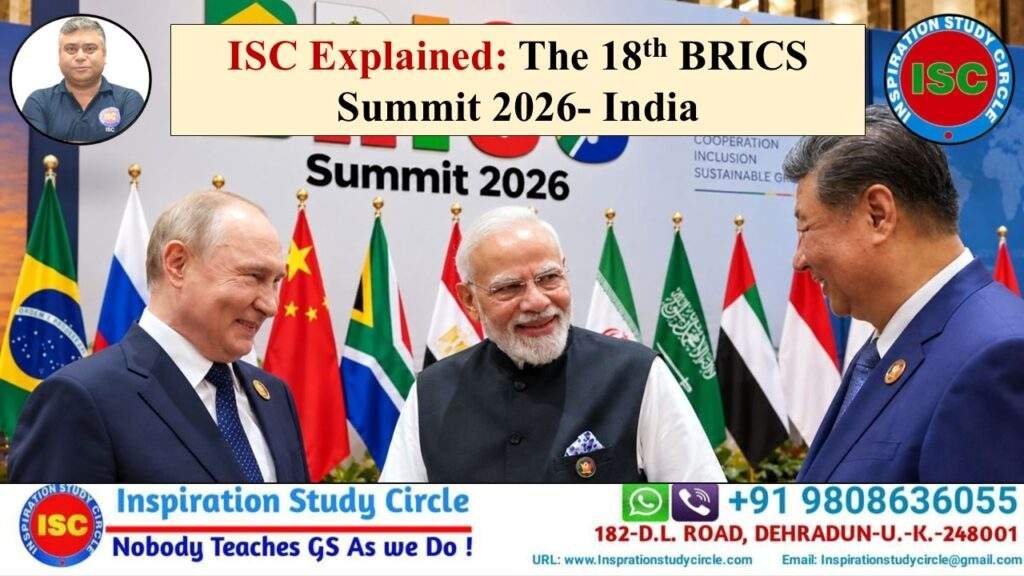
The 18th BRICS Summit concluded on September 13, 2026, in New Delhi, India, under India’s fourth official chairmanship of the bloc. Hosted by Indian Prime Minister Narendra Modi at the Bharat Mandapam convention centre, the two-day event (September 12–13) brought together leaders from the expanded 10-member grouping, including Russian President Vladimir Putin, Chinese President Xi Jinping, and Iranian President Masoud Pezeshkian.

The summit operated under the official theme: “Building for Resilience, Innovation, Cooperation and Sustainability”.

Key Takeaways & Decisions

  • The New Delhi Declaration: On the very first day, member states unanimously adopted a 140-point joint consensus statement. The document highlights a shared commitment to reforming global governance, boosting sustainable development, and amplifying the voice of the Global South.
  • Careful Geopolitical Balancing: To achieve total consensus amid deep internal divisions, the final text intentionally sidestepped direct blame regarding major ongoing conflicts. It called for “maximum restraint” in West Asia/Middle East without directly naming Israel or the US, and completely omitted any mention of the Russia-Ukraine war.
  • Concerns Over “Technology Weaponisation”: Prime Minister Narendra Modi issued a strong warning against the weaponisation of technology and critical minerals, noting that unilateral restrictions risk slowing down shared prosperity across developing nations.
  • China’s Global South Initiatives: Chinese President Xi Jinping introduced several practical cooperation initiatives in trade and Artificial Intelligence (AI) to cement the “Greater BRICS” as a primary development engine for emerging economies.
  • Trade and Sanctions: The declaration formally criticised the rise of indiscriminate global tariffs and unilateral financial sanctions, subtly addressing US policies without explicitly identifying the country by name.

Here is a detailed breakdown of each major decision and key takeaway from the 18th BRICS Summit in New Delhi:

1. The New Delhi Declaration

The 18th BRICS Summit New Delhi Declaration served as the unified blueprint for the expanded 10-member bloc, comprising 140 comprehensive points.

    • Global Governance Reform: The core focus of the declaration was a collective demand to overhaul ageing international systems, including the United Nations Security Council (UNSC), the International Monetary Fund (IMF), and the World Bank. The bloc argued these institutions no longer reflect modern geopolitical realities.
    • Amplifying the Global South: With the expansion of BRICS, the declaration explicitly positioned the group as the primary geopolitical shield and economic voice for developing nations across Africa, Latin America, and Asia.
    • Economic Integration: It finalised structural frameworks for deeper financial cooperation, aiming to reduce dependency on traditional Western financial networks.

2. Careful Geopolitical Balancing

Achieving a 10-country consensus required immense diplomatic negotiation, especially given the diverse foreign policies of nations like India, China, Russia, Iran, and Saudi Arabia.

  • The Middle East / West Asia: The declaration called for an immediate ceasefire and “maximum restraint” to protect civilian lives. However, to maintain consensus and avoid alienating neutral members, it refrained from pointing fingers at specific countries or naming Israel or the United States.
  • The Russia-Ukraine War: In a massive diplomatic feat for the hosts, the final declaration completely omitted any mention of the conflict. By bypassing this highly polarising topic, India ensured that internal friction did not derail the economic agreements of the summit.

3. Concerns Over "Technology Weaponisation"

Prime Minister Narendra Modi’s address focused heavily on the hidden vulnerabilities facing developing economies in the digital age.

  • Supply Chain Risks: India warned that global monopolies over critical minerals (like lithium and cobalt) and advanced semiconductors are being used as geopolitical leverage.
  • Equitable Tech Access: The takeaway emphasises that cutting-edge technology should be a tool for global development, not an exclusive weapon used by powerful nations to enforce compliance or restrict the growth of others.

4. China’s Global South Initiatives

President Xi Jinping used the New Delhi platform to introduce specific, practical programs designed to anchor the “Greater BRICS” ecosystem around shared development.

  • Trade Programs: China proposed new multilateral trade corridors to accelerate customs processing and lower tariffs between the 10 member states.
  • Artificial Intelligence (AI) Cooperation: Beijing launched initiatives to share AI framework architectures and data tools with member states, establishing alternative technological standards outside the Silicon Valley ecosystem.

5. Trade and Sanctions

The summit delivered a sharp, unified critique of the current international trade landscape, targeting Western economic policies without naming them directly.

  • Protectionism and Tariffs: The bloc condemned the rising global wave of unilateral tariffs and trade barriers, labelling them as harmful to open markets and global supply chains.
  • De-dollarisation & Financial Independence: The text heavily criticised the use of unilateral financial sanctions (such as freezing asset reserves or cutting countries off from SWIFT). This underscored the group’s ongoing push to increase trade settlements in local currencies rather than the US dollar.

6. Bilateral Diplomatic Wins

The physical gathering at Bharat Mandapam allowed for critical face-to-face diplomacy outside the official BRICS agenda.

    • India-China Dynamics: The summit provided a vital neutral venue for PM Modi and President Xi Jinping to maintain direct dialogue, continuing the stabilisation of their bilateral borders.
    • Middle East Mediation: India successfully utilised its strong diplomatic ties with both Iran and the UAE to host quiet sideline talks, easing localized friction points and demonstrating BRICS’ growing capability to handle regional security disputes independently.

The Impact of the Summit on Indian Economy and Geopolitics

The overall impact of the 18th BRICS Summit (September 12–13, 2026) on India was a major diplomatic victory that cemented New Delhi’s position as a vital bridge-builder between conflicting global factions. By steering a fractured, expanded 10-member bloc toward a unanimous consensus, India proved its capacity to balance competing interests while securing its own national priorities.

The impact can be broken down into four distinct strategic areas:

1. Elevated Geopolitical & Global South Stature

  • The Consensus Achievement: Forging the unanimous 140-point New Delhi Declaration amidst severe internal friction—such as the active conflicts involving Russia, Iran, and economic pushback from the West—is viewed as a monumental win for Indian diplomacy. It mirrors the success of India’s 2023 G20 presidency.
  • Deflecting the China-Centric Narrative: A primary risk for India in an expanded BRICS format is the bloc turning into an anti-Western, China-dominated vehicle. By promoting a “humanity-first” and evolution-based approach to international institutions (reforming the UN and IMF rather than dismantling them), India prevented the group from adopting an overtly anti-American posture.

2. Concrete Bilateral Wins

  • India-China Boundary Trajectory: The summit marked a continuous milestone for India-China ties, providing a vital neutral platform for Prime Minister Modi and President Xi Jinping. It also led to structural real-world updates, such as the announced resumption of regular direct passenger flights between the two nations after a long hiatus.
  • Middle East Mediator Status: By successfully orchestrating high-level bilateral sideline meetings between rivals Iran and the UAE, India showcased its growing regional clout and ability to act as a trustworthy diplomatic channel in West Asia.

3. Economic & Technological Opportunities

  • Digital Public Infrastructure (DPI) Export: India heavily pitched its localised technological stack—including the Unified Payments Interface (UPI) and Aadhaar frameworks—as a low-cost blueprint for the Global South. The group’s active review of an integrated cross-border UPI network opens new financial export pathways for Indian fintech.
  • Supply Chain Protections: Modi’s strong stance against the “weaponisation of critical minerals” directly protects India’s manufacturing ambitions. It shields India’s local “China Plus One” manufacturing strategy, ensuring steady access to the resources required for semiconductors and electric vehicles.

4. Counter-Terrorism Alignment

  • Unified Stance on Security: India leveraged its chairship to position its national security priorities on the global stage firmly. Through the BRICS Counter-Terrorism Working Group, India secured a collective consensus condemning state-sponsored terror, cross-border threats, and the rise of emerging security risks, providing a crucial multilateral shield for its defence policy.

Relevance for UPSC/PCS

The 18th BRICS Summit (2026) is highly relevant for the UPSC Civil Services Examination (CSE) and State PCS exams. It serves as a textbook case study for multiple core syllabus topics across Prelims, Mains, and the Interview stage.

Here is a comprehensive breakdown of how this topic maps to your syllabus and how you should approach it for maximum marks.

Syllabus Mapping

Exam StagePaper / SectionCore Syllabus Topic
PrelimsCurrent Events of National & International ImportanceBilateral/Multilateral groupings, International Declarations, Geography of member states.
Mains (GS-II)International Relations (IR)Bilateral, regional and global groupings involving India; Effect of policies of developed/developing countries on India’s interests.
Mains (GS-III)Economic Development / Internal SecurityGlobal trade frameworks, Digital Public Infrastructure (DPI), Supply chain resilience, Counter-terrorism.
InterviewPersonality TestIndia’s balancing act between the West and BRICS, De-dollarisation, Boundary disputes.

Key Dimensions for Mains Answers

If a question on BRICS 2026 appears in your Mains exam, you should structure your arguments around the following analytical frameworks:

  1. Strategic Autonomy & India’s “Balancing Act” (GS-II)
  • The Multi-Aligned Approach: Highlight how India successfully managed its geopolitical tightrope. India is a member of the Quad (pro-Western) while simultaneously leading BRICS (which contains anti-Western poles like Russia and Iran).
  • Preventing an Anti-West Bloc: Emphasise India’s role in ensuring BRICS remains a “Non-Western” platform for developmental cooperation rather than becoming an “Anti-Western” geopolitical weapon championed by China and Russia.
  1. Global Governance & The New Delhi Declaration (GS-II)
  • Reforming the Status Quo: The New Delhi Declaration pushed hard for structural reforms in the UNSC, IMF, and World Bank. Use this to argue how India champions the cause of the Global South, filling the leadership vacuum left by developed nations.
  • Consensus Builder: Draw parallels between the 2023 G20 New Delhi Declaration and the 2026 BRICS Declaration. Both showcased India’s unique diplomatic capital in achieving consensus by omitting polarising language on major conflicts (like the Russia-Ukraine war).
  1. Geo-Economics & Technology Sovereignty (GS-III)
  • Weaponisation of Technology: Quote PM Modi’s speech on the “weaponisation of critical minerals and semiconductors.” This is highly relevant for questions on Supply Chain Resilience and India’s Atmanirbhar Bharat (self-reliance) in electronics manufacturing.
  • DPI and FinTech Diplomacy: Discuss how India is exporting its Digital Public Infrastructure (DPI)—like UPI and open-source data systems—to BRICS nations as a tool for financial inclusion, challenging traditional Western tech monopolies.

Potential Question Formats

Prelims-Style Fact Check

  • The Theme: “Building for Resilience, Innovation, Cooperation and Sustainability”
  • The Venue: Bharat Mandapam, New Delhi.
  • Composition: Keep in mind the expanded 10-member matrix (Brazil, Russia, India, China, South Africa, Egypt, Ethiopia, Iran, Saudi Arabia, and UAE).

Mains Analytical Questions

  1. “The expansion of BRICS threatens to dilute India’s influence within the grouping and turn it into a vehicle for Chinese hegemony. Critically evaluate India’s options in navigating this expanded matrix in light of the 18th BRICS Summit.” (15 Marks, 250 words)
  2. “Weaponisation of supply chains and financial systems has forced emerging economies to seek alternatives. In this context, examine the outcomes of the New Delhi Declaration 2026.” (10 Marks, 150 words)

High-Yield Keywords for Your Answers

To make your answers stand out to the evaluator, integrate these terms:

  • Strategic Autonomy
  • Multi-alignment vs. Non-alignment
  • Technology Weaponisation / Mineral Cartelisation
  • Voice of the Global South
  • De-dollarisation & Local Currency Settlement (LCS)
  • Reformed Multilateralism

Disclaimer: The above-mentioned information and facts are taken from news sources such as the Press Information Bureau and The Hindu.

Indian Navy’s Active Measures

The Navy has shifted from “passive monitoring” to a “high-tempo” escort posture to ensure national energy security:

  • Naval Shield & Escorts: At least five frontline warships (destroyers and frigates) are permanently deployed near the Gulf of Oman to take over escort duties the moment tankers exit the Strait.
  • “Safe Corridor” Guidance: Navy officials provide precise, route-specific instructions to merchant vessels, often guiding them through Iran-controlled channels (such as the Qeshm–Larak route) to avoid potential underwater mines and missile threats.
  • Identification Protocols: Under Navy direction, India-bound tankers now clearly display “INDIAN” on their hulls using the Automatic Identification System (AIS) to signal their “friendly” status and prevent accidental targeting.
  • Recent Successes: The LPG tankers Jag Vikram (April 11, 2026), Shivalik, and Nanda Devi have completed transits under naval watch, easing domestic fuel shortages.

Strategic & Diplomatic Context

India’s ability to maintain shipping during the 2026 crisis is attributed to back-channel diplomacy led by the National Security Advisor and the External Affairs Ministry. By refusing to join U.S.-led naval coalitions in favour of an independent posture, India has maintained the strategic autonomy necessary to secure its energy interests without escalating regional tensions.

FOR MORE BLOGS :

  1. Foreign Contribution (Regulation) Amendment Bill 2026
  2. India in the Iran War 2026
  3. The Constitutional Boundary of SC Status: The Latest Supreme Court Judgement

Disclaimer: The above information and views are taken from various news and information platforms such as Wikipedia, The Hindu, and the Indian Explorer.

Recent Post​
Blank Form (#5)

Scroll to Top