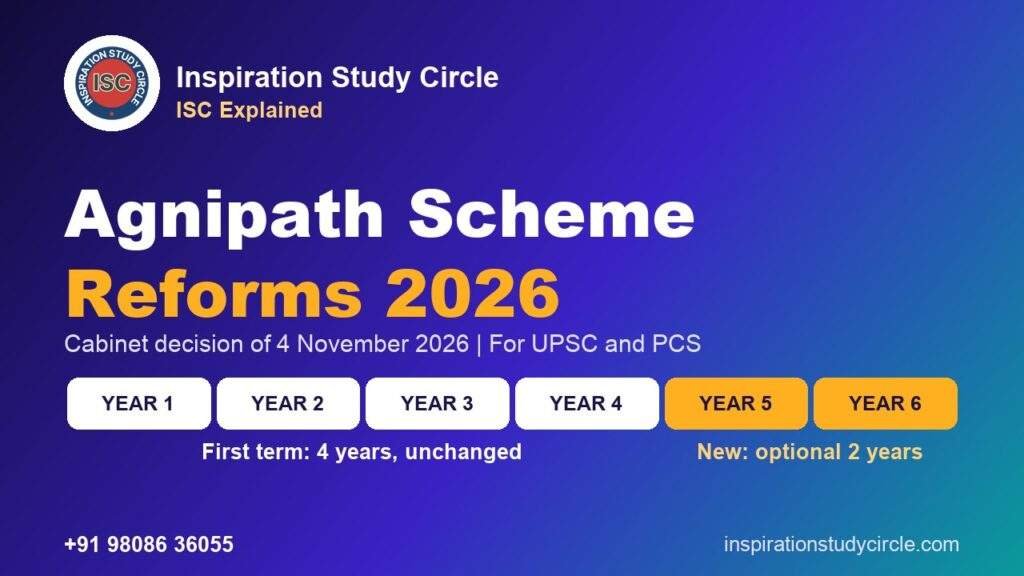
On 4 November 2026, the Union Cabinet approved a major change to the Agnipath Scheme. Agniveers not selected for regular service after four years can now serve another two years, and can then be considered for enrolment as regular soldiers. The official PIB release says the Cabinet “has created a pathway for absorption of all Agniveers into Defence Forces”. It also states clearly that the Agnipath scheme shall continue.
This topic is important for UPSC GS Paper 3 and for State PCS exams, especially UKPSC, because Uttarakhand has its own reservation for former Agniveers.
25% stream unchanged: Based on merit, 25% of Agniveers will be offered regular employment, as envisaged earlier.
New engagement period: The remaining 75% will be offered another engagement period of 2 years, based on their willingness and on the recommendations of the Defence Forces.
Route to regular service: After these two years, all Agniveers will be offered enrolment as regular soldiers, subject to their willingness and their meeting selection criteria.
Better terms: The second engagement period will have higher remuneration, an enhanced Seva Nidhi package and seniority benefits.
Defence Minister Rajnath Singh has described the extension as a “Second Tour of Duty”. The PIB release itself uses the phrase “another engagement period”.
Agnipath 2022 vs 2026: Key Differences
Term
Original Scheme (June 2022)
After 4 November 2026
First term
4 years, including training
4 years, unchanged
Regular entry
Up to 25% of each batch
25% on merit after 4 years; others may be enrolled after 6 years if willing and meeting selection criteria
Extra service
None
Optional 2 years for the remaining 75%
Monthly package
₹30,000 / ₹33,000 / ₹36,500 / ₹40,000
Higher (PIB). Media reports: ₹43,500 in year 5 and ₹47,500 in year 6
Seva Nidhi
30% of package, matched by the government: ₹10.04 lakh, about ₹11.71 lakh with interest
Enhanced (PIB). Media reports: government share of 70% for the extended term
Seniority
No such provision
Seniority benefits (PIB)
Pension and gratuity
Not payable for Agniveer service
No change reported
Note: The PIB release does not state the pay or Seva Nidhi amounts. These figures come from media reports, for example Outlook and Bharat Shakti, and should be confirmed when the detailed orders are issued.
Key Facts of the Original Agnipath Scheme
Announced: 14 June 2022.
Age limit: 17.5 to 21 years, with a one-time relaxation to 23 years for the 2022 cycle.
Insurance: ₹48 lakh non-contributory life cover.
After exit: No pension, gratuity or ex-servicemen status for those not retained.
Courts: The Delhi High Court upheld the scheme on 27 February 2023, and the Supreme Court declined to interfere on 10 April 2023.
First batch: About 24,400 recruits. Media reports say about 18,300 were due to exit in phases by the end of December 2026, which makes this decision time-sensitive.
Why Was the Scheme Changed?
The government’s stated reasons: The release cites an “objective assessment in terms of organisational requirements and operational efficiency”. It says this assessment showed outstanding performance by Agniveers in skills, motivation, physical fitness and technological prowess, and that the aim is to align “the aspirations of Agniveers and organisational efficiency”.
The achievements listed by the government:
Wider recruitment across districts of the country
A more standardised and transparent recruitment process
High levels of fitness, morale, motivation and discipline
Better skills, technological adaptability and education during service
Various branches of the Defence Forces opened for women
Other explanations from commentators: Analysts have linked the debate to the Army’s manpower shortfall and the defence pension bill. These are not stated government reasons in the coverage reviewed, so attribute them correctly in your answer. For reference, the defence pension allocation in Budget 2026-27 is ₹1,71,338.22 crore within a Ministry of Defence budget of ₹7.85 lakh crore (PIB), or about 21.8%.
The Debate: Arguments For and Against
Arguments in Favour
Retains trained soldiers instead of losing most of a batch after four years.
Gives specialist arms more time to use skills, a concern raised by defence analysts since 2022.
Reduces the uncertainty Agniveers faced about employment after four years.
Agniveer years remain non-pensionable, which supporters say preserves part of the savings.
Arguments and Concerns Raised by Critics
Congress leaders have called the move a U-turn, and The Tribune has reported it as a course correction, linking its timing to upcoming assembly elections in Punjab, Uttar Pradesh and Uttarakhand. That electoral motive is an interpretation, not an official position. Other concerns include:
Selection criteria for year six have not been published.
Veterans, including Admiral Arun Prakash (Retd), have warned about creating a separate class of soldiers.
More regular soldiers would eventually mean a higher pension bill.
Those leaving at six years may be older when they seek jobs under quotas designed for four-year leavers.
What Is Still Unclear?
The decision is very recent. The following points were not settled in the official release, so avoid writing them as facts:
Selection criteria: The release does not define them or say whether any limit applies.
Exact amounts: The official release gives no pay table or final Seva Nidhi figure.
Future batches: Clear service-wise rules are awaited.
Existing quotas: How central and state reservations will work for six-year leavers is not clear.
Cost: No official cost estimate was found.
The Uttarakhand Angle for UKPSC
Uttarakhand has a 10% horizontal reservation for former Agniveers in direct recruitment to Group C uniformed posts, with rules issued on 1 September 2025. As reported:
It covers posts such as police constable, sub-inspector, fireman, forest guard and excise constable.
Eligible candidates must be Uttarakhand natives or permanent residents.
They are exempt from the physical efficiency test.
They get upper-age relaxation equal to their period of service.
First term: 4 years. Optional second engagement: 2 years.
25% on merit after 4 years is unchanged.
Regular enrolment after 6 years depends on willingness and selection criteria.
Uttarakhand: 10% horizontal reservation in Group C uniformed posts.
2. GS Paper 3: Security Forces and Defence Manpower
This maps to the GS Paper 3 theme “Various Security Forces and Agencies and their Mandate”. A good answer weighs four goals against each other: a younger force, skilled manpower, fiscal sustainability and post-service welfare.
3. Way Forward for Mains Answers
Publish clear and objective selection criteria.
Ensure fairness for those who are not enrolled after six years.
Update central and state quotas for six-year leavers.
Consider the Standing Committee on Defence’s 2023 recommendation of a nodal agency for Agniveers who are not retained.
Review the outcomes using published data.
4. Common Mistakes to Avoid
Do not write “all Agniveers made permanent”. Write “enrolment offered to willing Agniveers, subject to selection criteria”.
Do not write “tenure raised to six years”. Write “an optional two-year engagement after the four-year term”.
Do not state manpower shortage or pension savings as the government’s official reasons.
Write that the Supreme Court “declined to interfere”, not that it “upheld” the scheme.
Model Mains Questions for UPSC/PCS
These are practice questions prepared for revision. They are not previous year questions.
Question 1: The Reform Focus (GS Paper 3)
Critically examine whether the 2026 revision of the Agnipath Scheme resolves the tension between a younger armed force, skilled manpower, fiscal sustainability and post-service welfare. (250 words)
Question 2: The Fiscal Focus (GS Paper 3)
Defence pensions are a major part of India’s defence budget. Discuss how the changes to the Agnipath Scheme could affect this burden over the long term. (150 words)
Question 3: The Welfare Focus (GS Paper 2 and 3)
“A reform in recruitment must be matched by a reform in resettlement.” Discuss this statement in the context of Agniveers. (150 words)
Question 4: The State Focus (UKPSC)
Evaluate Uttarakhand’s 10% horizontal reservation for former Agniveers, and discuss how the new two-year engagement period may affect it. (125 words)