Prehistoric India: A Comprehensive Guide for UPSC 2027- 28 Aspirants
Table of Contents
Prehistoric India for UPSC 2027-28
Prehistory refers to the vast epoch before the invention of writing. For the UPSC 2027- 28 Civil Services Examination, this topic is vital for understanding the evolution of human technology, subsistence patterns, and ecological adaptation in the Indian subcontinent.
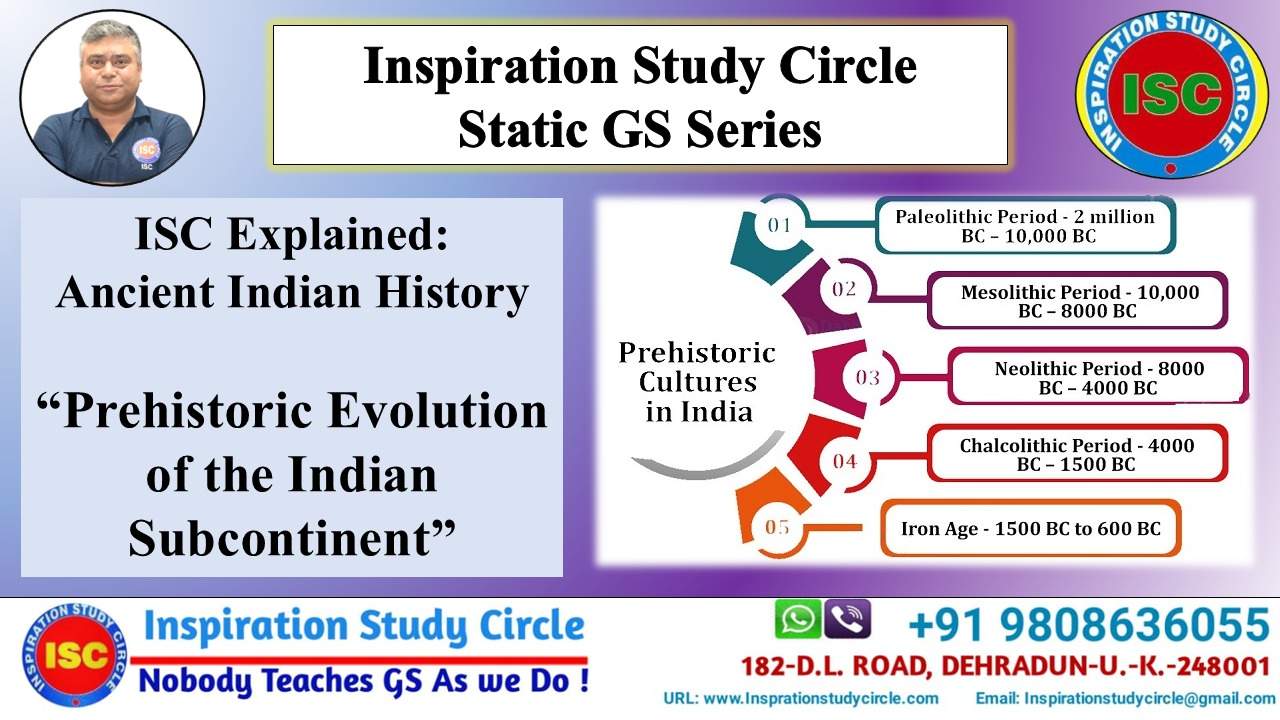
Historians divide the Stone Age into three distinct phases based on tool technology and subsistence strategies: the Palaeolithic, Mesolithic, and Neolithic Ages, followed by the metal-using Chalcolithic Age.
The Palaeolithic Age (Old Stone Age)
Timeline: c. 500,000 BCE – 10,000 BCE
Climate Context: Coincided with the Pleistocene epoch (Ice Age), meaning extreme cold conditions prevailed.
Subsistence: Humans were nomadic hunter-gatherers. They did not know about agriculture or pottery.
Tool Technology: Predominantly large, unrefined stone tools made of quartzite (hence, Palaeolithic humans are often called “Quartzite Men”).
Sub-Divisions of the Indian Palaeolithic Period
Chronological Classification
• Lower Palaeolithic (Early)
Tool Types: Handaxes, cleavers, choppers.
Key Indian Sites: Soan Valley (Punjab, Pakistan), Bori (Maharashtra), Belan Valley (UP).
Main Characteristics: Dominated by large pebble tools made of quartzite; associated with Homo erectus.
• Middle Palaeolithic
Tool Types: Flakes, blades, scrapers, borers.
Key Indian Sites: Narmada Valley, Nevasa (Maharashtra), Didwana (Rajasthan).
Main Characteristics: Transition to smaller, sharper flake-based tools; increased precision in hunting and skinning.
• Upper Palaeolithic (Late)
Tool Types: Bone tools, needles, burins.
Key Indian Sites: Kurnool Caves (AP), Bhimbetka (MP), Baghor (MP).
Main Characteristics: Emergence of modern Homo sapiens; introduction of bone technology and early rock art (Bhimbetka).
• Major Geographical Hubs:
North & Northwest: Soan Valley, Didwana, Belan Valley.
Central India: Narmada Valley, Bhimbetka, Baghor.
Peninsular India: Bori, Nevasa, Kurnool Caves.
• Important Note-Worthy Points:
Bhimbetka (Madhya Pradesh): A UNESCO World Heritage site showcasing continuous human occupation from the Upper Palaeolithic through the Mesolithic eras, featuring spectacular rock paintings.
Hathnora (Madhya Pradesh): Discovery site of the partial hominin cranium (“Narmada Human”), the oldest human fossil found in India.
The Mesolithic Age (Middle Stone Age)
Timeline: c. 10,000 BCE – 6,000 BCE
Climate Context: Transition to the Holocene epoch. The climate became warmer and more humid, leading to increased flora and fauna.
Subsistence: Continued hunting and gathering, but shifted toward fishing and bird hunting. Crucially, this period marks the beginning of animal domestication (dogs, cattle, sheep).
Tool Technology: Characterised by Microliths—tiny, sharp stone tools (1 to 5 cm long) made of chalcedony, chert, and jasper. These were often geometric (triangles, crescents) and hafted onto wooden handles to make spears or arrows.
Key Indian Sites:
Bagor (Rajasthan) & Adamgarh (Madhya Pradesh): Provide the earliest undisputed archaeological evidence for the domestication of animals in India.
Langhnaj (Gujarat): Important site showing early burials and microlith production.
Sarai Nahar Rai (Uttar Pradesh): Evidence of human burials and early geometric microliths.
The Neolithic Age (New Stone Age)
Timeline: c. 6,000 BCE – 1,000 BCE (Varies significantly by region; Mehrgarh dates back to ~7000 BCE).
Historical Significance: Often termed the “Neolithic Revolution” because it completely reshaped human society.
Subsistence: Transition to a settled agrarian lifestyle. Humans began cultivating crops like wheat, barley, and rice.
Society: Development of permanent mud-brick villages, early pottery (first hand-made, then wheel-made) for grain storage, and division of labour.
Tool Technology: Polished and ground stone tools (celts, axes) tailored for clearing vegetation and tilling the soil.
Key Neolithic Sites in the Indian Subcontinent
Neolithic sites in India mark the transition from nomadic hunting to settled agriculture, pottery making, and animal domestication during the New Stone Age (circa 7000 BCE to 1000 BCE).
1. The Northwestern Frontier (c. 7000 BCE)
Core Site:Mehrgarh (Balochistan, Pakistan).
UPSC Significance: It is the oldest known agricultural settlement in the Indian subcontinent.
Key Findings: Evidence of advanced mud-brick houses, early cultivation of wheat and barley, animal domestication (sheep, goat, cattle), and the earliest evidence of proto-dentistry (drilled teeth).
2. The Northern Zone (c. 2500 BCE)
Core Sites:Burzahom and Gufkral (Kashmir Valley).
UPSC Significance: Displays a highly distinct sub-Himalayan culture adapted to extreme cold.
Key Findings:
Subterranean pit-dwellings with plastering.
Absence of microliths; heavy reliance on bone tools (needles, harpoons).
Unique ritual burials showing domestic dogs buried alongside their masters.
3. The Vindhyan & Central Ganga Valley (c. 6000 BCE – 5000 BCE)
Core Sites:Koldihwa and Mahagara (Uttar Pradesh), Chirand (Bihar).
UPSC Significance: Crucial for tracking the origin of indigenous rice cultivation.
Key Findings:
Koldihwa provides some of the earliest global evidence for rice cultivation.
Chirand is notable for an extraordinary abundance of bone and antler tools in an alluvial plain.
Circular, thatched wattle-and-daub huts.
4. The Southern Peninsular Zone (c. 2500 BCE – 1000 BCE)
UPSC Significance: Dominated by a pastoral, cattle-keeping economy rather than intense crop farming.
Key Findings:
Characterised by “Ash Mounds”—massive mounds created by the intentional, cyclical burning of accumulated cattle dung inside stockades.
Pointed-butt stone axes and gold ornaments (at Tekkalakota).
5. The Northeastern Zone (c. 2000 BCE)
Core Sites:Daojali Hading and Sarutaru (Assam, Dima Hasao hills).
UPSC Significance: Shows strong cultural links and migratory patterns connecting Northeast India with Southeast Asia.
Key Findings: Distinctive cord-marked pottery, shouldered celts (axes), and evidence of shifting cultivation (jhum).
The Chalcolithic Age (Stone-Copper Age)
Timeline: c. 2,100 BCE – 700 BCE
Metal Usage: Marks the transition from stone to metals, with copper being the first metal used alongside stone tools.
Economy & Society: Highly developed rural farming communities. They cultivated a diverse range of crops (pulses, wheat, bajra) and domesticated animals. They produced distinct pottery styles, primarily Black and Red Ware.
Religious Beliefs: Terracotta figurines of mother goddesses and bull icons indicate early forms of nature worship.
Key Regional Cultures & Their Prominent Sites
The Indian Chalcolithic is best studied through its distinct geographical clusters, known as “cultures,” named after their type-sites.
1. The Ahar-Banas Culture (c. 2100 – 1500 BCE)
Geographical Zone: Banas River Valley, Rajasthan.
Prominent Sites:Ahar, Balathal, and Gilund.
UPSC Takeaways:
Ahar: Known anciently as Tambavati (the place of copper) due to an extraordinary abundance of copper ores and smelting hearths. No microliths (stone tools) were found here; copper completely replaced stone.
Gilund: Unique for its use of kiln-burnt bricks, a feature usually restricted to the urban Harappan civilisation.
Pottery: Distinctive Black-and-Red ware painted with white geometric designs.
2. The Kayatha Culture (c. 2000 – 1800 BCE)
Geographical Zone: Chambal River Valley, Madhya Pradesh (Malwa region).
Prominent Sites:Kayatha and Eran.
UPSC Takeaways:
Kayatha is considered the earliest Chalcolithic culture of Central India.
Houses were made of mud and wattle-and-daub.
Key Finds: Cache of copper axes and thousands of semi-precious stone beads (steatite and carnelian) stored in pots, indicating early trade networks and wealth accumulation.
3. The Malwa Culture (c. 1700 – 1200 BCE)
Geographical Zone: Central India (Narmada, Tapi, and Mahi valleys).
Prominent Sites:Navdatoli, Eran, and Nagda.
UPSC Takeaways:
Navdatoli: Situated on the Narmada River, it is the largest excavated open-air Chalcolithic farming settlement in India. It revealed evidence of an incredibly diverse food economy (cultivation of wheat, barley, linseed, lentil, and black gram).
Pottery: Malwa ware is considered the finest among Chalcolithic ceramics, featuring a rich orange-to-red slip painted with dark brown patterns of animals and humans.
4. The Jorwe Culture (c. 1400 – 700 BCE)
Geographical Zone: Godavari-Pravara River systems, Maharashtra.
Prominent Sites:Inamgaon, Daimabad, Nevasa, and Chandoli.
UPSC Takeaways:
Daimabad: The largest Jorwe site. It is famous for a sensational find of four massive bronze figures (a chariot driven by a man, a rhinoceros, an elephant, and a buffalo), displaying late-Harappan technological influence.
Inamgaon: A highly fortified settlement featuring a massive mud wall and a moat. Excavations revealed a clear social hierarchy (large five-roomed houses for chiefs vs. small circular pits for labourers) and specialised craftsmen such as goldsmiths and coppersmiths.
Burial Practices: The dead were buried inside the house under the floor, with adults buried with their feet chopped off (a ritual practice to prevent the spirit from returning as a ghost).
The Ecological Shift: Holocene Stabilisation
(From Neolithic to Chalcolithic)
The transition from the Neolithic to the Chalcolithic was not a linear improvement in human comfort but a complex survival response. As the warm, wet Neolithic climate gave way to drier Chalcolithic realities, humans used copper metallurgy, riverine engineering, and multi-crop rotation to wrest a surplus from an increasingly challenging Indian landscape.
The most obvious transition is the introduction of copper alongside stone (Chalcolithic). This was a direct response to resource availability and the need for more efficient environmental manipulation.
Overcoming Stone Limitations: Neolithic polished stone axes were effective for clearing soft vegetation but inefficient against dense tropical hardwoods. The introduction of copper axes and chisels allowed for more aggressive deforestation to clear land for farming.
Localisation of Metallurgy: Communities adapted to localised mineral geography. For instance, the Ahar-Banas culture in Rajasthan settled near the Khetri copper deposits. Because copper was abundant locally, they completely adapted away from stone microliths, creating a unique stone-free metal culture.
2. Agricultural Diversification and Soil Negotiation
As the climate grew drier, Chalcolithic communities could no longer rely on the simple, rain-fed subsistence patterns of the Neolithic era.
The Black Cotton Soil Adaptation: In Western India and the Deccan (e.g., Jorwe and Malwa cultures), communities settled on heavy black cotton soil. Since they lacked iron ploughs to till this dense earth, they adapted by practising semi-arid dry-farming, using heavy wooden digging sticks with stone ring-stones for weight.
Crop Rotation and Double Cropping: While Neolithic farmers usually stuck to a few staples (like wheat/barley in the North-west or rice in the East), Chalcolithic communities introduced crop diversification to hedge against monsoon failures. They mastered double-cropping:
Kharif Crops: Bajra, jowar, ragi, and cotton (adapted to summer monsoons).
Rabi Crops: Wheat, barley, lentils, and peas (adapted to winter moisture).
3. Water Management & Riverine Settlement Patterns
The shift toward semi-aridity forced Chalcolithic people to engineer their hydraulic environments.
Perennial River Reliance: Unlike Neolithic settlements that were often perched on high terraces or mountain slopes to avoid floods, Chalcolithic sites moved directly onto the banks of semi-perennial and seasonal rivers (tributaries of the Tapi, Godavari, and Bhima rivers).
Artificial Irrigation: At sites like Inamgaon (Maharashtra), archaeologists found evidence of a massive embankment and a diversion canal built to store floodwater. This represents a monumental leap in ecological adaptation: storing water during monsoon surpluses to survive winter droughts.
4. Faunal Adaptation & Domestication Trends
Animal exploitation shifted from a purely dietary requirement to an economic and ecological strategy.
The Decline of Wild Hunting: Neolithic sites still show a high percentage of wild animal bones (deer, boars). In the Chalcolithic era, wild animal bones dropped drastically. Humans adapted by relying almost entirely on domesticated herds (cattle, sheep, goats, pigs).
Secondary Products Revolution: Cattle were no longer killed just for meat. In the Chalcolithic era, they were adapted for draught power (pulling carts, heavy loads) and dairy production, allowing humans to extract more calories from the environment without killing their capital assets.
5. Architectural & Demographic Shifts
The way humans housed themselves changed to match their modified interaction with nature.
From Pits to Circular/Rectangular Houses: In the northern Neolithic (Burzahom), humans adapted to sub-zero temperatures by digging pit-dwellings into the earth. As populations migrated to warmer zones and entered the Chalcolithic era, they constructed above-ground wattle-and-daub houses (made of mud, reeds, and wooden posts) designed to maximise ventilation in tropical climates.
Sedentism and Social Storage: Because Chalcolithic agriculture generated a higher surplus than Neolithic farming, societies adapted by creating dedicated storage structures—such as underground silos and granaries—to guard against seasonal famines.
In essence, Prehistoric India
The prehistoric saga of the Indian subcontinent represents an extraordinary journey of human resilience, ecological adaptation, and technological evolution, bridging the gap from vulnerable Pleistocene foragers to complex agricultural societies. The evolution of stone and copper technologies—from Palaeolithic tools to Chalcolithic metallurgy—facilitated sedentary life and provided the indispensable ecological and demographic scaffolding for the rise of the Indus Valley Civilisation. This foundational epoch highlights a gradual, uneven transformation across regions, emphasising critical shifts in survival strategies rather than just chronological tool changes.