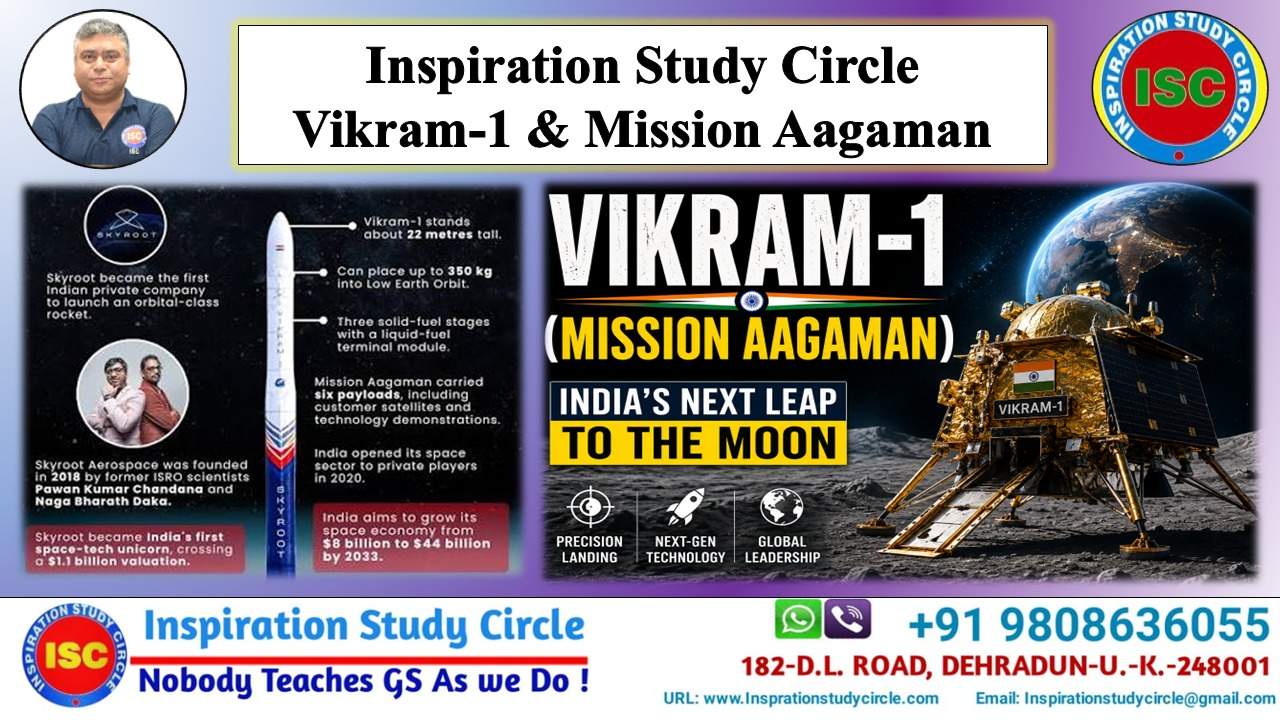
Vikram-1 is an expendable, small-lift orbital rocket developed by the Hyderabad-based aerospace startup, Skyroot Aerospace. Standing 24 meters (79 feet) tall, it is a multi-stage rocket capable of carrying payloads of up to 350 kg into Low Earth Orbit (LEO). It is highly significant as India’s first privately developed orbital-class rocket.
The rocket features an advanced, lightweight carbon-composite structure and utilises three solid-fuel stages, alongside a fourth liquid-fueled kick stage equipped with 3D-printed engines for precise orbital insertion.
Its highly anticipated maiden voyage—named Mission Aagaman (Arrival)—successfully lifted off from the Satish Dhawan Space Centre in Sriharikota, Andhra Pradesh, on July 18, 2026. This historic flight placed six miniaturised payloads into an orbit 450 kilometres above the Earth, making India only the third country in the world to have a private company independently place payloads in orbit.
Key Specifications & Architecture
Dimensions: Stands roughly 22 to 24 metres tall (about a seven-storey building) with a diameter of 1.7 metres.
Structure: Built entirely with an all-carbon composite airframe to drastically minimise structural weight and maximise payload efficiency.
Capacity: Capable of delivering payloads up to 350 kg to a 450-km Low Earth Orbit (LEO) and up to 260 kg into a Sun-Synchronous Orbit (SSO).
Four-Stage Propulsion: Features a highly optimised configuration to ensure pinpoint deployment:
Stage 1 (Kalam 1200): Solid-fuel motor producing a peak thrust of 120 tonnes.
Stage 2 (Kalam 250): Solid-fuel motor utilising thrust vector control for primary steering.
Stage 3 (Kalam 100): Solid-fuel motor using vacuum-optimised flex nozzles.
Stage 4 (Orbital Adjustment Module): Powered by a cluster of four Raman-I hypergolic liquid engines that are 100% 3D-printed.
Tech Innovations & Mission Highlights
3D-Printed Engines: The reliance on additive manufacturing allowed Skyroot to scale down weight, eliminate structural leak points, and reduce part manufacturing lead times by 80%.
On-Demand Launching: Designed with modular avionics and low-infrastructure support, allowing the rocket to be fully assembled and ready to launch within 24 hours.
Pneumatic Separation: Utilises an ultra-low-shock pneumatic separation system instead of conventional explosives, shielding delicate satellite payloads from harsh flight vibrations.
Unique Cargo: Aside from scientific instruments, Mission Aagaman carried a space debris removal demonstration robotic arm (EMBRACE), an artistic lab-grown diamond, and a handwritten postcard signed by Prime Minister Narendra Modi.
Mission Aagaman
Mission Aagaman (Sanskrit for “Arrival”) was the historic maiden orbital test flight of India’s first privately developed rocket, Vikram-1. Executed by the space startup Skyroot Aerospace on 18 July 2026 at 12:05 PM IST, the mission successfully placed multiple customer satellites into orbit from the Satish Dhawan Space Centre in Sriharikota.
The flight represents the official “arrival” of India’s private sector into the global commercial satellite launch business.
Mission Architecture & Path
Light Profile: The complete mission lasted 15.46 minutes, seamlessly navigating 14 distinct flight phases from ignition to payload deployment.
Target Orbit: Placed its cargo into a 450-km Low Earth Orbit (LEO) at a 60-degree inclination.
Launch Execution: Lift-off occurred 35 minutes later than the scheduled 11:30 AM slot due to a brief “planned hold” to clear minor navigation parameters.
The Satellite Manifest
The rocket carried four active functional technology demonstration satellites:
SCOPE: Skyroot’s own proprietary core demonstration satellite.
EMBRACE: Developed by Cosmoserve Space, a specialised robotic arm designed to test space debris removal mechanisms.
SOLARAS S3: An Earth-observation technology platform built by Indian startup Grahaa Space.
DCUBED Payload: A specialised hardware deployment demonstration from German aerospace firm DCUBED.
Cultural & Commemorative Cargo
To mark the historic leap, Mission Aagaman carried distinct symbolic items:
Micro-Rocket Tribute: An 18-karat gold miniature rocket crafted by artist Ajay Kumar Mattewada, featuring microscopic sculptures of Indian scientific legends Dr Vikram Sarabhai, Sir C.V. Raman, and Dr A.P.J. Abdul Kalam.
Cosmic Bloom: A specialised lotus-shaped art piece designed using 32 lab-grown diamonds by Cosmos Diamonds.
Vande Mataram Postcard: A handwritten commemorative postcard signed by Prime Minister Narendra Modi, flown alongside messages from Skyroot’s engineers and space supporters.
Implications of the Mission for India
The successful execution of Mission Aagaman by Skyroot Aerospace carries profound strategic, economic, and geopolitical implications for India:
1. Breaking the State Monopoly and Entering an Elite Club
Strategic Elevation: India is now only the third nation in the world (after the United States and China) to possess proven private-sector orbital launch capabilities.
End of ISRO’s Sole Burden: Traditionally, all Indian orbital flights were state-funded and managed by the Indian Space Research Organisation (ISRO). This success validates the government’s 2020 space sector reforms, proving that Indian private industry can independently carry the nation’s operational launch load.
2. Fast-Tracking the $44 Billion Space Economy
Economic Scaling: The Indian government aims to scale its domestic space economy from $8.4 billion to $44 billion by 2033. The Vikram-1 flight serves as concrete proof to global markets that India’s private launch infrastructure is mature and commercially viable.
Attracting Foreign Direct Investment (FDI): Following India’s 2024 policy shift allowing up to 49% automatic FDI in launch vehicles, the success of a billion-dollar startup like Skyroot acts as a major green flag for international venture capital.
3. Creating a Low-Cost Global "Space Cab" Service
Capturing Global Markets: Skyroot intends for 70% to 80% of its business to serve international clients. By offering on-demand, customizable small-satellite launches, India can challenge dominant international providers like SpaceX and Rocket Lab with highly competitive pricing.
Alleviating Global Bottlenecks: With a factory built to produce 12 rockets annually, Skyroot provides a reliable alternative for commercial satellite constellations globally, bypassing massive backlog queues associated with heavy-lifter rockets.
4. Shifting ISRO’s Core Focus to Deep Space
Division of Labour: With private players stepping up to handle commercial, low-margin Small Satellite Launch Vehicle (SSLV) tasks, ISRO can pivot its personnel and resources toward high-stakes scientific breakthroughs.
Deep Space Enablement: This structural shift frees state resources to focus heavily on the upcoming Gaganyaan crewed spaceflights, the 2028 Venus orbiter mission, and building India’s independent space station by 2035.
5. Validating Radical Indigenous Manufacturing
Manufacturing Autonomy: The mission successfully validated cutting-edge domestic technologies under maximum flight stress—including an all-carbon composite airframe and 3D-printed liquid engines.
Supply Chain Disruption: Proving that 3D printing can slash rocket component lead times by 80% establishes a framework for India to become a high-tech, rapid-turnaround defence and aerospace manufacturing hub.
Key Takeaways for UPSC Mains 2026 and UPSC 2027
For UPSC civil services candidates, the success of Skyroot Aerospace’s Mission Aagaman serves as a textbook example for multiple syllabus segments. This milestone is highly relevant for Science & Technology and Economic Development in both Prelims and Mains.
For UPSC Prelims 2027: Core Facts & Terminology
Expect questions focused on technical distinctions, institutional frameworks, and space policy basics.
IN-SPACE (Indian National Space Promotion and Authorisation Centre): Acts as the single-window, autonomous nodal agency under the Department of Space. It is the regulator and authorizer for private space activities, not ISRO.
NewSpace India Limited (NSIL): The commercial arm of ISRO. It interfaces with private industries to transfer ISRO technologies and handle commercial launch contracts.
Raman-I engines (100% 3D-printed, utilising hypergolic liquid propellant for the upper stage).
Solid vs. Liquid stages (Three solid-fuel stages for massive thrust, followed by a liquid-fuel fourth stage for precise orbital injection).
FDI Policy in Space Sector (2024 Amendments):
Up to 74% FDI under the automatic route for satellite manufacturing and data products.
Up to 49% FDI under the automatic route for launch vehicles and associated systems.
Up to 100% FDI under the automatic route for manufacturing components and systems/sub-systems.
Space Debris Demonstration: The inclusion of the EMBRACE robotic arm links directly to India’s commitment to Project NETRA and the Inter-Agency Space Debris Coordination Committee (IADC) guidelines for sustainable space operations.
For UPSC Mains 2026: Analytical Themes (GS Paper III)
This development fits perfectly into GS Paper III: Science & Technology (Indigenisation of technology) and Economic Development (Infrastructure and Investment Models).
Theme 1: Democratisation and Liberalisation of Space (S&T / Economy)
The Shift: Transitioning from a state-led, monopolistic model (ISRO as the sole actor) to a market-driven ecosystem where ISRO acts as a facilitator and research body.
The India Space Policy 2023: Institutionalized the roles of ISRO (advanced R&D), IN-SPACe (regulation/promotion), and NSIL (commercialisation), providing the legal clarity needed for venture capital to back Skyroot.
Theme 2: Boosting the Manufacturing Sector & 'Make in India' (Economy)
Value Multiplier: The space sector has a massive spillover effect. Advanced manufacturing techniques like 3D printing (additive manufacturing) and carbon composite fabrication, developed for rockets, will trickle down to the Indian defence, aviation, and automobile sectors.
Employment & Brain Drain: Creating a private aerospace ecosystem helps retain top-tier IIT and ISRO talent within India, converting “Brain Drain” into “Brain Gain” through high-tech start-ups.
Theme 3: Geopolitical and Strategic Lever (International Relations / S&T)
Space Diplomacy: Low-cost, on-demand launch capabilities allow India to offer affordable satellite launches to developing nations in the Global South (e.g., SAARC, African Union nations), strengthening diplomatic ties.
Countering Dominance: Helps India build a robust, independent alternative to Western private giants (SpaceX) and Chinese state/private players in the rapidly growing Small Satellite market.
Theme 4: Challenges to Address (Mains Critical Analysis)
Legal Liability: In case of flight failures or space collisions, international law (Outer Space Treaty, Liability Convention) holds the State (Government of India) responsible, not the private company. Setting up a robust domestic space liability insurance framework is a pending bottleneck.
Space Traffic Management: A massive influx of private small-satellite constellations will drastically crowd Low Earth Orbit (LEO), escalating the risk of the Kessler Syndrome (runaway space debris collisions)
Bonus: Mains Practice Question
“The successful transition of India’s space program from a state monopoly to a vibrant private-public ecosystem is crucial for achieving a $44 billion space economy by 2033.” Evaluate this statement in light of recent developments in private launch capabilities. What regulatory and structural challenges persist? (15 Marks, 250 Words)
Disclaimer: The above article is compiled from information, facts, and figures sourced from Wikipedia and various news platforms, such as The Hindu and The Indian Express.